






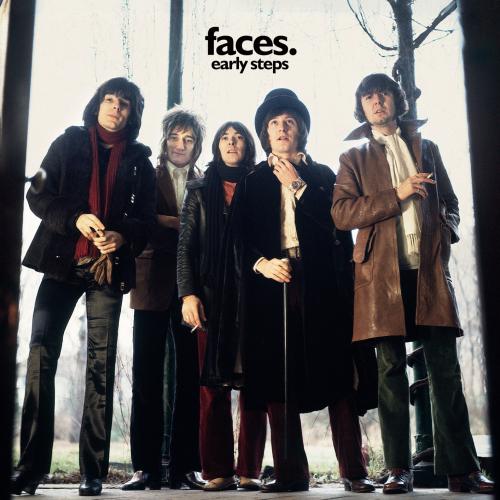
Early Steps (2025 Remaster) Faces
Album info
Album-Release:
2025
HRA-Release:
05.12.2025
Album including Album cover
I`m sorry!
Dear HIGHRESAUDIO Visitor,
due to territorial constraints and also different releases dates in each country you currently can`t purchase this album. We are updating our release dates twice a week. So, please feel free to check from time-to-time, if the album is available for your country.
We suggest, that you bookmark the album and use our Short List function.
Thank you for your understanding and patience.
Yours sincerely, HIGHRESAUDIO
- 1 Shake, Shudder, Shiver (Take 1 Rough Mix, Olympic Studios, Autumn 1969) 03:10
- 2 Devotion (Take 1 Rough Mix, Olympic Studios, Autumn 1969) 04:16
- 3 Train (Take 4 Rough Mix, Olympic Studios, Autumn 1969) 04:26
- 4 Flying (Take 1 Rough Mix, Olympic Studios, Autumn 1969) 03:50
- 5 I Feel So Good (Rehearsal, Rolling Stones Rehearsal Space, Summer 1969) 06:23
- 6 Evil (Rehearsal, Rolling Stones Rehearsal Space, Summer 1969) 06:35
- 7 Shake, Shudder, Shiver (Rehearsal, Rolling Stones Rehearsal Space, Summer 1969) 03:37
- 8 Pineapple and the Monkey (Rehearsal, Rolling Stones Rehearsal Space, Summer 1969) 04:06
- 9 Stone (Rehearsal) 08:22
- 10 Devotion (Rehearsal) 05:28
Info for Early Steps (2025 Remaster)
Take early steps back to 1960s London with Rod Stewart, Ronnie Wood, Kenney Jones, Ronnie Lane and Ian McLagan to the Faces’ first and previously unheard recording session at Olympic Studios in Barnes.
Early Steps’, a new album with one side devoted to studio session recordings and one side to rehearsals recorded on the band’s very own cassette tapes, prior to signing with Warner Bros and releasing their debut album, ‘First Step,‘ in 1970.
Early Steps’ is produced for release by Rob Caiger, with all tracks newly restored and remastered by Nick Robbins at Nick Robbins Mastering in London. The Olympic Studio tapes were transferred and mixed by Rob Keyloch and Rob Caiger; tape restoration was completed by Dave Corbettand the team at FX Copy Room and lacquers were cut by Henry Rudkins at AIR Studios in London.
Many musicians across punk, new wave, new romantic, Britpop, rock and metal cite the Faces as an important influence on their careers. But the band also inspired Rob Caiger, then a young London music obsessive who is now archivist and reissue producer for a number of important catalogues, including the Faces and also Kenney Jones’ own Nice Records which is currently reissuing Immediate Records’ titles.
As part of Caiger’s meticulous research work, he came across an Olympic tape reel that began his journey into an undocumented part of Faces‘ history, six months before their debut LP was released in March 1970. The tape, labelled “Small Faces”, had been recorded in September 1969 and stored for years in the Olympic Studio archive. In 1987, new owners Virgin Music were rebuilding parts of the studio and decided there was no room for an archive and began disposing of tapes into a large skip outside. Fans, collectors and opportunists quickly descended on Barnes and took whatever they could carry or load into their cars.
Tapes were lost, destroyed, or disappeared into private archives. Eventually, tapes for the Small Faces were tracked to Germany and brought back to the UK. While working on these tapes as part of a Small Faces remaster series, Caiger noticed a session tape that did not make sense. The songs written on the tape box were not Small Faces songs and the date of the recording session was six months after the band had split up. As soon as the tape was rolling, Caiger realised he had the very first Faces studio recording – unknown, undocumented, and only vaguely remembered by those who were there.
This lost session with Glyn Johns at Olympic captured the Faces superbly. The passion and soul of Rod’s vocals coupled with the raw power of the band’s playing. There’s no “’60s stereo” separation diluting the sound as there was on First Step, which rooted that LP very much in its time. Instead, the Faces are locked in an almost telepathic groove, driving the session onward with an infectious urgency.
Prior to their first studio session at Olympic in September, the only other recordings of the Faces were those made by Ian McLagan on his cassette recorder during rehearsals in the summer of 1969. These were taped in the basement of 47 Bermondsey Street, which was used by The Rolling Stones as their rehearsal space. It was looked after by Ian Stewart, known to all as “Stu.” Held in great affection by all those who got to know him, Stu was the Stones’ original piano player, who became the band’s tour manager when Andrew Oldham decided he did not fit the image of the band. When Stu heard the Faces needed a rehearsal space but were broke, he arranged for them to use the basement as the Stones were no longer using it.
From late spring into summer 1969, the band were rehearsing as a four-piece: three ex-Small Faces, Kenney, Mac & Ronnie, together with Ronnie Wood, with whom Ronnie Lane had been working. Wood soon brought his bandmate from the Jeff Beck Group, Rod Stewart, to Bermondsey Street to have a listen. The then-reserved and shy singer would not sing, preferring just to go for drinks afterwards at the nearby Kings Arms. But Rod was always listening… When Kenney finally convinced Rod to have a go with the band, it was a revelation.
Take early steps back to 1960s London to the Faces‘ first and previously unheard recording session at Olympic Studios in Barnes. Walk by the River Thames to Bermondsey to hear rehearsals in The Rolling Stones’ warehouse, the earliest recordings of the Faces captured in all their raucous glory on the band’s own cassette tapes. Hear the Faces before they took the First Step!
Rod Stewart, lead vocals, harmonica, guitar
Ronnie Wood, lead guitar, vocals, bass, harmonica
Kenney Jones, drums, percussion
Ronnie Lane, bass, vocals
Ian McLagan, organ, piano, guitar, vocals
Digitally remastered

Faces
When Steve Marriott left the Small Faces in 1969, the three remaining members brought in guitarist Ron Wood and lead singer Rod Stewart to complete the lineup and changed their name to the Faces, which was only appropriate since the group now only slightly resembled the mod-pop group of the past. Instead, the Faces were a rough, sloppy rock & roll band, able to pound out a rocker like "Had Me a Real Good Time," a blues ballad like "Tell Everyone," or a folk number like "Richmond" all in one album. Stewart, already becoming a star in his own right, let himself go wild with the Faces, tearing through covers and originals with abandon. While his voice didn't have the power of Stewart, bassist Ronnie Lane's songs were equally as impressive and eclectic. Wood's rhythm guitar had a warm, fat tone that was as influential and driving as Keith Richards' style.
Notorious for their hard-partying, boozy tours and ragged concerts, the Faces lived the rock & roll lifestyle to the extreme. When Stewart's solo career became more successful than the Faces, the band slowly became subservient to his personality; after their final studio album, Ooh La La, in 1973, Lane left the band. After a tour in 1974, the band called it quits. Wood joined the Rolling Stones, drummer Kenny Jones eventually became part of the Who, and keyboardist Ian McLagan became a sought-after supporting musician; Stewart became a superstar, although he never matched the simple charm of the Faces.
While they were together, the Faces never sold that many records and were never considered as important as the Stones, yet their music has proven extremely influential over the years. Many punk rockers in the late '70s learned how to play their instruments by listening to Faces records; in the '80s and '90s, guitar rock bands from the Replacements to the Black Crowes took their cue from the Faces as much as the Stones. Their reckless, loose, and joyous spirit stayed alive in much of the best rock & roll of the subsequent decades.
Lane was diganosed with multiple sclerosis in the 1970s but continued to work. He relocated to Austin, Texas in the 1980s and worked until the disease claimed his life in 1997.
MacLagan also relocated to Austin, where he became an integral part of the city's vibrant music scene. In addition to leading his own group, the Bump Band, he collaborated with musicians—well known and obscure—in recording sessions and on the stage. He suffered a stroke on December 2, 2014, and passed away a day later.
This album contains no booklet.