


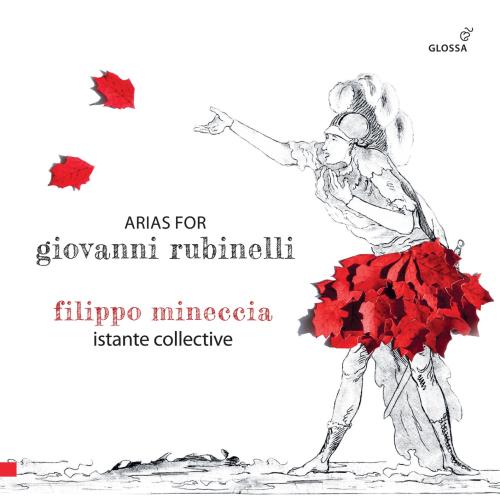
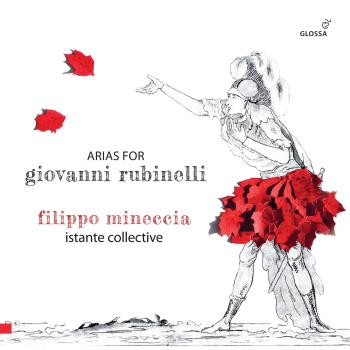
Arias for Giovanni Rubinelli Filippo Mineccia & Istante Collective
Album info
Album-Release:
2026
HRA-Release:
19.06.2026
Label: Glossa
Genre: Classical
Subgenre: Vocal
Artist: Filippo Mineccia & Istante Collective
Composer: Antonio Maria Sacchini (1730-1786), Pasquale Anfossi (1727-1797), Niccolo Piccinni (1728-1800), Antonio Salieri (1750-1825), Giuseppe Sarti (1729-1802), Giovanni Paisiello (1740-1816), Georg Friedrich Händel (1685-1759), Sebastiano Nasolini (1768-1799), Carlo Lenzi (1735-1805), Tommaso Traetta (1727-1779), Josef Myslivecek (1737-1781)
Album including Album cover Booklet (PDF)
- Antonio Maria Sacchini (1730 - 1786): Calliroe:
- 1 Sacchini: Calliroe: Aria. Suon funesto notte e giorno (Agricane) 03:57
- Pasquale Anfossi (1727 - 1797): Lucio Silla:
- 2 Anfossi: Lucio Silla: Aria. A partir tu mi condanni (Cecilio) 05:18
- Niccolò Piccinni (1699 - 1783): Tigrane:
- 3 Piccinni: Tigrane: Aria. Ah non resiste il core (Sesto) 02:41
- Tommaso Traetta (1727 - 1779): Ifigenia in Tauride:
- 4 Traetta: Ifigenia in Tauride: Aria. Ah! per pietà placatevi (Oreste) 02:47
- Josef Mysliveček (1737 - 1781): Atide:
- 5 Mysliveček: Atide: Aria. Affanni di quest'alma (Adrasto) 06:43
- Antonio Maria Salieri (1750 - 1825): Europa riconosciuta:
- 6 Salieri: Europa riconosciuta: Duetto. Perder l'oggetto amatom (Isseo) 04:13
- Gaetano Andreozzi (1755 - 1826): Arbace:
- 7 Andreozzi: Arbace: Recitativo. Dove son? Che rimiro? In queste cupe (Arbace) 01:33
- 8 Andreozzi: Arbace: Aria. Non fareste ombre di morte (Arbace) 02:22
- Giuseppe Sarti (1729 - 1802): Siroe:
- 9 Sarti: Siroe: Aria. Mi credi infedele (Siroe) 02:29
- Angelo Tarchi (ca. 1759 - 1814): Ademira:
- 10 Tarchi: Ademira: Aria. Ah se in vita o mio tesoro (Flavio Valente) 06:21
- Giovanni Paisiello (1740 - 1816): Antigono:
- 11 Paisiello: Antigono: Recitativo. Ch'io fugga, e lasci intanto (Demetrio) 01:39
- 12 Paisiello: Antigono: Duetto. Non temer, non sono amante (Demetrio) 06:47
- Francesco Bianchi (ca. 1750 - 1810): Cajo Mario:
- 13 Bianchi: Cajo Mario: Aria. Se fedel mi serbi amore (Annio) 05:57
- George Frideric Handel (1685 - 1759): Poro, re delle Indie, HWV 28:
- 14 Handel: Poro, re delle Indie, HWV 28: Aria. Se possono tanto 02:57
- Riccardo primo, re d'Inghilterra, HWV 23:
- 15 Handel: Riccardo primo, re d'Inghilterra, HWV 23: Duetto. T'amo sì, sarai tu quella 04:09
- Michele Mortellari (ca. 1750 - 1807): Venere e Adone:
- 16 Mortellari: Venere e Adone: Aria. Cercando l'idol mio (Adone) 03:01
- Sebastiano Nasolini (ca. 1768 - ca. 1799): La morte di Cleopatra:
- 17 Nasolini: La morte di Cleopatra: Aria. Queste lagrime dolenti (Marc' Antonio) 02:25
- Luigi Cherubini (1760 - 1842): Didone abbadonata (Luigi Cherubini):
- 18 Cherubini: Didone abbadonata (Luigi Cherubini): Aria. Quando saprai chi sono 03:37
- Carlo Lenzi (1735 - 1805): Quoniam tu solus Sanctus:
- 19 Lenzi: Quoniam tu solus Sanctus 06:10
Info for Arias for Giovanni Rubinelli
The renowned music historian Charles Burney counted him among the three great castrato voices of the late 18th century: Giovanni Rubinelli (1753–1829). At a time when the era of opera seria and castrati was drawing to a close, Rubinelli was one of its last great protagonists. Numerous composers wrote specifically for his voice, which was not the favoured high soprano voice of a castrato, but that of a contralto. This CD traces Rubinelli’s artistic career: he made his debut in Ludwigsburg at the age of 16 in Calliroe by Antonio Sacchini, sang in Antonio Salieri’s Europa riconosciuta at the inauguration of La Scala in Milan in 1778, and made guest appearances in London in the late 1780s, performing in Handel’s Julius Caesar, among other works. Countertenor Filippo Mineccia gives an emotive and virtuoso performance, creating a historical portrait of a singer who also stands for the development of opera from the virtuosity of the castrato stars to the sensitive arias of the new simplicity of Gluck’s opera reform.
Filippo Mineccia, alto
Istante
Filippo Mineccia
Born in Florence, countertenor Filippo Mineccia has gained an international reputation for being one of the leading specialists in the repertoire of the castrato era. He has worked with renowned conductors such as Ottavio Dantone, Diego Fasolis, Václav Luks, Christophe Rousset, David Stern, Jordi Savall, Antonio Florio, Thomas Hengelbrock, Michael Hofstetter, Adam Viktora, Javier Ulises Illán, Ruben Jais, Enrico Onofri and the late Alan Curtis.
Filippo Mineccia has appeared in a number of roles in Handel’s operas including Tolomeo and the title role in Giulio Cesare at the Opéra Royal du Château de Versailles, Unulfo (Rodelinda) at the Opera Rara Festival in Krakow and Ottone (Agrippina) at the Theater an der Wien, as well as the title role in Rinaldo, Alessandro (Tolomeo) and Oronte (Riccardo Primo). His appearances at the Handel Festival in Halle include Demetrio (Berenice), Dardano (Amadigi di Gaula) and the title role in Lucio Cornelio Silla.
Other appearances include Ottone (L’incoronazione di Poppea) at the Liceu in Barcelona and the Teatro Colón in Buenos Aires, Endimione (Cavalli’s La Calisto) in Strasbourg, Carmina Burana at the Teatro dell’Opera in Rome and Bach’s Magnificat with the NHK Symphony Orchestra and Thomas Hengelbrock in Tokyo. Appearances in rarer repertoire include Achille in Francesco Sacrati’s La finta pazza with Leonardo García Alarcón in Dijon, Geneva and Versailles and Anassandro in the first modern performances of Riccardo Broschi’s Merope conducted by Alessandro De Marchi in Innsbruck and at the Theater an der Wien.
Recent and future engagements include Scarlatti’s Cain, overo Il primo omicidio with Ensemble Artaserse and Philippe Jaroussky in Montpellier and Salzburg, a revival of La finta pazza at Versailles and a recording project for three countertenors with the newly founded Orchestre de l’Opéra Royal de Versailles and Stefan Plewniak.
Booklet for Arias for Giovanni Rubinelli