



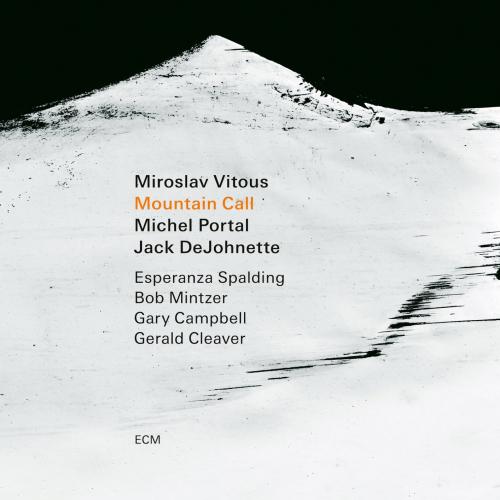
Mountain Call Miroslav Vitous, Michel Portal, Jack DeJohnette
Album Info
Album Veröffentlichung:
2026
HRA-Veröffentlichung:
27.03.2026
Das Album enthält Albumcover Booklet (PDF)
Entschuldigen Sie bitte!
Sehr geehrter HIGHRESAUDIO Besucher,
leider kann das Album zurzeit aufgrund von Länder- und Lizenzbeschränkungen nicht gekauft werden oder uns liegt der offizielle Veröffentlichungstermin für Ihr Land noch nicht vor. Wir aktualisieren unsere Veröffentlichungstermine ein- bis zweimal die Woche. Bitte schauen Sie ab und zu mal wieder rein.
Wir empfehlen Ihnen das Album auf Ihre Merkliste zu setzen.
Wir bedanken uns für Ihr Verständnis und Ihre Geduld.
Ihr, HIGHRESAUDIO
- 1 New Energy 01:52
- 2 Second Touch 01:41
- 3 On the Way 00:56
- 4 Unexpected Solutions 04:47
- 5 Tribal Dance 02:26
- 6 Rehearsal in Theatre 01:07
- 7 Discussion 01:19
- 8 Epilog 05:03
- 9 Delusion 01:44
- 10 Evolution: Path Begins 02:03
- 11 Evolution: Nature Opening 02:05
- 12 Evolution: Fulfillment 02:28
- 13 Rhapsody: In You 02:22
- 14 Rhapsody: Fun & Games 02:20
- 15 Rhapsody: Africa 01:13
- 16 Rhapsody: In Me 02:32
- 17 Rhapsody: Lullaby 01:30
- 18 Mountain Call 05:30
Info zu Mountain Call
Mountain Call ist ein Höhepunkt im musikalischen Schaffen von Miroslav Vitous und präsentiert den Meisterbassisten in unterschiedlichen Ensemblekonstellationen, in denen unter anderem der renommierte französische Klarinettist Michel Portal und der amerikanische Schlagzeuger Jack DeJohnette, beide kürzlich verstorben, prominent vertreten sind. Das Album führt überzeugend mehrere Tendenzen und Strömungen in Vitous’ Werk zusammen und legt Zeugnis ab von seinen vielfältigen Fähigkeiten als dynamischer Improvisator, Jazzkomponist, Arrangeur und kreativer Pionier des Samplings. Der ungewöhnlich begabte tschechische Bassist und Mitbegründer von Weather Report kam Ende der 1970er-Jahre erstmals zu ECM, in einem Trio mit Terje Rypdal und Jack DeJohnette. Schon damals bildeten Miroslav und Jack eine eruptive, kraftvolle Rhythmussektion, die später erfolgreich wieder zusammen kam – auf Vitous’ Album Universal Syncopations (2003) mit Jan Garbarek und Chick Corea. Auch auf Mountain Call kommt dieser Kombination eine zentrale Rolle zu. Bassist und Schlagzeuger interagieren dynamisch auf „Tribal Dance“ und „Epilog“, wobei ihr Spiel im letzteren Stück von Miroslavs großen Orchesterakkorden gerahmt wird. Zudem soliert Jack innerhalb von Vitous’ dreiteiligem Werk „Evolution“ mit einer geradezu malerischen Liebe zum Detail. In der Suite „Rhapsody“ tritt die Stimme der Bassistin Esperanza Spalding in den Vordergrund, die Vitous’ Texte singt. Mountain Call beginnt und endet jedoch mit einer Reihe herausragender, funkelnd einfallsreicher Duette mit Michel Portal, die möglicherweise Miroslavs stärkste improvisatorische Momente seit seiner gefeierten Zusammenarbeit mit Jan Garbarek auf Atmos darstellen. Der abschließende Titelsong mit Miroslavs dramatischem Arco-Spiel und Portals eindringlicher Bassklarinette bestätigt ihre bemerkenswerte kreative Verbindung. Mountain Call wurde über einen Zeitraum von sieben Jahren in mehreren Sessions im Prager Studio von Vitous aufgenommen. Produziert wurde das Album von Miroslav Vitous und Manfred Eicher.
Miroslav Vitous, Kontrabass
Michel Portal, Klarinette
Jack DeJohnette, Schlagzeug
Esperanza Spalding, Gesang
Bob Mintzer, Klarinette
Gary Campbell, Sopransaxophon
Gerald Cleaver, Schlagzeug
CSNO-Orchester
Miroslav Vitous
The prodigiously gifted Czech bassist and founding member of Weather Report, who as been called “one of the heroes of the jazz bass” by Ben Ratliff in the New York Times, first came to ECM in the late 1970s, in a collaborative trio with Terje Rypdal and Jack DeJohnette. Back then, Miroslav and Jack made for an eruptive, powerful rhythm section (successfully revisited on Vitous’s Universal Syncopations album of 2003)
Vitous’s work on ECM covers a wide stylistic range. After the collaborative trio encounters with Terje Rypdal and Jack DeJohnette, he launched his own group with John Surman, Jon Christensen and Kenny Kirkland with the album First Meeting. On subsequent recordings Miroslav Vitous Group and Journey’s End, John Taylor was the featured pianist.
The 1980s saw the revival of the trio of Chick Corea, Miroslav Vitous and Roy Haynes. This was the line-up that had recorded the modern jazz classic Now He Sings, Now He Sobs in 1968, a reference work for a generation of players. Reunited in 1981, Corea, Vitous and Haynes recorded the album Trio Music, with free improvisations plus tunes by Thelonious Monk. A concert recording, Trio Music Live In Europe widened the scope to include compositions by each of the trio.
Miroslav’s 1985 album Emergence was an important addition to ECM’s select series of solo bass recordings. In the 1990s he was heard with Jan Garbarek in duo and trio contexts (“Atmos”, “Star”). After a hiatus during which the bassist was developing his highly successful symphonic orchestra samples software, he returned to the studio for two volumes of “Universal Syncopations” (2003 and 2007) – both of which were critical and popular successes. The first volume featured what was perceived as an “all-star” line-up, with Jan Garbarek, John McLaughlin, Chick Corea and Jack DeJohnette (“a mysterious and beautiful album – slightly disembodied, and (…) stronger for being so – The New York Times). “Universal Syncopations II” won the Großer Deutscher Schallplattenpreis, the Album of the Year Award of the German Record Critics. Two further albums reflected upon the creative legacy of the innovative ensemble of which Vitous had been a founder member: Remembering Weather Report and Music of Weather Report (2009 and 2016). Of the latter, The Guardian wrote that “The set simmers with sharp responses to unforgettable material.”
Mountain Call (2026), his first ECM leader date in ten years, is a late peak achievement in Miroslav Vitous’s music, presenting the bassist in varying ensemble configurations that prominently include the late French clarinetist Michel Portal and American drummer Jack DeJohnette among other notable collaborators.
Michel Portal (1935–2026)
has established himself as one of the leading figures in European jazz, an undisputed pioneer of free jazz, a virtuoso clarinetist and saxophonist, and a multi-award-winning film composer. An artist who defies categorization, he navigates with remarkable ease between classical repertoire, contemporary music, and free improvisation, embodying audacity, risk-taking, and creative freedom for over fifty years.
Trained in the rigorous tradition of Western classical music, Michel Portal quickly distinguished himself as an exceptional interpreter of Mozart, Brahms, and Schumann. His career as a concert performer and chamber musician, however, never diminished his commitment to the most innovative music: from the 1970s onward, he became one of the torchbearers of free jazz in Europe, notably with his iconic Michel Portal Unit.
A close collaborator of great masters of contemporary music such as Pierre Boulez, Karlheinz Stockhausen, and Luciano Berio, Michel Portal also develops remarkable work for film (Comolli, Oshima, etc.), where his sensitivity and inventiveness have earned him unanimous acclaim.
An insatiable artist, always seeking renewal, Portal cultivates numerous encounters and collaborations—from Bernard Lubat to Martial Solal, Joachim Kühn, Joey Baron, Jack DeJohnette, Richard Galliano, and Bojan Z. This constant ferment nourishes a profoundly personal body of work, in perpetual metamorphosis, where each performance appears as a deliberate act of risk, an experience of total improvisation.
Impossible to confine to a style or genre, Michel Portal embodies a nomadic, free, soulful, undisciplined, and borderless music. A music that does not seek to found a school, but which captures with rare truth the instability and unpredictability of our contemporary lives.
Today a true legend of French and European music, Michel Portal continues to reinvent himself, from the most intimate solo performances to more classic jazz ensembles. For him, music remains above all a burning passion, a total commitment, a vital space allowing him to escape boredom and re-enchant reality.
Jack DeJohnette
Widely regarded as one of the great drummers in modern jazz, Jack DeJohnette had a wide-ranging style that makes him a dynamic sideman and bandleader. He played with virtually every major jazz figure from the 1960s on, including Miles Davis, Herbie Hancock, Ornette Coleman, Sonny Rollins, and Abbey Lincoln. His versatility on the drums is accented by DeJohnette's additional accomplishments as a keyboardist: he studied classical piano for ten years before taking up drums.
In his early years on the Chicago scene, DeJohnette was active with the premiere musician organization, the Association for the Advancement of Creative Musicians, whose members included Muhal Richard Abrams, Roscoe Mitchell, and Joseph Jarman. In 1966, he drummed alongside Rashied Ali in the John Coltrane Quintet. However, he became more widely known as a member of Charles Lloyd's band, where he first began playing with pianist Keith Jarrett. In 1968, he recorded his first album as a leader, The DeJohnette Complex, on which DeJohnette doubled on melodica.
The second major association of DeJohnette's early career spanned the years 1969-72, when he performed with Miles Davis' first fusion band. Davis gave a nod to DeJohnette in his autobiography, Miles: "Jack DeJohnette gave me a deep groove that I just loved to play over." Besides allowing him to play alongside such stellar musicians as Dave Holland, Chick Corea, and John McLaughlin, the Davis years also increased DeJohnette's session work.
DeJohnette began leading several groups in the early 1970s, including Compost, Directions, New Directions, and Special Edition, featuring a diverse gathering of musicians including David Murray, Eddie Gomez, Chico Freeman, John Abercrombie, and Lester Bowie. Since the 1980s, while continuing to lead his own projects and bands, DeJohnette was also been a member of the highly acclaimed Keith Jarrett/Gary Peacock/Jack DeJohnette trio. DeJohnette continued to record and perform on keyboards, releasing albums such as Zebra, a mesmerizing synthesizer/trumpet duo with Lester Bowie featuring African music influences. He further explored his interest in African music in a 2005 duet with noted Gambian kora player Foday Musa Suso.
In 2005, DeJohnette launched Golden Beams Productions, an independent record label "as an outlet for the broad range of creative projects." The label garnered DeJohnette a Grammy Award for Peace Time, on which he is both featured artist and co-producer. He composed soundtracks for both television and video, and received numerous awards including the French Grand Prix du Disque in 1979. In 1991, he was awarded an honorary doctorate of music from the Berklee College of Music. DeJohnette was the winner of numerous DownBeat magazine "Drummer of the Year" critics' and readers' polls, and JazzTimes magazine's reader polls for "Best Drummer."
Booklet für Mountain Call