





[].
Rossini: Fogli d'album Anna Bonitatibus & Adele D'Aronzo
Album info
Album-Release:
2026
HRA-Release:
02.10.2026
Label: Prospero Classical
Genre: Classical
Subgenre: Vocal
Artist: Anna Bonitatibus & Adele D'Aronzo
Composer: Gioacchino Rossini (1792-1868)
Album including Album cover Booklet (PDF)
- Gioacchino Rossini (1792 - 1868): Se il vuol la mulinara:
- 1 Rossini: Se il vuol la mulinara 02:20
- Apprendete, o cari amanti. Canzonetta:
- 2 Rossini: Apprendete, o cari amanti. Canzonetta 00:57
- Quai voci, quai note:
- 3 Rossini: Quai voci, quai note 02:01
- Chi m’ascolta il canto usato. Canzonetta:
- 4 Rossini: Chi m’ascolta il canto usato. Canzonetta 02:20
- Infelice ch’io son (Andante) [1821]:
- 5 Rossini: Infelice ch’io son (Andante) [1821] 01:02
- Infelice ch’io son (Andante) [1822]:
- 6 Rossini: Infelice ch’io son (Andante) [1822] 00:58
- Arietta spagnuola (Allegretto):
- 7 Rossini: Arietta spagnuola (Allegretto) 02:22
- Un’empia mel rapì (Andantino mosso):
- 8 Rossini: Un’empia mel rapì (Andantino mosso) 00:54
- Preghiera nuova (Andante):
- 9 Rossini: Preghiera nuova (Andante) 02:17
- Chant romain (Moderato):
- 10 Rossini: Chant romain (Moderato) 01:39
- Amori scendete (Andantino):
- 11 Rossini: Amori scendete (Andantino) 01:52
- La Passeggiata (Allegretto):
- 12 Rossini: La Passeggiata (Allegretto) 04:09
- Mi lagnerò tacendo (Andantino in D Major):
- 13 Rossini: Mi lagnerò tacendo (Andantino in D Major) 01:37
- Mi lagnerò tacendo. Bolero (Moderato in D Minor):
- 14 Rossini: Mi lagnerò tacendo. Bolero (Moderato in D Minor) 00:22
- Mi lagnerò tacendo (Allegretto in F Major):
- 15 Rossini: Mi lagnerò tacendo (Allegretto in F Major) 01:19
- Mi lagnerò tacendo (Moderato in B-Flat Major):
- 16 Rossini: Mi lagnerò tacendo (Moderato in B-Flat Major) 00:23
- Odia la pastorella. Canzonetta (Allegretto):
- 17 Rossini: Odia la pastorella. Canzonetta (Allegretto) 01:14
- Mi lagnerò tacendo “Rossini-Carafa” (Andantino in A-Flat Major):
- 18 Rossini: Mi lagnerò tacendo “Rossini-Carafa” (Andantino in A-Flat Major) 00:42
- Pensée pour l’album de la princesse Hercolani (Moderato in A-Flat Major):
- 19 Rossini: Pensée pour l’album de la princesse Hercolani (Moderato in A-Flat Major) 00:55
- Mi lagnerò tacendo (Moderato in A-Flat Major):
- 20 Rossini: Mi lagnerò tacendo (Moderato in A-Flat Major) 01:06
- Waltz in E-Flat Major (E. Puerari):
- 21 Rossini: Waltz in E-Flat Major (E. Puerari) 02:30
- L’ esule (1843, Andantino mosso):
- 22 Rossini: L’ esule (1843, Andantino mosso) 02:53
- Waltz in E-Flat Major (C. Rothschild):
- 23 Rossini: Waltz in E-Flat Major (C. Rothschild) 02:20
- Per la collezione della Biblioteca Reale di Berlino (Andantino):
- 24 Rossini: Per la collezione della Biblioteca Reale di Berlino (Andantino) 00:44
- Mi lagnerò tacendo (Allegretto moderato in F Major):
- 25 Rossini: Mi lagnerò tacendo (Allegretto moderato in F Major) 00:38
- Vivace in E-Flat Major:
- 26 Rossini: Vivace in E-Flat Major 02:27
- Tutta Forza, a pieno Petto, senza Freno (Moderato):
- 27 Rossini: Tutta Forza, a pieno Petto, senza Freno (Moderato) 00:18
- Francesca da Rimini. Recitativo ritmato:
- 28 Rossini: Francesca da Rimini. Recitativo ritmato 02:07
- La separazione. Melodia drammatica:
- 29 Rossini: La separazione. Melodia drammatica 04:19
- Un’empia mel rapì (Andantino in C Major):
- 30 Rossini: Un’empia mel rapì (Andantino in C Major) 00:23
- Mi lagnerò tacendo “Al Maestro de’ Maestri” (in G Major):
- 31 Rossini: Mi lagnerò tacendo “Al Maestro de’ Maestri” (in G Major) 00:36
- Mi lagnerò tacendo “A Mad.lle Nau” (Moderato in G Major):
- 32 Rossini: Mi lagnerò tacendo “A Mad.lle Nau” (Moderato in G Major) 00:49
- Mi lagnerò tacendo (Moderato in D Minor):
- 33 Rossini: Mi lagnerò tacendo (Moderato in D Minor) 00:39
- Ninette Nicoló (1814 - 1876): La Plainte, pour piano (Andante ben legato):
- 34 Nicoló: La Plainte, pour piano (Andante ben legato) 05:30
Info for Rossini: Fogli d'album
The mezzo-soprano Anna Bonitatibus turns her attention to Gioachino Rossini’s little-known *Fogli d’album* – occasional compositions for friends, patrons and special occasions that offer a surprisingly personal insight into the composer. Many of the works are recorded here for the first time and presented in chronological order, thereby tracing both Rossini’s life and his artistic development. In pianist Adele D’Aronzo, Anna Bonitatibus has found a kindred musical spirit. Both deliberately eschew any operatic exaggeration and instead develop a subtle, transparent sound that allows the miniatures to retain their poetic independence. As a result, the music does not come across as a by-product of the great opera composer, but as a chapter in its own right within his oeuvre.
Anna Bonitatibus, mezzo-soprano
Adele d’Aronzo, piano
Recorded 19–20 November 2024; 23 April 2025, Fazioli Concert Hall, Sacile (PN), Italy
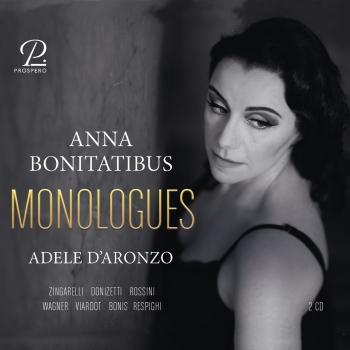

Anna Bonitatibus
Winner of The International Opera Awards (2015), for Semiramide – La Signora regale, and Best Female Voice Finalist IOA (2016), the anti-Diva, as she likes to describe herself, Anna Bonitatibus is renowned for the noble passion with which she interprets titles between the most famous of ‘teatro musicale’, as well as the tireless commitment with which she promotes the divulgation of a rarer repertoire. She includes in her performed titles, seventy operas, from Claudio Monteverdi’s masterpieces to titles back to proscenium by Francesco Cavalli (Didone, Ercole amante, Calisto), crossing Händel’s operatic production (Agrippina, Deidamia, Giulio Cesare, Orlando, Tamerlano, Tolomeo, Ottone, Il Trionfo del Tempo e del Disinganno) and composers from the Neapolitan school, from Pergolesi to Cimarosa, until her beloved Gioachino Rossini: La Cenerentola, Il Barbiere di Siviglia, L’Italiana in Algeri, Le Comte Ory, Il Viaggio à Reims, Tancredi and furthermore Cantate, Masses and the rare and preciouses Péchés de Vieillesse by the ‘pesarese’.
As the embodiment of Cherubino from the Daponteian Le Nozze di Figaro, she has become one of the most acclaimed performers of Mozart. Then follows Don Giovanni, Così fan tutte, Mitridate Re di Ponto, La Clemenza di Tito, as well as sacred and profane repertoire by the Salzburgian composer. The Mezzo-soprano’s wide repertoire includes also Messa da Requiem by Giuseppe Verdi, Ginevra di Scozia by Simon Mayr and Enrico di Borgogna by Donizetti interpreted with great success at the Donizetti Opera di Bergamo (2018). The French repertoire includes Carmen, a role brilliantly debuted in Madrid (2018) and L’Enfant et les sortilèges by Ravel, Roméo et Juliette by Berlioz and Gounod as well as Les contes d’Hoffmann by Offenbach, Werther and Don Quichotte by Massenet.
From first steps at the Teatro alla Scala, to Bayerische Staatsoper in Munich, to the Théâtre des Champs-Elysées in Paris, to the Teatro Real in Madrid, La Monnaie in Bruxelles, Staatsoper in Vienna, to Royal Opera House in London, Festivals (Salzburg, Florence, Munich, Bologna, Grange) and to the most renowned international concert halls (from Russia to United States), Anna Bonitatibus has collaborated with the most acclaimed conductors and directors: Sir Charles Mackerras, Riccardo Muti, Sir Antonio Pappano, René Jacobs, William Christie, Ivor Bolton, Myung Whun Chung, Alan Curtis, Roberto Abbado, Ottavio Dantone, Marc Minkowski and Luca Ronconi, Jerome Savary, Pier Luigi Pizzi, Dario Fo, David McVicar, David Alden, Sir Jonathan Miller, Kasper Holten, Emilio Sagi, Sven-Eric Bechtolf, David Pountney.
The Convegno Internazionale Rossini 2017 opened their recent celebrations dedicated to Rossini150 and Anna Bonitatibus has been invited as interpreter for the special concert ‘Rossini e gli altri. La Gran scena’ produced by Fondazione Rossini di Pesaro. For the same celebrations, she participated at the Rossini Opera Festival 2018 and in September of the same year, she has been Rossini’s ambassador at the Seoul National University (South Korea) and at St. John College, Cambridge, with Recitals and Master Classes dedicated to Gioachino Rossini.
Alongside her artistic activity, Anna Bonitatibus is engaged in the research and promotion of Lirica italiana da camera (Italian Art Songs) through the music publishing house Consonarte – Vox in Musica, founded by her and that counts on a collaboration with experts, musicians and scholars from renown European universities. The project seeks to renew appreciation of this immense musical patrimony for which valuable initiatives are undertaken, including the recent performances by the Mezzo-soprano at the Wigmore Hall in London.
Among her most successful recordings: L’Infedeltà costante dedicated to Haydn; Un Rendez-vous, a portrait of Gioachino Rossini’s chamber music repertoire; Semiramide - La Signora regale, a musical itinerary from Porpora to García consecrated to the first Queen of Mesopotamia; La Tempesta, chamber Cantatas by the composer Marianna Martines, released for DHM/RCA/SONY. In DVD Il Barbiere di Siviglia for Hardy-RaiTrade, La Didone and Ercole amante by Cavalli (OpusArte) and Così fan tutte by Mozart (Arthaus), L’incoronazione di Poppea for Virgin Classic. In streaming, Anna Bonitatibus recently appeared in La Clemenza di Tito and Lucio Silla (La Monnaie, Bruxelles) and in L’Italiana in Algeri (Wiener Staatsoper, Vienna). Her latest recording (2018, BR Klassis) is the album ‘en travesti’: the recital, warmly acclaimed by audiences and press, crosses the parable of trouser roles composed for female voices and of which Anna Bonitatibus has always been an interpreter of reference.
Booklet for Rossini: Fogli d'album