







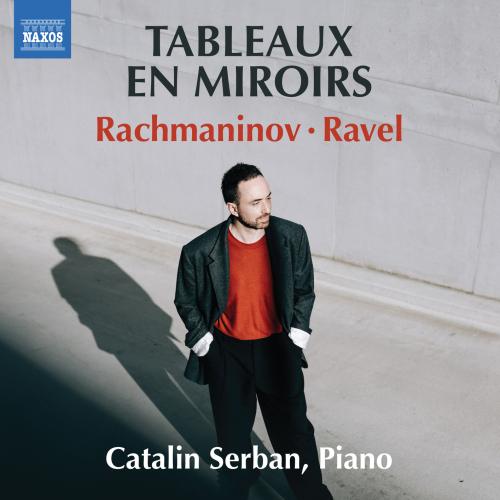
Tableaux en miroirs Catalin Serban
Album info
Album-Release:
2026
HRA-Release:
13.11.2026
Label: Naxos
Genre: Classical
Subgenre: Instrumental
Artist: Catalin Serban
Composer: Sergei Rachmaninoff (1873-1943), Maurice Ravel (1875-1937)
Album including Album cover Booklet (PDF)
Coming soon!
Thank you for your interest in this album. This album is currently not available for sale but you can already pre-listen.
Tip: Make use of our Short List function.
- Sergei Rachmaninoff (1873 - 1943): Études-tableaux, Op. 39:
- 1 Rachmaninoff: Études-tableaux, Op. 39: No. 1 in C Minor. Allegro agitato 03:30
- 2 Rachmaninoff: Études-tableaux, Op. 39: No. 2 in A Minor. Lento assai 06:20
- 3 Rachmaninoff: Études-tableaux, Op. 39: No. 3 in F-Sharp Minor. Allegro molto 03:22
- 4 Rachmaninoff: Études-tableaux, Op. 39: No. 4 in B Minor. Allegro assai 03:54
- 5 Rachmaninoff: Études-tableaux, Op. 39: No. 5 in E-Flat Minor. Appassionato 04:55
- 6 Rachmaninoff: Études-tableaux, Op. 39: No. 6 in A Minor. Allegro 03:01
- 7 Rachmaninoff: Études-tableaux, Op. 39: No. 7 in C Minor. Lento lugubre 08:24
- 8 Rachmaninoff: Études-tableaux, Op. 39: No. 8 in D Minor. Allegro moderato 03:24
- 9 Rachmaninoff: Études-tableaux, Op. 39: No. 9 in D Major. Allegro moderato 03:51
- Maurice Ravel (1875 - 1937): Miroirs, M. 43:
- 10 Ravel: Miroirs, M. 43: No. 1, Noctuelles 05:04
- 11 Ravel: Miroirs, M. 43: No. 2, Oiseaux tristes 04:14
- 12 Ravel: Miroirs, M. 43: No. 3, Une barque sur l'océan 06:55
- 13 Ravel: Miroirs, M. 43: No. 4, Alborada del gracioso 06:37
- 14 Ravel: Miroirs, M. 43: No. 5, La vallée des cloches 06:20
Info for Tableaux en miroirs
A sonic reflection on imagination, virtuosity, and poetic depth.
Rachmaninoff’s "Études-tableaux," Op. 39, are a masterpiece of the late Romantic era—filled with extreme contrasts and marked by an overwhelming sense of melancholy. Ravel’s "Miroirs" are distinguished by a concise, richly colored musical language, characterized by sonic experimentation, subtle timbres, and a sophistication of expression that demands the utmost technical precision.
Pianist Catalin Serban has long harbored the desire to present these two major piano cycles side by side, in order to explore the tensions between them and discover an underlying narrative arc that spans both works.
"Serban shone with tremendous brilliance and an unpretentious virtuosity. His playing possessed a noble clarity, precision, and a contemplative quality." – Badische Zeitung
Catalin Serban, piano

Catalin Serban
Born in Bucharest and based in Berlin, Catalin Serban is a pianist whose artistic work encompasses a broad spectrum of solo, chamber music, and curatorial projects. His musical profile is defined by an extensive repertoire and a personal, sensitive approach to sound—one rooted in a deep connection to vocal expression.
From a young age, Catalin Serban was recognized in Romania as one of the significant pianists of his generation. He continued his musical education in Berlin and Lübeck, supported by scholarships from various foundations, and went on to win prizes at international piano competitions in Germany, Italy, and Romania. He has performed across Europe and Asia in venues such as the Konzerthaus Berlin, the Berlin Philharmonie, the Romanian Athenaeum in Bucharest, Die Glocke in Bremen, and the Stadtcasino Basel. He has also appeared at festivals including the Beethovenfest Bonn, the Fränkische Kammermusiktage, the Oberstdorf Music Summer, the Maastricht Chamber Music Festival, and the Brahms Festival in Lübeck.
A particular focus of his artistic work lies in the Romantic and early modern repertoire, which he interprets with structural clarity and expressive intensity. Critics have praised his playing for its “breathing, vocal-like suppleness” (*taz*), as well as for its “delicate, clear delivery” and “multifaceted expressive power” (G. Constantinescu). He has also been described as a pianist who is “technically superb… performing with tremendous brilliance and an unobtrusive virtuosity” (*Badische Zeitung*). Alongside his solo career, chamber music forms a central pillar of his artistic output. Together with cellist Andrei Ioniță, Catalin Serban founded the chamber music ensemble and project "Spielende Insel"—an artistically curated platform for high-caliber chamber music featuring a diverse repertoire. The project collaborates with internationally active soloists in varying ensemble configurations to develop conceptually ambitious programs. Contributors include, among others, Veriko Tchumburidze, Seiji Okamoto, Tobias Feldmann, William Hagen, Pablo Barragán, Sindy Mohamed, and Lisa Jacobs.
In parallel, Serban serves as the artistic director of a new chamber music series in Berlin, which specifically fosters encounters between established artists and outstanding young musicians. Furthermore, in 2026, he will assume the role of artistic director for the chamber music series presented by *Konzertleben e.V.* at the Max Planck Institute in Berlin.
His discography reflects this artistic vision: *Des cloches sonores* (2018) combines works by Schubert with those of Enescu and Scriabin, while *Resemblances* (2022) presents a dual portrait of Chopin and Scriabin. His recordings have been praised for their "tonally diverse and expressive playing" (*piano news*, Bechstein). With *Mélodies infinies* (Naxos, 2024)—a collection of piano quartets by Fauré and Enescu—he delivered a recording that the international music press highlighted as a significant contribution to the Enescu discography.
Also slated for release in 2026 is a new solo album on the Naxos label, featuring works by Ravel (*Miroirs*) and Rachmaninoff (*Études-Tableaux*, Op. 39).
In addition to his concert career, Catalin Serban is also active as an educator. He teaches at music conservatories in Berlin and Lübeck and gives masterclasses in France, China, Romania, and the Netherlands.
Booklet for Tableaux en miroirs