




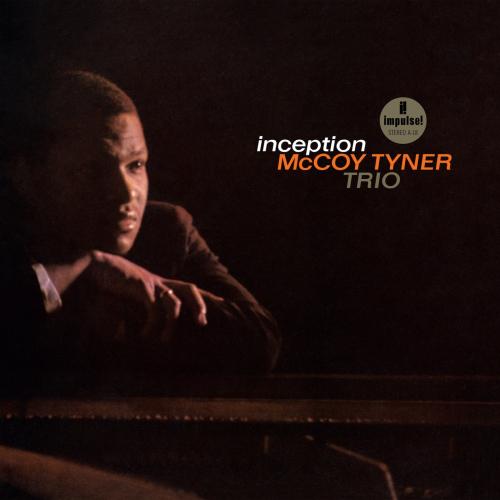
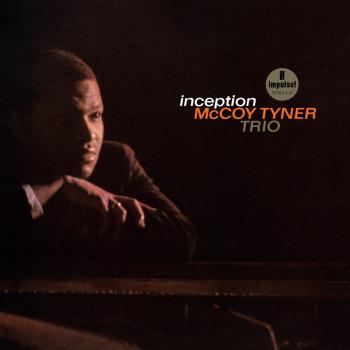
Inception (2026 Remaster) McCoy Tyner Trio
Album info
Album-Release:
2026
HRA-Release:
24.04.2026
Album including Album cover
I`m sorry!
Dear HIGHRESAUDIO Visitor,
due to territorial constraints and also different releases dates in each country you currently can`t purchase this album. We are updating our release dates twice a week. So, please feel free to check from time-to-time, if the album is available for your country.
We suggest, that you bookmark the album and use our Short List function.
Thank you for your understanding and patience.
Yours sincerely, HIGHRESAUDIO
- 1 Inception 04:27
- 2 There Is No Greater Love 06:18
- 3 Blues For Gwen 04:24
- 4 Sunset 04:40
- 5 Effendi 06:38
- 6 Speak Low 06:17
Info for Inception (2026 Remaster)
McCoy Tyner took a break from the classic John Coltrane Quartet of the early 60s to record this, his debut solo album, in January of 1962.
Originally released later that same year on the legendary Impulse! label, Inception is essentially the John Coltrane Quartet minus Coltrane as it features Art Davis on bass and Elvin Jones on drums.
A mellow and lyrical album that includes 4 Tyner originals, Inception is an early look at the work of one of post-bop jazz' finest pianists.
"Those familiar with the dense, percussive style that pianist McCoy Tyner has cultivated since the 1970s onwards may be surprised by what they hear on Inception. Like Reaching Fourth and Nights of Ballads and Blues, this album gives listeners the chance to hear what a very young Tyner sounded like outside the confines of the classic John Coltrane quartet of the early '60s; it reveals a lyrical approach to jazz piano that seems a far cry from Tyner's mature style. The choice of material is fairly evenly split between modal pieces like "Inception" and more harmonically involved tunes like "Speak Low," and the pianist's treatment of both demonstrates the extent to which his early work was rooted in bebop. Tyner had yet to develop the massive orchestral sound and highly distinctive vocabulary of modal licks that would mark his later style, and throughout this album he spins dizzyingly long and singing lines with an exquisitely light touch. The irresistible rush of forward momentum that he maintains on tracks like "Effendi" and "Blues for Gwen" is breathtaking, and there is an exuberant, almost athletic quality to much of his solo work. Bassist Art Davis and drummer Elvin Jones provide superb accompaniment throughout, and they lay a solid rhythmic foundation for Tyner's sparkling melodic flights. The pianist's penchant for drama, which asserts itself more strongly in his later work, is on brief display in the original ballad "Sunset"; his skills as an arranger, though evident on several tracks, are perhaps best illustrated by the intricate contrapuntal treatment of "There Is No Greater Love." (Alexander Gelfand, AMG)
McCoy Tyner, piano
Art Davis, double bass
Elvin Jones, drums
Recorded January 10 and 11, 1962 at at the Van Gelder Studio, Englewood Cliffs, New Jersey
Digitally remastered
McCoy Tyner
Tyner’s piano style, complete with sophisticated chords and an explosively percussive left hand, has transcended conventional styles to become one of the most identifiable sounds in improvised music. His harmonic contributions and dramatic rhythmic devices form the vocabulary of a majority of jazz pianists.
Born December 11,1938 in Philadelphia, PA, he became a part of the emerging jazz and R&B scenes of the early 1950s. His parents instilled in him a love for music at an early age, and his mother encouraged him to explore his musical interests through formal training.
At age 20, Tyner began a career-changing relationship; first through performing and recording with legendary saxophonist Benny Golson, as well as performing on Golson’s famed album Meet The Jazztet (1960). While performing live with his sister-in-law, jazz singer Khadijah Davis, and musician/composer Cal Massey, he was introduced to saxophonist John Coltrane. He then joined Coltrane for the classic album My Favorite Things (1960), and he remained a core member of what became one of the most seminal groups in jazz history, The John Coltrane Quartet. The band, which also included drummer Elvin Jones and bassist Jimmy Garrison, had an extraordinary chemistry, fostered in part by Tyner’s almost familial relationship with Coltrane.
Tyner also began to explore his own solo talents as well at this time, releasing several albums on the Impulse record label, including his first-ever album Inception (1962) and Today and Tomorrow (1964).
From 1960 through 1965, Tyner developed a new vocabulary that transcended the piano styles of the time, providing a unique harmonic underpinning and rhythmic charge on classic Coltrane recordings including Live at the Village Vanguard, Impressions and Coltrane’s signature suite, A Love Supreme.
In 1965, after over five years as part of Coltrane’s quartet, Tyner left the group to explore more of his identity as a composer and bandleader. In 1967, he released his Blue Note Records debut, The Real McCoy, on which he was joined by saxophonist Joe Henderson, bassist Ron Carter and fellow Coltrane alumnus Elvin Jones.
The Blue Note Recordings of the 1960s and 1970s era inspired many experimental, as well as legendary albums including Tender Moments (1968) and Expansions (1968).
In 1972, Tyner joined forces with legendary jazz producer Orrin Keepnews to release his debut album, Sahara on Milestone/Fantasy Records. The album harnessed the sounds and rhythms of Africa, and would go on to receive two GRAMMY Award nominations that year for Best Jazz Performance by a Soloist and Best Jazz Performance by a Group.
From 1972 through 1980, Tyner would become one of the most successful jazz artists under the Milestone label, scoring some of the most well known recordings of his career. Enlightenment (1973), Fly With The Wind (1976), and Inner Voices (1977) mark a few of the well known classics recorded during this time period.
Throughout the 1980s and 1990s Tyner, now an established artist in his own right, continued to expand at a high level, allowing him to record albums with different record labels, which gave him the freedom to explore various musical settings and styles. From recording alongside Carlos Santana and Stanley Clarke Looking Out (1982 / Sony), with his own quintet on Dimensions (1984 / Elektra), to a solo piano concerto, Revelations (1988 / Blue Note), Tyner was able to defy limitations on his art. From jazz to R&B to classical, he made a statement regarding music as a whole being and not as an individual category.
This era also saw the emergence of Tyner’s well known Jazz Trio featuring Avery Sharpe on bass and Aaron Scott on drums. This was a steady line up which toured the world many times over the course of a 20 year period.
Throughout the late 1980s, McCoy and his trio also arranged his lavishly textured harmonies for a big band that performed around the world over the course of a 10 year period as McCoy Tyner Big Band. This relationship led to a GRAMMY Award-nominated live album, Uptown/Downtown (1988 / Milestone) and a GRAMMY Award-winning album in The Turning Point (1992 / Universal/Birdology).
1995 saw a collaboration album, Infinity, featuring saxophonist Michael Brecker, as well as the 1996 album What The World Needs Now, which featured the music of Burt Bacharach in a symphonic setting. Tyner finally ended a successful run by joining the Telarc label in the late 1990s, creating the latin-infused McCoy Tyner and the Latin All-Stars (1998), as well as McCoy Tyner with Stanley Clarke and Al Foster (2000).
During the 2000s, Tyner began work on some unique projects, including performances with tap dancer Savion Glover and the development of the Impulse! Septet, featuring his trio with some of today’s top musicians.
Tyner also briefly formed his own record label, aptly titled McCoy Tyner Music, which was a subsidiary house record label of Half Note Records. The label launched on September 11, 2007 with the release of Quartet, featuring Joe Lovano, Christian McBride, and Jeff “Tain” Watts. Recorded live on New Year’s Eve 2006, the album showcases a working band at its finest with some of today’s “legends in training.” Additionally, the record showed that Tyner, now the only surviving member of the John Coltrane Quartet, was still at the top of his game as a composer, performer and bandleader.
Thomas Conrad of JazzTimes wrote, “Quartet succeeds not only because everyone plays so well, but also because they play so well together. The pairing of Tyner and Lovano is synergistic. The McBride/Watts rhythm section, for intelligent propulsion, is state-of-the-art. Quartet succeeds once more because of its excellent sonic quality. It was recorded by engineer Phil Edwards at Yoshi’s in Oakland, Calif., over New Year’s Eve weekend 2006. Almost always, even the best-sounding jazz albums require you to make a choice. You can have the visceral in-the-moment reality of a live recording, or the full bandwidth resolution of a studio session. This one has both.”
In the summer of 2008, McCoy Tyner Music also released Guitars, featuring the stellar rhythm section of Tyner, Ron Carter, and Jack DeJohnette, alongside world-class musicians Bill Frisell, Marc Ribot, John Scofield, Derek Trucks and Bela Fleck. The CD/DVD package featured state-of-the-art technology, allowing the viewer to manually choose which musician(s) they would like to view in the studio at any time during each track. In 2009, Tyner released his third and final recording for McCoy Tyner Music, a solo piano performance recorded live in San Francisco during the summer of 2007.
McCoy Tyner is one of the most revered and influential musicians of all time. His vision of the musical landscape and ability to seamlessly incorporate a variety of elements, whether from distant continents or diverse musical influences, makes him a true innovator. In a career spanning six decades, he has earned a multitude of honors and awards, including five GRAMMY Awards.
Critically lauded and universally respected, McCoy continues to inspire fans, improvisers and rising stars across musical genres and generations, all while remaining a disarmingly modest and spiritually directed man.
This album contains no booklet.