
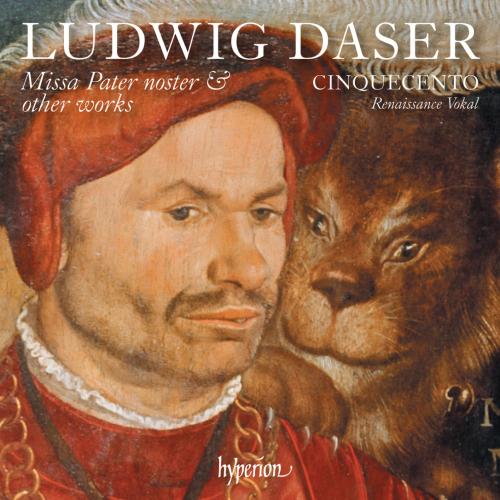
Daser: Missa Pater noster & Other Works Cinquecento
Album info
Album-Release:
2023
HRA-Release:
06.10.2023
Label: Decca (UMO) (Classics)
Genre: Classical
Subgenre: Choral
Artist: Cinquecento
Composer: Ludwig Daser (1525-1589)
Album including Album cover
I`m sorry!
Dear HIGHRESAUDIO Visitor,
due to territorial constraints and also different releases dates in each country you currently can`t purchase this album. We are updating our release dates twice a week. So, please feel free to check from time-to-time, if the album is available for your country.
We suggest, that you bookmark the album and use our Short List function.
Thank you for your understanding and patience.
Yours sincerely, HIGHRESAUDIO
- Ludwig Daser (1526 - 1589): Benedictus Dominus:
- 1 Daser: Benedictus Dominus 02:58
- Pater noster:
- 2 Daser: Pater noster 01:25
- Missa Pater noster:
- 3 Daser: Missa Pater noster: I. Kyrie: a. Kyrie I 02:14
- 4 Daser: Missa Pater noster: I. Kyrie: b. Christe 02:34
- 5 Daser: Missa Pater noster: I. Kyrie: c. Kyrie II 02:11
- 6 Daser: Missa Pater noster: II. Gloria: a. Gloria in excelsis Deo 02:25
- 7 Daser: Missa Pater noster: II. Gloria: b. Domine Deus, Agnus Dei 01:16
- 8 Daser: Missa Pater noster: II. Gloria: c. Qui tollis peccata mundi, suspice 02:28
- Ave Maria:
- 9 Daser: Ave Maria 00:38
- Missa Pater noster:
- 10 Daser: Missa Pater noster: III. Credo: a. Credo in unum Deum / Pater noster / Ave Maria 02:59
- 11 Daser: Missa Pater noster: III. Credo: b. Et incarnatus est / Et ne nos inducas / Et benedictus 00:58
- 12 Daser: Missa Pater noster: III. Credo: c. Crucifixus 01:30
- 13 Daser: Missa Pater noster: III. Credo: d. Et ascendit in caelum 01:53
- 14 Daser: Missa Pater noster: III. Credo: e. Et in Spiritum Sanctum / Pater noster / Ave Maria 03:00
- 15 Daser: Missa Pater noster: IV. Sanctus: a. Sanctus 02:12
- 16 Daser: Missa Pater noster: IV. Sanctus: b. Benedictus 01:27
- 17 Daser: Missa Pater noster: IV. Sanctus: c. Osanna 01:00
- 18 Daser: Missa Pater noster: V. Agnus Dei / Pater noster 03:15
- Ad te levavi oculos meos:
- 19 Daser: Ad te levavi oculos meos: I. Ad te levavi oculos meos 02:39
- 20 Daser: Ad te levavi oculos meos: II. Miserere nostri Domine 03:06
- Dilexi, quoniam:
- 21 Daser: Dilexi, quoniam 04:07
- Danck sagen wir alle:
- 22 Daser: Danck sagen wir alle 02:10
- Daran gedenck Jacob und Israel:
- 23 Daser: Daran gedenck Jacob und Israel: I. Daran gedenck Jacob und Israel 03:14
- 24 Daser: Daran gedenck Jacob und Israel: II. Jauchtzet ir Himmel 02:31
- Salvum me fac:
- 25 Daser: Salvum me fac 03:35
- Fracta diuturnis:
- 26 Daser: Fracta diuturnis 03:43
- Fratres, sobrii estote:
- 27 Daser: Fratres, sobrii estote 03:12
- Christe, qui lux es et dies:
- 28 Daser: Christe, qui lux es et dies: Verse 1. Christe, qui lux es et dies 00:27
- 29 Daser: Christe, qui lux es et dies: Verse 2. Precamur sancte Domine 01:42
- 30 Daser: Christe, qui lux es et dies: Verse 3. Ne gravis somnus irruat 00:30
- 31 Daser: Christe, qui lux es et dies: Verse 4. Defensor noster aspice 01:41
- 32 Daser: Christe, qui lux es et dies: Verse 5. Deo Patri sit gloria 00:47
Info for Daser: Missa Pater noster & Other Works
Ludwig Daser’s life and work encompassed both Catholic and Lutheran courts, at Munich and Stuttgart respectively. Cinquecento’s programme—which, besides the substantial Missa Pater noster, includes a selection of Latin motets and German chorale settings—illustrates a variety of styles and genres from both, offering a welcome introduction to this lesser-known master from the sixteenth century.
Of the three composers and chapelmasters at the Munich court chapel during the sixteenth century—Ludwig Senfl (1489/91-1543), Ludwig Daser (1526-1589) and Orlande de Lassus (1530/32-1594)—Daser has to this day remained the least known. This may come as a surprise, for it was he who, between Senfl and Lassus, made a decisive contribution to the development of the Munich court chapel choir into a professional ensemble under Duke Albrecht V of Bavaria. The fact that Daser and his work were quickly forgotten after his death cannot be blamed on him personally. His considerable legacy was simply eclipsed by the posthumous fame of other composers, who continue to have a greater impact on our perception today of the musical landscape of sixteenth-century southern Germany—Senfl, Lassus and Leonhard Lechner (1553-1606) being among the best-known.
Daser’s compositions, however, are by no means inferior in quality to those of his better-known contemporaries. His surviving oeuvre includes twenty-two Masses, twenty-six motets, thirty-three Protestant chorale settings, two Magnificats, a Passion and several smaller organ works. The beginnings of this impressive life’s work were quite modest. Daser came from a family of Munich fishermen who, as purveyors to the court, were closely connected with the Bavarian ducal family. He received his musical education at the Munich court chapel, first as a chorister and later probably as a composition pupil of Senfl. After his voice broke, in 1542 he began studying theology at the University of Ingolstadt. In 1550 he was called back to the Munich court chapel as a tenor and composer, and in 1552 he was made chapelmaster, a post which he retained for ten years. This period was overshadowed by many difficulties for him, in part due to disciplinary problems among the musicians of the Munich court chapel, but also because of his increasing inclination towards Protestantism. It is therefore not surprising that when in 1556 Lassus—by then internationally renowned—was engaged as a chapel singer and composer for the secular repertoire of the Munich court, Daser’s fate was effectively sealed. His honourable dismissal followed in 1562, officially justified by health problems. ....
Cinquecento
Cinquecento
Comprising five professional singers from five European countries, Cinquecento takes its name from the Italian term for the sixteenth century. The pan-European structure of the ensemble (its members are from Austria, Belgium, England, Germany and Switzerland) harks back to the imperial chapel choirs of the sixteenth century, whose members would have been chosen for their musicianship from Europe’s most prized musical establishments.
Formed in Vienna in October 2004 the group quickly established itself as one of Europe’s premier vocal ensembles. Cinquecento aims to bring the lesser-known sixteenth-century choral repertoire from the courts of imperial Austria to a wider public, as well as performing a varied range of Renaissance polyphony with a view to illuminating to audiences the kaleidoscopic diversity of compositional styles operating within Europe over the period. Recent interest from modern composers has also seen the ensemble add a variety of contemporary works to its repertoire.
Aside from numerous performances in Austria, the ensemble continues to forge a busy international touring schedule. Performances abroad have taken them to Belgium, Holland, Poland, the United Kingdom, Switzerland, France, Portugal, Hungary, Italy, Slovakia, Slovenia, Germany, the Czech Republic, as well as the USA, Canada and South Korea.
In summer 2021, Cinquecento made its successful debut at the Salzburg Festival.
Alongside the many accolades lavished on the group’s recordings such as the „Diapason d’Or de l’année“ for Heinrich Isaac’s six-part Missa „Wohlauff gut Gsell von Hinnen“, 2009 saw Cinquecento awarded the ‘Deutschlandfunk-Förderpreis’ for outstanding promise by the Musikfest Bremen. Since September 2005 Cinquecento has been ‘Ensemble in Residence’ at the church of St Rochus and Sebastian, Vienna, performing a polyphonic Mass-setting each week.
Since 2006 Cinquecento has been recording for Hyperion, focusing on Habsburg court composers from the sixteenth century. The latest release features Jacob Regnart’s Missa „Christ ist erstanden“ (2021).
…at the very forefront of modern-day specialists in the performance of Renaissance vocal music. (International Record Review)
This album contains no booklet.