


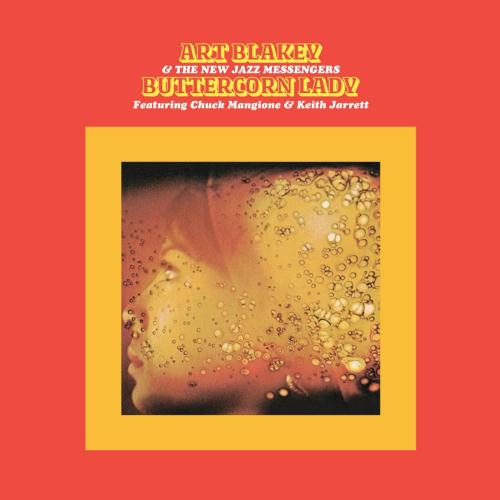
Buttercorn Lady (Remastered) Art Blakey & The New Jazz Messengers
Album info
Album-Release:
1966
HRA-Release:
07.08.2026
Album including Album cover
I`m sorry!
Dear HIGHRESAUDIO Visitor,
due to territorial constraints and also different releases dates in each country you currently can`t purchase this album. We are updating our release dates twice a week. So, please feel free to check from time-to-time, if the album is available for your country.
We suggest, that you bookmark the album and use our Short List function.
Thank you for your understanding and patience.
Yours sincerely, HIGHRESAUDIO
- 1 Buttercorn Lady 03:24
- 2 Recuerdo 14:27
- 3 The Theme 02:23
- 4 Between Races 04:33
- 5 My Romance (From 'Jumbo') 06:53
- 6 Secret Love 09:06
Info for Buttercorn Lady (Remastered)
As these words are written, Art Blakey continues to lead with the same energy and authority that has defined his career, keeping the New Messengers a vital force in modern jazz. At the heart of the band is the remarkably gifted young pianist Keith Jarrett, born May 8, 1945, in Allentown, Pennsylvania. From his earliest days, Jarrett displayed an uncanny facility for music, performing professionally before his teens and already commanding attention with extended solo concerts by the mid-1960s. His playing on this album ranges from soulful interpretation to daring experimentation, giving the listener only a taste of the extraordinary breadth he brings to every performance.
Joining Jarrett are Reggie Johnson on bass, whose background spans trombone, army bands, and work with leading modern jazz artists, and Frank Mitchell on tenor sax, a forceful improviser who drives the band's intensity forward. Together they form a unit that balances precision with fire, responding to Blakey’s polyrhythmic leadership with remarkable agility.
The recordings took place at the Lighthouse in Hermosa Beach, California, a modest 130-seat venue whose legacy as a West Coast jazz landmark is unmatched. Under the guidance of Howard Rumsey, the Lighthouse has long been a haven for musicians, providing the instruments, atmosphere, and audience that allow a band like the New Messengers to thrive. Blakey himself notes that the club's environment, from the quality of the piano to the comfort of the dressing room, contributes as much to the success of the performances as any single musical factor.
Musically, the album opens with Chuck Mangione’s 'Buttercorn Lady', a melody with a gentle Caribbean lilt that sets the stage for Jarrett’s first remarkable solos. 'Recuerdo' follows, a composition in which Mangione’s thoughtful writing and Jarrett’s delicate yet adventurous keyboard work intertwine with Mitchell and Johnson to create an intensely expressive conversation. Side Two features the hard-driving 'Between Races', highlighting Mitchell’s inventive saxophone lines, and the timeless 'My Romance', in which Jarrett’s lyrical touch adds fresh nuance to a classic standard. The album closes with a vigorous rendition of 'Secret Love', a tour de force for the entire ensemble and a vivid demonstration of Blakey’s relentless rhythmic guidance.
This record is, above all, a testament to a band operating at peak energy, a young ensemble guided by a master, blending improvisation, structure, and sheer excitement. It preserves the spirit of a live experience, the excitement of a club performance, and the brilliance of musicians who were, even at this early stage, shaping the future of jazz. — Leonard Feather
"Few jazz followers would think of trumpeter Chuck Mangione and pianist Keith Jarrett as former members of Art Blakey's Jazz Messengers, but in 1966, they both worked in the drummer's classic hard bop unit and the stint gave them needed exposure and helped the pair to develop their own individual voices. With tenor saxophonist Frank Mitchell and bassist Reggie Johnson completing the quintet, this particular version of the Jazz Messengers only had the opportunity to record this one excellent live LP but proved to be a worthy successor to their more acclaimed predecessors." (Scott Yanow, AMG)
Art Blakey, drums
Chuck Mangione, trumpet
Frank Mitchell, tenor saxophone
Keith Jarrett, piano
Reggie Johnson, bass
Recorded January 1 & 9, 1966 at The Lighthouse, Hermosa Beach, California
Digitally remastered

Art Blakey
Born in 1919, Art Blakey began his musical career, as did many jazz musicians, in the church. The foster son of a devout Seventh Day Adventist Family, Art learned the piano as he learned the Bible, mastering both at an early age.
But as Art himself told it so many times, his career on the piano ended at the wrong end of a pistol when the owner of the Democratic Club — the Pittsburgh nightclub where he was gigging — ordered him off the piano and onto the drums.
Art, then in his early teens and a budding pianist, was usurped by an equally young, Erroll Garner who, as it turned out, was as skilled at the piano as Blakey later was at the drums. The upset turned into
a blessing for Art, launching a career that spanned six decades and nurtured the careers of countless other jazz musicians.
As a young drummer, Art came under the tutelage of legendary drummer and bandleader Chick Webb, serving as his valet. In 1937, Art returned to Pittsburgh, forming his own band, teaming up with Pianist Mary Lou Williams, under whose name the band performed.
From his Pittsburgh gig, Art made his way through the Jazz world. In 1939, he began a three-year gig touring with Fletcher Henderson. After a year in Boston with a steady gig at the Tic Toc club, he joined the great Billy Eckstine, gigging with the likes of Charlie Parker, Dizzy Gillespie, and Sarah Vaughn.
In 1948, Art told reporters he had visited Africa, where he learned polyrhythmic drumming and was introduced to Islam, taking the name Abdullah Ibn Buhaina. It was in the late ’40s that Art formed his first Jazz Messengers band, a 17-piece big band.
After a brief gig with Buddy DeFranco, in 1954 Art met up with pianist Horace Silver, altoist Lou Donaldson, trumpeter Clifford Brown, and bassist Curly Russell and recorded "live" at Birdland for Blue Note Records. The following year, Art and Horace Silver co-founded the quintet that became the Jazz Messengers. In 1956, Horace Silver left the band to form his own group leaving the name, the Jazz Messengers, to Art Blakey.
Art’s driving rhythms and his incessant two and four beat on the high hat cymbals were readily identifiable from the outset and remained a constant throughout 35 years of Jazz Messengers bands. What changed constantly was a seeming unending supply of talented sidemen, many of whom went on to become band leaders in their own right.
In the early years luminaries like Clifford Brown, Hank Mobley and Jackie McLean rounded out the band. In 1959, tenor saxophonist Benny Golson joined the quintet and — at Art’s behest — began working on the songbook and recruiting what became one of the timeless Messenger bands — tenor saxman Wayne Shorter, trumpeter Lee Morgan, pianist Bobby Timmons and bassist Jymmie Merritt.
The songs produced from ’59 through the early ’60s became trademarks for the Messengers — including Timmon’s Moanin’, Golson’s Along Came Betty and Blues March and Shorter’s Ping Pong.
By this time, the Messengers had become a mainstay on the jazz club circuit and began recording on Blue Note Records. They began touring Europe, with forays into North Africa. In 1960, the Messengers became the first American Jazz band to play in Japan for Japanese audiences. That first Japanese tour was a high point for the band. At the Tokyo airport, the band was greeted by hundreds of fans as Blues March played over their airport intercom and their visit was televised nationally.
In 1961, trombonist Curtis Fuller transformed the Messengers into a proper sextet, giving the band the opportunity to incorporate a big band sound into their hard bop repertoire. Throughout the ’60s, the Messengers remained a mainstay on the jazz scene with jazz greats including Cedar Walton, Chuck Mangione, Keith Jarrett, Reggie Workman, Lucky Thompson and John Hicks. In the jazz drought of the ’70s, the Messengers remained a strong force, with fewer recordings, but no less energy. At a time when many jazz musicians were experimenting with electronics and fusing their music with pop, the Messengers were a mainstay of straight-ahead jazz.
Art’s steadfast belief in jazz music left him well positioned to take advantage of the music’s resurgence in the early ’80s. Art had been working with musicians including trumpeter Valery Ponomarev, tenor Billy Pierce, alto saxman Bobby Watson and pianist James Williams. Trumpeter Wynton Marsalis’ 1980 entrance into the band coincided — and played no small part in — the resurgence of the music in the ’80s.
Throughout the ’80 and until his death in 1990, Art maintained the integrity of the message, incubating the careers of musicians including trumpeters Wallace Rooney and Terence Blanchard, pianists Mulgrew Miller and Donald Brown, bassists Peter Washington and Lonnie Plaxico and many others.
Art died at the age of 71 after a career that spanned six of the best decades of jazz music. The messenger has moved on, but his message lives on in the music of the scores of sidemen whose careers he nurtured, the many other drummers he mentored and countless fans who have been blessed to hear the Messengers’ music. — By Yawu Miller, Managing Editor, The Baystate Banner (Boston, MA)
This album contains no booklet.