
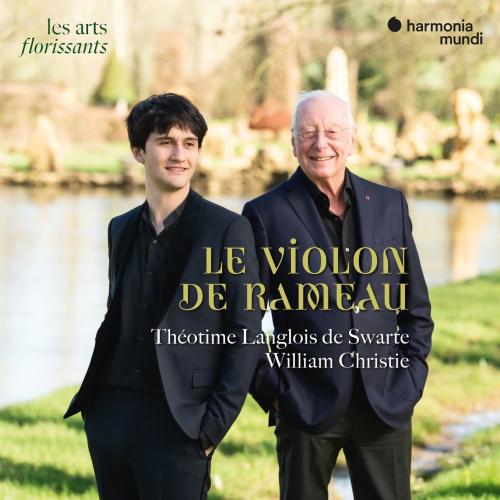
Le Violon de Rameau Théotime Langlois de Swarte & William Christie
Album info
Album-Release:
2026
HRA-Release:
28.08.2026
Label: Harmonia Mundi
Genre: Classical
Subgenre: Instrumental
Artist: Théotime Langlois de Swarte & William Christie
Composer: Jean Philippe Rameau (1683-1764), Charles-Antoine Branche (1722-1779), Jean Baptiste Cupis de Camargo (1719-1788), Toussaint Bordet (1721-1799), Jacques Aubert (1689-1753), Theodore-Jean Tarade (1731-1788), Andre-Joseph Exaudet (1710-1762)
Album including Album cover Booklet (PDF)
- Charles-Antoine Branche: Violin Sonata No. 1 in D Minor:
- 1 Branche: Violin Sonata No. 1 in D Minor: I. Preludio, Grave 03:20
- Jean-Baptiste Cupis (1711 - 1788): Violin Sonata in D Major, Op. 2 No. 1:
- 2 Cupis: Violin Sonata in D Major, Op. 2 No. 1: II. Grave - Andante 05:02
- Jean-Philippe Rameau (1683 - 1764): Les Fêtes d'Hébé, RCT 41, Acte II Scene 5:
- 3 Rameau: Les Fêtes d'Hébé, RCT 41, Acte II Scene 5: Air tendre. L'Amour va prendre Apollon (Version for Violin and Harpsichord) 02:05
- Suite in D Major, RCT 3:
- 4 Rameau: Suite in D Major, RCT 3: I. Les Tendres Plaintes (Version for Violin and Harpsichord) 04:23
- William Christie: Improvised Prelude for Harpsichord in E Major:
- 5 Christie: Improvised Prelude for Harpsichord in E Major 01:00
- Jean-Philippe Rameau: Castor et Pollux, RCT 32B, Acte III Scene 4:
- 6 Rameau: Castor et Pollux, RCT 32B, Acte III Scene 4: Première Gavotte pour Hébé et les Plaisirs célestes (Version for Violin and Harpsichord) 02:17
- Castor et Pollux, RCT 32B, Acte I Scene 5:
- 7 Rameau: Castor et Pollux, RCT 32B, Acte I Scene 5: Air pour une Spartiate, sans lenteur (Version for Violin and Harpsichord) 02:05
- Toussaint Bordet: Air tendre. Rossignol dont le doux ramage:
- 8 Bordet: Air tendre. Rossignol dont le doux ramage: Air tendre. Rossignol dont le doux ramage (Version for Violin and Harpsichord) 02:42
- Jacques Aubert (1689 - 1753): Suite, Op. 27 No. 3:
- 9 Aubert: Suite, Op. 27 No. 3: Tendrement 01:18
- 10 Aubert: Suite, Op. 27 No. 3: Gayement & Double 04:02
- Jean-Philippe Rameau: Les Indes Galantes, RCT 44, Prologue Scene 2:
- 11 Rameau: Les Indes Galantes, RCT 44, Prologue Scene 2: Musette en rondeau (Version for Violin and Harpsichord) 01:51
- 12 Rameau: Les Indes Galantes, RCT 44, Prologue Scene 2: Air grave pour deux Polonois (Version for Violin and Harpsichord) 01:11
- 13 Rameau: Les Indes Galantes, RCT 44, Prologue Scene 2: Menuet I (Version for Violin and Harpsichord) 00:45
- Les Indes Galantes, RCT 44, First Entrance "Le Turc généreux" Scene 6:
- 14 Rameau: Les Indes Galantes, RCT 44, First Entrance "Le Turc généreux" Scene 6: Rigaudons I & II (Version for Violin and Harpsichord) 01:22
- 15 Rameau: Les Indes Galantes, RCT 44, First Entrance "Le Turc généreux" Scene 6: Tambourins I & II (Version for Violin and Harpsichord) 01:17
- Les Indes Galantes, RCT 44, Third Entrance "Les Fleurs" Scene 8:
- 16 Rameau: Les Indes Galantes, RCT 44, Third Entrance "Les Fleurs" Scene 8: Orage (Version for Violin and Harpsichord) 00:40
- Théodore-Jean Tarade (1731 - 1788): Les Sauvages de Mr. Rameau, variations:
- 17 Tarade: Les Sauvages de Mr. Rameau, variations 02:43
- Louis Aubert: Violin Sonata in A Minor, Op. 1 No. 3:
- 18 Aubert: Violin Sonata in A Minor, Op. 1 No. 3: I. Preludio, Adagio 01:23
- 19 Aubert: Violin Sonata in A Minor, Op. 1 No. 3: II. Pastorale, in poco Allegro gratioso 02:06
- 20 Aubert: Violin Sonata in A Minor, Op. 1 No. 3: III. Corrente, Allegro 02:28
- 21 Aubert: Violin Sonata in A Minor, Op. 1 No. 3: IV. Arie I-II, Gratioso 02:21
- 22 Aubert: Violin Sonata in A Minor, Op. 1 No. 3: V. Giga, Presto 01:40
- Jean-Baptiste Cupis: Violin Sonata in B-Flat Major, Op. 1 No. 6:
- 23 Cupis: Violin Sonata in B-Flat Major, Op. 1 No. 6: Tambourin 01:55
- André-Joseph Exaudet ca. 1710 - 1762): Violin Sonata in G Minor, Op. 1 No. 4:
- 24 Exaudet: Violin Sonata in G Minor, Op. 1 No. 4: I. Largo 03:11
- Jean-Philippe Rameau: Hippolyte et Aricie, Acte III Scene 8:
- 25 Rameau: Hippolyte et Aricie, Acte III Scene 8: Premier Air des Matelots (Version for Violin and Harpsichord) 01:34
- 26 Rameau: Hippolyte et Aricie, Acte III Scene 8: Deuxième Air des Matelots (Version for Violin and Harpsichord) 01:09
- 27 Rameau: Hippolyte et Aricie, Acte III Scene 8: Premier et Deuxième Rigaudons en tambourin (Version for Violin and Harpsichord) 01:52
- William Christie: Improvisation for Organ:
- 28 Christie: Improvisation for Organ 01:45
- Jean-Philippe Rameau: Canon in E Major. Avec du vin, endormons-nous, RCT 18:
- 29 Rameau: Canon in E Major. Avec du vin, endormons-nous, RCT 18: Canon in E Major. Avec du vin, endormons-nous, RCT 18 (Version for Violin and Harpsichord) 01:15
- Dardanus, RCT 35A, Acte IV Scene 2:
- 30 Rameau: Dardanus, RCT 35A, Acte IV Scene 2: Sommeil, rondeau tendre (Version for Violin and Harpsichord) 03:18
- Les Indes Galantes, RCT 44, Second Entrance "Les Incas du Pérou" Scene 2:
- 31 Rameau: Les Indes Galantes, RCT 44, Second Entrance "Les Incas du Pérou" Scene 2: Air. Viens, Hymen (Version for Violin and Harpsichord) 03:54
- Les Indes Galantes, RCT 44, New Entrance "Les Sauvages" Scene 6:
- 32 Rameau: Les Indes Galantes, RCT 44, New Entrance "Les Sauvages" Scene 6: Chaconne (Version for Violin and Harpsichord) 06:28
Info for Le Violon de Rameau
The popularity of his harpsichord pieces and operas may have led people to forget that Rameau was also an accomplished violinist: William Christie and Théotime Langlois de Swarte have therefore conceived this imaginary concert, in which the violin and harpsichord vie with one another in ingenuity and creativity. The programme is, of course, inspired by the most famous arias and scenes from his operatic oeuvre, but also features numerous works by his contemporaries. A poetic journey through theatre, dance and song.
Théotime Langlois de Swarte, baroque violin
William Christie, harpsichord, organ
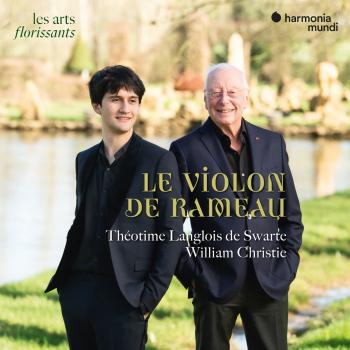
Théotime Langlois de Swarte
“Performances so special that I feel a changed man from listening” [Gramophone]; “A stunner by any standard” [The Strad]; and “Mesmerizing” [The New Yorker] – these represent common reactions upon encountering violinist Théotime Langlois de Swarte, who is rapidly emerging as a much sought-after violin soloist (on both baroque and modern instruments), chamber musician, recitalist, and conductor. Whether wielding bow or baton, de Swarte has built a reputation for breathing new life into centuries-old music, whether it be standards of baroque repertoire, an obscure, unfinished work by Vivaldi, or the trio sonatas of his long-forgotten Venetian contemporary, Giovanni Reali. Regardless of what is on his music stand, and whatever his role on stage, de Swarte’s dynamic, spontaneous, and frequently improvisational approach delights audiences the world over.
Recognition has come in the form of major awards, including the 2022 “Diapason D’or of the year” for his recording of Vivaldi, Locatelli, and Leclair concertos (harmonia mundi), and the 2022 “Ambassador of the Year” award from the European Early Music Network (REMA), along with multiple additional recording awards and a February, 2022 cover story in The Strad magazine.
In solo appearances on both baroque and modern violin, de Swarte regularly offers concertos by all of the baroque masters, along with those of Haydn and Mozart. He has appeared with Les Arts Florissants, Le Consort, Orchestre de l’Opera Royal, Holland Baroque, Orchestra of the 18th Century, Orchestra of St. Luke’s, The Australian Brandenburg Orchestra, Les Ombres, and Orchestre National de Lorraine. His engagements have brought him to prestigious venues such as Carnegie Hall, Wigmore Hall, Royal Albert Hall (BBC Proms) the Philharmonie de Paris, Vienna’s Musikverein, Hamburg’s Elbphilharmonie, Berlin’s Philharmonie, Los Angeles’ Walt Disney Hall, and the Shanghai National Art Center.
Théotime Langlois de Swarte studied at the Paris Conservatory under Michael Hentz, and became a regular member of Les Arts Florissants at William Christie’s invitation in 2014, while still a student. In 2025 he led the ensemble on two North American tours comprising 31 venues including Carnegie Hall, Boston, Berkeley, Ann Arbor, Toronto, and Washington DC. He has also appeared in recital with William Christie, including a 2021 recording of sonatas by Leclair and Senaille (“Generations” on harmonia mundi).
As co-founder - with harpsichordist Justin Taylor - of the baroque ensemble Le Consort, de Swarte can be heard on numerous highly-acclaimed recordings including “Specchio Veneziano”, “Opus 1”, and “Philarmonica”, all on Alpha Classics. Le Consort performs widely throughout Europe, and in North America have appeared in Montreal, Boston, Washington, Kansas City, Berkeley, Chicago, St. Paul, Louisville, New Orleans, Vancouver, and Ottawa.
Besides William Christie, frequent recital collaborators include harpsichordist Justin Taylor and lute player Thomas Dunford, with whom he recorded a much-praised album titled “The Mad Lover”. Another notable recording, “A Concert at the Time of Proust”, was made on the newly-restored Davidoff Stradivarius at the Philharmonie de Paris Museum. His most recent recording – of Vivaldi’s “Four Seasons” (harmonia mundi) – has garnered wide acclaim.
Alongside his instrumental work, de Swarte is emerging as a conductor. At Paris’ l’Opera Comique he has led performances of Lully’s Le Bourgeois gentilhomme (with Les Musiciens du Louvre at Marc Minkowski’s invitation), Gretry’s Zemire et Azor (at Louis Langrée’s invitation), and Gluck’s Iphigénie en Tauride. In June 2026 a project he conceived and developed for Les Arts Florissants featuring concertos of Bach and Vivaldi with dance choreography by Maud Le Pladec will premiere in France, including at the Philharmonie in Paris.
Théotime Langlois de Swarte is a laureate of the Banque Populaire Foundation. He plays a violin of Carlo Bergonzi (1733) on generous loan from an anonymous patron.
William Christie
harpsichordist, conductor, musicologist, and teacher, is the inspiration behind one of the most exciting musical adventures of the last 40 years. A pioneer in the rediscovery of baroque music, he has introduced the repertoire of 17th- and 18th-century France to a wide audience across the globe. Born in Buffalo, New York, and educated at Harvard and Yale, Christie has lived in France since 1971. The turning point in his career came in 1979, when he founded Les Arts Florissants.
As director of this vocal and instrumental ensemble, Christie soon made his mark as both a musician and man of the theater, concert hall, and opera house. Major public recognition came in 1987 with the production of Jean Baptiste Lully’s Atys at the Opéra-Comique in Paris.
Christie is the uncontested master of tragédie-lyrique as well as opéra-ballet, and is just as comfortable with the French motet as with music of the court. But, his affection for French music does not preclude him from exploring other European repertoires.
Notable among his most recent operatic work are Henry Purcell’s Dido and Aeneas at the Canal Theatres in Madrid, Royal Opera of Versailles, and Great Theater of the Lyceum in Barcelona; Purcell’s The Fairy Queen on an international tour; Marc-Antoine Charpentier’s Médée at the Paris Opera and Royal Theater in Madrid; and Jean-Philippe Rameau's Les Fêtes d’Hébé at the Opéra-Comique in Paris.
As a guest conductor, Christie often appears alongside the Berlin Philharmonic or the Orchestra of the Age of Enlightenment, at opera festivals, and at opera houses. His extensive discography includes more than 100 recordings.
Wishing to develop further his work as a teacher, in 2002, Christie created Le Jardin des Voix, Les Arts Florissant’s biennial baroque academy for young singers. Since 2007, he has been artist in residence at the Juilliard School in New York, where he gives master classes twice a year. In 2021, with Les Arts Florissants, he launched the first “Arts Flo Masterclasses” for young professional musicians.
In 2022, he was the recipient of the PdSK (German Record Critics’ Award) Honorary Award.
During the 2024-25 season, an anniversary tour and exceptional events marked the celebration of Christie's 80th birthday.
Highlights of the 2025-26 season include a South American tour of Purcell's The Fairy Queen, Charpentier's Midnight Mass at the Brooklyn Academy of Music in New York, George Frideric Handel's Concerti grossi, Giuseppe Domenico Scarlatti's Messa di Santa Cecilia, an international tour of Les Arts florissants / La Descente d'Orphée aux Enfers by Charpentier with the winners of the 12th edition of Le Jardin des Voix, as well as residencies at the Philharmonie Luxembourg and in Madrid.
Booklet for Le Violon de Rameau