



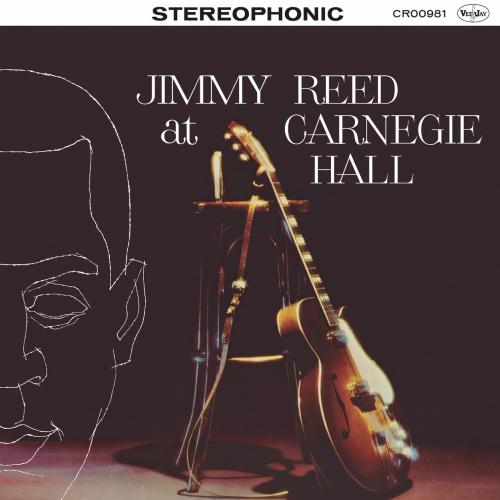
Jimmy Reed At Carnegie Hall (Remastered 2026) Jimmy Reed
Album info
Album-Release:
1961
HRA-Release:
21.08.2026
Album including Album cover
I`m sorry!
Dear HIGHRESAUDIO Visitor,
due to territorial constraints and also different releases dates in each country you currently can`t purchase this album. We are updating our release dates twice a week. So, please feel free to check from time-to-time, if the album is available for your country.
We suggest, that you bookmark the album and use our Short List function.
Thank you for your understanding and patience.
Yours sincerely, HIGHRESAUDIO
- 1 Bright Lights Big City (Remastered 2026) 02:46
- 2 I'm Mr. Luck (Remastered 2026) 03:30
- 3 Baby What’s Wrong (Remastered 2026) 03:22
- 4 Found Joy (Remastered 2026) 03:36
- 5 Kind Of Lonesome (Remastered 2026) 02:47
- 6 Aw Shucks Hush Your Mouth (Remastered 2026) 02:29
- 7 Tell Me You Love Me (Remastered 2026) 02:53
- 8 Blue Carnegie (Remastered 2026) 02:48
- 9 I'm A Love You (Remastered 2026) 02:01
- 10 Hold Me Close (Remastered 2026) 02:33
- 11 Blue Blue Water (Remastered 2026) 02:40
Info for Jimmy Reed At Carnegie Hall (Remastered 2026)
Jimmy Reed’s enduring blues classics: Studio recreation of an electrifying 1961 setlist from Carnegie Hall. This album includes the enduring classic, “Bright Lights, Big City,” which was included in The Rock and Roll Hall of Fame’s 500 Songs that Shaped Rock and Roll. Released in partnership with Acoustic Sounds, the album has been (AAA) remastered from the original tapes by Matthew Lutthans at The Mastering Lab.
Born in Dunleith, Mississippi, Jimmy Reed (1925–1976), a Blues and Rock and Roll Hall of Fame inductee, is best known for his electric blues style, which went on to influence some of the rock world’s biggest names, including Elvis Presley, Van Morrison, and the Rolling Stones.
Decades before players were emulating him, Reed began his career as a performer and busker in and around his home state of Mississippi. He relocated to Chicago in 1943 to pursue his blue-tinted dreams, but they were put on hold when he was drafted into the Navy during World War II. After being discharged in 1945, Reed moved back to Mississippi, married his girlfriend, singer Mary “Mama” Reed (who goes uncredited on many of his records, including the aforementioned “Bright Lights Big City”), and moved again to Indiana, where he found work in the meat-packing industry.
However, Reed’s ambitions remained rooted in music. Reed’s career took off in the 1950s when he signed to Vee-Jay Records, with a little help from future bandmate and blues legend Albert King, a drummer at the time. Reed scored his first hit song, “You Don’t Have to Go,” which peaked at #5 on the R&B charts in 1955. A string of acclaimed singles soon followed, including “Baby What You Want Me to Do,” a 1961 Top 10 single, and the up-tempo “Big Boss Man,” a 1961 Top 20 single.
It was also in 1961 that Reed released his double album Jimmy Reed at Carnegie Hall(Bluesville’s remastered version includes sides A/B of disc 1). Though Reed did, in fact, perform at the fabled New York City concert hall the previous May—he was on a bill with the great Muddy Waters and Big Maybelle—the album instead features “studio recreations” recorded during sessions at Bell Sound Studios in New York City and Universal Recording Studio in Chicago, rather than live cuts from the venue.
Highlights include side A opener “Bright Lights Big City,” which soared to #3 on the R&B chart and eventually completed its run in the Top 100. An original Reed composition, the song would go on to become a country music hit, reaching No. 1 for Sonny James in 1971, underscoring Reed’s far-reaching influence across genres. It was later included in the Rock and Roll Hall of Fame’s 500 Songs That Shaped Rock and Roll. Additional standouts include “Hold Me Close,” a declaration of love, which includes blues journeyman Willie Dixon on bass, “Blue, Blue Water” featuring guitarists Eddie Taylor and Phil Upchurch, and “Tell Me You Love Me,” a co-write with fellow bluesman Al Smith.
Billington calls At Carnegie Hall “a classic Jimmy Reed album,” with “superbly recorded songs.” And PopMatters praises the “excellent quality of [the album’s] music and its subsequent importance as a touchstone recording for scores of artists.”
Jimmy Reed, guitar, vocals, harmonica
Eddie Taylor, guitar
Phil Upchurch, guitar
Lonnie Brooks, guitar
William "Lefty" Bates, second guitar
Willie Dixon, bass
Earl Phillips, drums
Mary Lee Reed, backing vocals
Digitally remastered
Please Note: we do not offer the 192kHz version of this album, because our analysis clearly showed, that the 192kHz does not reach a frequency spectrum, that would justify to offer 192kHz. Hence we offer the 96kHz version.

Jimmy Reed
The blues was born in the deep South, a wild outcry against segregation, poverty and hard, back-breaking work. Sadly most of the great musicians who created this vibrant, influential music have passed on, leaving only their recordings to testify to their genius. However, one man, whose career stretches back to the time when rhythm ‘n’ blues was just bursting onto the popular music scene, is still with us and playing better than ever.
Leon Atkins, better known as Lil’ Jimmy Reed, is the real deal, as will be attested to by anyone who has been privileged to hear his stinging guitar work, gritty vocals and haunting harmonica. A tall charismatic figure, Lil’ Jimmy epitomises the classic Louisiana down-home blues tradition. Born in the late nineteen-thirties in a shot-gun shack in Hardwood, LA, a small cotton and sawmill town on the Mississippi River, Leon grew up near a club where every night he absorbed the wail of the blues from across the street. At six he had his own guitar, made from a cigar box, and by the time he was a teenager he was proficient on both guitar and harmonica, playing local clubs around Baton Rouge. Filling-in one night for blues star Jimmy Reed earned him the sobriquet Lil’ Jimmy Reed and started him on the long path to success.
After years of playing small clubs and taverns, Lil’ Jimmy took time out to serve his country in the military. Since his return to civilian life his career has blossomed. He has shared the stage with B. B. King and Bobby “ Blue” Bland and head-lined festivals in the UK, Ireland, Belgium, Holland, Germany, Denmark, Sweden and Switzerland. In recent years, he’s added Italy, Spain, Israel and Russia to his tally. His many fans recognise that Lil’ Jimmy’s performances are almost the last chance to hear the raw, unadulterated sound of authentic Louisiana blues.
In the sixties, the blues came to Britain and inspired a generation of teenagers who in turn took the music to international success. Prominent amongst these young men was the critically-acclaimed pianist Bob Hall, whose distinctive blues and boogie style on hundreds of recordings has influenced a host of others. Bob and his wife, the dynamic singer and rock-steady bassist Hilary Blythe, have joined forces with Lil’ Jimmy to form The Lil’ Jimmy Reed Band. Over the past five years this tight little outfit has given a series of show-stopping performances all over Europe.
This album contains no booklet.