


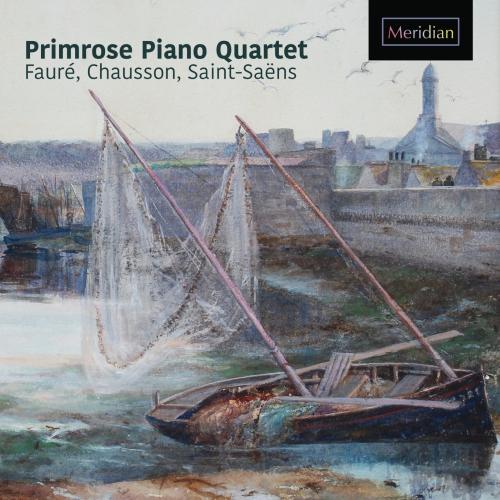
Fauré, Chausson, Saint-Saëns - Piano Quartets The Primrose Piano Quartet
Album info
Album-Release:
2024
HRA-Release:
08.09.2026
Label: Meridian Records
Genre: Classical
Subgenre: Chamber Music
Artist: The Primrose Piano Quartet
Composer: Gabriel Fauré (1945-1924), Ernest Chausson (1855-1899), Camille Saint-Saëns (1835-1921)
Album including Album cover
- Gabriel Fauré (1845 - 1924): Piano Quartet No. 1 in C Minor, Op. 15:
- 1 Fauré: Piano Quartet No. 1 in C Minor, Op. 15: I. Allegro molto moderato 10:16
- 2 Fauré: Piano Quartet No. 1 in C Minor, Op. 15: II. Scherzo - Allegro vivo 06:05
- 3 Fauré: Piano Quartet No. 1 in C Minor, Op. 15: III. Adagio 06:15
- 4 Fauré: Piano Quartet No. 1 in C Minor, Op. 15: IV. Allegro molto 08:53
- Piano Quartet No. 2 in G Minor, Op. 45:
- 5 Fauré: Piano Quartet No. 2 in G Minor, Op. 45: I. Allegro molto moderato 11:52
- 6 Fauré: Piano Quartet No. 2 in G Minor, Op. 45: II. Allegro molto 04:01
- 7 Fauré: Piano Quartet No. 2 in G Minor, Op. 45: III. Adagio non troppo 09:03
- 8 Fauré: Piano Quartet No. 2 in G Minor, Op. 45: IV. Allegro molto 09:23
- Camille Saint-Saëns (1835 - 1921): Barcarolle Op. 108:
- 9 Saint-Saëns: Barcarolle Op. 108: I. Allegretto molto moderato 08:55
- Ernest Chausson (1855 - 1899): Piano Quartet in A Major, Op. 30:
- 10 Chausson: Piano Quartet in A Major, Op. 30: I. Animé 12:38
- 11 Chausson: Piano Quartet in A Major, Op. 30: II. Très calme 08:00
- 12 Chausson: Piano Quartet in A Major, Op. 30: III. Simple et sans hâte 03:55
- 13 Chausson: Piano Quartet in A Major, Op. 30: IV. Animé 12:15
Info for Fauré, Chausson, Saint-Saëns - Piano Quartets
The piano firm Erard dominated mid-nineteenth century Europe and France well into the twentieth century. All the composers featured in this disc owned Erard pianos and dealt regularly with the firm whose Director from the 1880s was Albert Blondel. Chausson is pictured with his family (he had five children) at his Paris apartment, 22 Boulevard de Courcelles, with his Erard 2.12 (7’) number 50621, manufactured in 1886.
The instrument used in this recording is Le grand modèle de Concert 2.6 (8’5’’) a 90 note straight-strung piano from G to C‘’’’ number 65566 sold on 29th December 1888 to Armstrong de Georges of Paris, restored by Frits Janmaat of Maison Erard (then in Amsterdam and now in Enkhuizen) in 2011, and bought by Royal Birmingham Conservatoire in 2022.
Only 444 such pianos were built but the make was influential. One became the concert piano at the Opera Garnier in Paris. Ravel’s works Jeux d’eau and Scarbo require the extra bottom notes (promoted also by Bösendorfer’s Imperial model) and the most successful concert pianist of all time, Ignacy Jan Paderewski, toured this model around the world (so that the model was sometimes nicknamed the Paderewski Erard) whilst also endorsing the later cross-strung Erard and indeed all other major manufacturers.
We used Bach/Lehman temperament for these recordings. Lehman’s adaption of Bach’s schematic “squiggle” penned at the top of the Well-Tempered Klavier manuscript and denoting the pureness of the fifths in equal temperament, tweaks a number of those notes which are troublesome in more remote keys, thus making them sweeter - at the expense of “spicing up” some near sharp keys (A and E major in particular). Truly "equal" temperament was not established until the twentieth century, and an understanding of temperaments contributes to an awareness of key characteristics and expressive chromatic harmony.
Erard were committed to straight-strung pianos (where all the strings run parallel to each other) and hand-built methods of construction. For example, whilst most piano manufactures embraced mass production and used machines to cut the felt that covers hammers from the 1870s, Erard were covering piano hammers by hand in the 1890s. The straight stringing gives greater clarity and affects pedalling, but what is more important still is the fundamental approach to construction. Where the later heavy cast iron frame allows the strings to be crossed under enormous tension, generating generalised sonority and power, the older pianos were based on wooden frames with steel strengthening. The strings are lighter and looser, with more colourful overtones , and speak more independently for themselves, but without generating so much volume.
The Primrose Piano Quartet believes that only with the lighter sound and shallower key of an Erard can a hugely virtuoso romantic chamber music piano part, such as that of the Chausson, be properly understood. In order to maintain good balance and musical momentum the piano’s thousands of notes must fly, which comes naturally on an Erard but only antithetically on a modern piano. Furthermore, such a piano releases string players to use covered gut on most of their strings, as we do here, as well as to embrace stylistic practices of the time, such as portamento (or sliding between notes).
It’s particularly appropriate that the string style here is influenced by singing as the composers on this disc wrote such famous songs, and the singing style of that time was less powerful, did not favour excessive vibrato to enhance projection, but was more intimately lyrical with notes often connected by portamento. Nineteenth century piano playing styles typically included asynchronicity (where the left hand might be played before the right), unwritten arpeggiation, presque plaqué (notes played “almost together”) and inégale (where rhythms can be treated freely), all of which feature on this recording. With an elastic pulse and freely lyrical style we aimed to capture something of the playing of romanticism’s Golden Age.
Primrose Piano Quartet:
Susanne Stanzeleit, piano
Dorothea Vogel, viola
Andrew Fuller, cello
John Thwaites, piano
Primrose Piano Quartet
was formed in 2004 and is named after the great violist, William Primrose. The group’s acclaimed discography includes favourites such as works by Fauré, Brahms, Elgar, Strauss and Schubert as well as British repertoire featuring neglected masterpieces of the 19th and 20th century and major commissions from Sir Peter Maxwell Davies and Anthony Payne amongst others (premièred at the Cheltenham Festival and at King’s Place London).
The group’s double CD of the complete Brahms piano quartets on period pianos was the culmination of years of research into Historically Informed Performance Practice and has been hailed by critics as “revelatory”. Their latest recording of works by Fauré, Saint-Saëns and Chausson featuring a contemporary Erard piano was released in 2024.
The Quartet enjoy a busy performing schedule throughout the UK and abroad with tours taking them to Denmark, Germany, Romania, Portugal and Bulgaria in addition to regular appearances at London’s Kings Place, Wigmore and Conway Halls.
Their own festival in West Meon is now in its 15th year, and they have residencies at Battle Festival and Torbay Musical Weekend.
Leader of groups such as the Werethina, Edinburgh and Maggini String Quartets, Susanne Stanzeleit has released more than 25 solo CDs.
Viola player in the renowned Allegri Quartet for over 20 years, Dorothea Vogel has performed widely throughout the UK and abroad.
Former principal cellist with the Royal Philharmonic Orchestra, Andrew Fuller is also well known as member of the Fibonacci Sequence and Primavera.
In addition to performing relationships with the Schidlof, Maggini, Brodsky, Martinu, Dante and Emperor quartets, John Thwaites is duo partner to cellists including Alexander Baillie and Johannes Goritzki.
This album contains no booklet.