
Berliner Barocksolisten & Reinhard Goebel
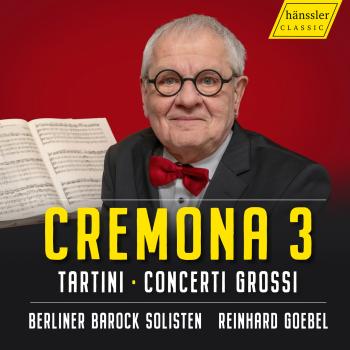
Biography Berliner Barocksolisten & Reinhard Goebel
Berliner Barock Solisten
A historically informed approach to performance using modern instruments—this was the vision behind the formation of the Berliner Barock Solisten in 1995, which brought together members of the Berlin Philharmonic and leading figures in the field of early music. The ensemble was initiated by Rainer Kussmaul, then First Concertmaster of the Berlin Philharmonic, and violinist Raimar Orlovsky. With Rainer Kussmaul—who led the group until 2012—at the helm, the ensemble was guided by a baroque specialist with extensive international experience. The members made a deliberate choice to interpret 17th- and 18th-century compositions on modern instruments while simultaneously embracing the principles of historically informed performance. In doing so, they cultivated a unique, distinctive sonic identity that has since become their hallmark.
Following Rainer Kussmaul’s retirement in 2012, the Berliner Barock Solisten began entrusting their artistic direction to various guest leaders on a project-by-project basis, including Bernhard Forck, Gottfried von der Goltz, Daishin Kashimoto, Noah Bendix-Balgley, and Wolfram Brandl. The ensemble has collaborated with a wide array of soloists, such as Anne-Sophie Mutter, Anne Sofie von Otter, Julia Lezhneva, Dorothee Oberlinger, Reinhold Friedrich, Andreas Staier, Daniil Trifonov, Frank Peter Zimmermann, and Janine Jansen, as well as various soloists from the Berlin Philharmonic.
Reinhard Goebel
is a living legend of early music and a dynamic conductor of modern symphony and chamber orchestras. Ever since he discovered his love for the Baroque violin as a youth, he has never ceased to meticulously address every detail—from bowing, fingering, and articulation down to the very last note—whether using period or "modern" instruments.
He is a fanatic for a highly structured sound, whether in string playing, ensemble work, or full orchestral performance. Since founding his ensemble, "Musica Antiqua Köln," half a century ago, he has consistently challenged established performance practices and set new benchmarks for musical brilliance, wit, and eloquence. Over the last two decades, he has brought this same approach to the podiums of modern orchestras.
For 33 years, "Musica Antiqua Köln"—the most virtuosic and influential Baroque ensemble ever founded in Germany—served as his primary vehicle. His discography is vast. In their day, these recordings pioneered a new, unsurpassed standard for historically informed performance: they were relentlessly unified, pristine, bold, and immediate. Goebel applied a tailored approach to every composer—from Biber to Bach—ensuring that every note, from the continuo to the first violin, was meticulously shaped. The performances were so full of verve that the live concert experience was every bit as compelling as the studio recordings. Goebel achieved the rare feat of maintaining the same presence and brilliance in the concert hall as on record—a true exception among the great figures of early music. Anyone who heard "Musica Antiqua" in its prime will never forget the *éclat triomphal* of its sound or the *élan terrible* of its tempos.
Even within the realm of chamber music, Baroque violinist Reinhard Goebel gave the complacent world of the 1980s a vigorous wake-up call—through his radiant tone and his fantastically varied bowing technique, whether in Bach’s *Musical Offering* and his sonatas for violin and harpsichord, in works by Telemann and Couperin, or even in pieces by Buffardin and Corrette. Exploring the side tracks—which, as it turned out, were often the main thoroughfares of music history—always provided Goebel with boundless intellectual pleasure. This enthusiasm became all the more infectious for audiences as "Musica Antiqua" evolved into a full-fledged Baroque orchestra: beginning with Telemann’s *Hamburg Ebb and Flow* (complete with a French overture devoid of any "over-dotting"), moving on to Bach’s orchestral suites and the extraordinary *Brandenburg Concertos*, and culminating in Telemann’s unsurpassable *Tafelmusik*, Heinichen’s *Dresden Concerti*, and a wealth of Italian music ranging from Valentini to Veracini. Renowned singers such as Anne Sofie von Otter, Magdalena Kožená, and Christine Schäfer took the place of the Baroque-specialist vocalists featured on earlier recordings, joining Goebel to perform works by Monteverdi, Vivaldi, Bach, and Handel.
These recordings already hinted at a shift toward a more "traditional" sound. In the new millennium, Reinhard Goebel naturally gravitated toward a new medium: the "modern" chamber and symphony orchestra. Having said everything he could possibly say within the sphere of early music—on gut strings and transverse flutes—he now applied that same meticulousness and uncompromising rigor to the "grand" sound of the modern orchestra. Applying the virtues of early music to "modern" string players became a new calling for this passionate violinist. At the helm of various radio symphony orchestras in Germany, he breathed new, vibrant life into the Mannheim school of music—works by composers such as Cannabich and Johann Christian Bach. He subsequently shook up the Viennese Classical repertoire, from Salieri to Mozart, while drawing attention to forgotten Italian and French composers who had long remained in Mozart’s shadow. It immediately became clear that he also had fresh, revelatory insights to offer regarding even the most well-known works of Mozart—from the violin concertos and the chaconne from *Idomeneo* to *Eine kleine Nachtmusik* and the grand finales of his major works. An ever-growing number of orchestras have joined him on these voyages of discovery, including the Bavarian Chamber Philharmonic, the Mozarteum Orchestra, the Karajan Academy of the Berlin Philharmonic, and the Frankfurt Radio Symphony. Abroad—in France, the Netherlands, Switzerland, and Italy—Goebel has also caused a stir with his bold, unconstrained approach to the Viennese Classical repertoire. This trajectory culminated in the Beethoven Year of 2020 with an extensive cycle featuring works by Beethoven’s contemporaries, such as Romberg, Hummel, Voříšek, Salieri, and many others. At the same time, he has remained faithful to Baroque music, reimagining it through the medium of modern chamber ensembles, such as the Berlin Baroque Soloists. Even when conducting Bach’s *St. Matthew Passion* with a modern orchestra, Reinhard Goebel remains what he has always been: an explorer in search of the authentic spirit and sound of music, spanning from Biber and Bach to Beethoven.
In his pursuit of this sonic ideal, Reinhard Goebel has always remained true to himself. It is fitting, therefore, that from 2010...
A key part of the ensemble’s mission is to perform works that have been unjustly forgotten—most notably those by Georg Philipp Telemann—and to explore pieces by lesser-known baroque composers. In 2014, the Berliner Barock Solisten performed for the first time with Reinhard Goebel, who subsequently assumed leadership of the ensemble in 2018. Over the years, the Barock Solisten have released numerous recordings, some of which have won prestigious awards. A recent highlight is the 2026 re-recording of Vivaldi’s *The Four Seasons*, featuring Daishin Kashimoto and released on the Berlin Philharmonic’s own label.