

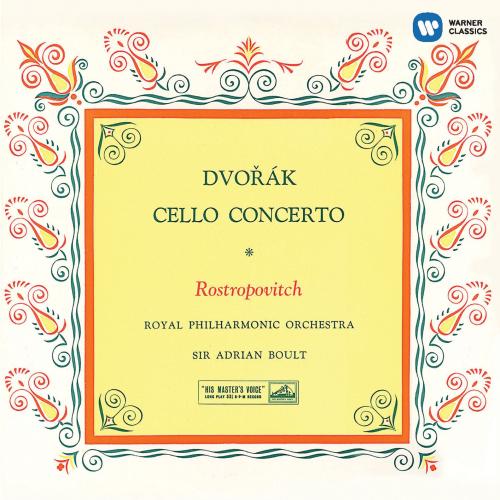
Dvorák: Cello Concerto Mstislav Rostropovich, Royal Philharmonic Orchestra & Sir Adrian Boult
Album info
Album-Release:
2017
HRA-Release:
16.10.2026
Label: Warner Classics
Genre: Classical
Subgenre: Concertos
Artist: Mstislav Rostropovich, Royal Philharmonic Orchestra & Sir Adrian Boult
Composer: Antonin Dvorak (1841-1904)
Album including Album cover
I`m sorry!
Dear HIGHRESAUDIO Visitor,
due to territorial constraints and also different releases dates in each country you currently can`t purchase this album. We are updating our release dates twice a week. So, please feel free to check from time-to-time, if the album is available for your country.
We suggest, that you bookmark the album and use our Short List function.
Thank you for your understanding and patience.
Yours sincerely, HIGHRESAUDIO
- Antonín Dvořák (1841-1904): Cello Concerto in B Minor, Op. 104:
- 1 Dvořák: Cello Concerto in B Minor, Op. 104: I. Allegro 14:44
- 2 Dvořák: Cello Concerto in B Minor, Op. 104, B. 191: II. Adagio ma non troppo 11:46
- 3 Dvořák: Cello Concerto in B Minor, Op. 104: III. Finale. Allegro moderato 12:32
Info for Dvorák: Cello Concerto
The Cello Concerto in B minor, Op. 104, B. 191, is the last solo concerto by Antonín Dvořák. It was written in 1894–95 for his friend, the cellist Hanuš Wihan.
That the cello's repertoire has been so wonderfully enriched during the 20th century is due largely to Mstislav Rostropovich, the most influential cellist of his time, a champion of liberty, and also a noted conductor and pianist. Born In Baku on 27 March 1927 to a pianist mother and a cello-playing father who had studied with Pablo Casals, 'Slava' received early paternal grounding in his chosen instrument.
Arguably the most beautiful cello concerto, featuring an instrument that ‘shrieks in the upper register and growls in the lower’ (Dvořák)
Dvořák was no fan of the cello. Nevertheless, he achieved a major success with this concerto. The circumstances were similar to those surrounding his 9th Symphony: a long stay in New York, a city he disliked, and a deep longing for his distant Czech homeland. The concerto was premiered in London in 1896, conducted by the composer himself.
The first movement is characterised by the energetic, powerful main theme – first presented by the orchestra – and a lyrical, delicate secondary theme played by the solo horn. Both themes are taken up by the solo cello. A beautiful, heartfelt melody played by the solo clarinet, which is then taken over again by the cello, defines the middle movement. Filled with joyful excitement – Dvořák was about to set off for his beloved homeland – the solo cello introduces us to the final movement with a march-like theme. In this movement, the composer incorporates themes from the preceding movements and leads us, via transfigured melodies from his homeland, to a finale of furious intensity.
With unrivalled expressiveness and technical brilliance, Mstislav Rostropovich interprets two of the most significant works in the cello repertoire. Under the baton of Sir Adrian Boult, the Dvořák Concerto unfolds with profound emotional tension, carried by Rostropovich’s warm, powerful tone. Every stroke of the bow tells a story – with melodious beauty and dramatic intensity.
Mstislav Rostropovich, cello
Royal Philharmonic Orchestra
Sir Adrian Boult, conductor
Digitally remastered
Mstislav Rostropovich
is internationally acclaimed and acknowledged as one of the world's greatest living cellists. He has given countless memorable performances and has inspired the world's leading composers to enlarge and enrich the standard cello repertoire with works specially composed for and dedicated to him. These include works by Britten, Bliss, Khachaturian, Lutoslawski, Prokofiev and Shostakovich. Rostropovich was soloist in the premieres of Prokofiev's second Cello Concerto in 1952, Shostakovich's two Cello Concertos in 1959 and 1966, Britten's Cello Symphony in 1964 and Bliss's Cello Concerto in 1970. Many other works have been written for him and today his repertoire includes more than 50 concertos, ranging from the baroque, through the classical and romantic periods, to the avant-garde. As a cellist, Rostropovich is noted for his commanding technique and intense, visionary playing.
Rostropovich was born in Baku, Azerbaijan in 1927. At the age of four he started piano lessons with his mother and shortly afterwards began to study the cello with his father. He continued under his father's tuition at the Central Music School in Moscow and then went on to the Moscow Conservatoire, where in addition to his cello and piano studies he began to conduct. He made his public debut as a cellist in 1942 at the age of 15 and was immediately recognized as a potentially great artist. When the war ended his reputation soon spread outside the USSR, principally through his recordings, and when he began touring in the West it was soon apparent that in Rostropovich the world had a natural successor to the great Pablo Casals, who had reigned as the supreme cellist for more than half a century.
Rostropovich has also won outstanding acclaim as a conductor, appearing with most of the world's leading orchestras, as well as conducting and recording many operas, including Queen of Spades, Eugene Onegin, Lady Macbeth of Mtsensk and Tosca. Since 1977 he has been Music Director of the National Symphony Orchestra of Washington. He appears regularly in the UK with the London Symphony Orchestra (he made his UK conducting debut in 1974) and with other leading British orchestras. The London Symphony Orchestra have forged close links with Rostropovich through major festivals which have made an enormous impact on London's musical life. Rostropovich was a close friend of Sergei Prokofiev and was the inspiration behind the LSO's Sergei Prokofiev: The Centenary Festival 1991, featuring orchestral and chamber music, and the world premiere of a cello fugue dedicated to Rostropovich. In 1993 Rostropovich led the Festival of Britten with the LSO, appearing both as conductor and soloist. Other events with the LSO have included Rostropovich's 60th Birthday series in 1987 and Shostakovich: Music from the Flames in 1988. Both on the cello and on the conductor's rostrum, Rostropovich is considered one of the leading interpreters of the music of Shostakovich (with whom he studied composition), Britten, and Prokofiev.
Mstislav Rostropovich is one of the world's most outspoken defenders of human and artistic freedoms. In 1974, after a period of four years during which the writer Solzhenitsyn resided in their home, Rostropovich and Vishnevskaya left the Soviet Union at their own request. Since then he has devoted much time and has given numerous performances to support humanitarian efforts around the world. In 1990, after an absence of 16 years, he made a triumphant return to the Soviet Union with the National Symphony Orchestra of Washington, giving concerts in Washington and Leningrad to enormous acclaim. During the coup of August 1991 the strength of his attachment to his native Russia compelled him to fly, without a visa, to Moscow, to spend those momentous days in the Russian Parliament building and on the streets, where he was hailed as a national hero.
Mstislav Rostropovich holds over 40 honorary degrees and over 30 different nations have bestowed more than 130 major awards and decorations upon him. These include the German Order of Merit, the Gold Medal of the Royal Philharmonic Society, the Lenin Prize, the Annual Award of the League of Human Rights, the ÆPreamium Imperiale from the Japan Arts Association and the Knight Commander of the Most Excellent Order of the British Empire. (Source: Cello.org)
This album contains no booklet.