
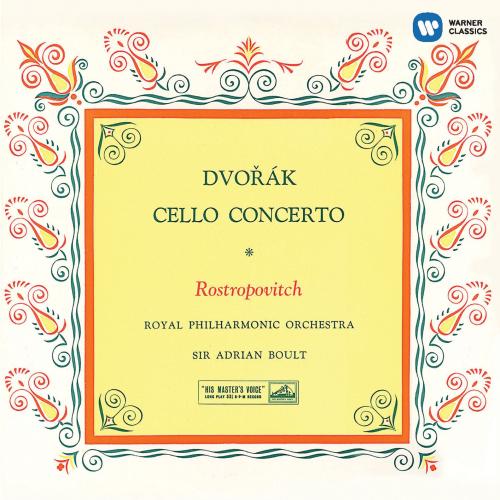
Dvorák: Cello Concerto Mstislav Rostropovich, Royal Philharmonic Orchestra & Sir Adrian Boult
Album Info
Album Veröffentlichung:
2017
HRA-Veröffentlichung:
16.10.2026
Label: Warner Classics
Genre: Classical
Subgenre: Concertos
Interpret: Mstislav Rostropovich, Royal Philharmonic Orchestra & Sir Adrian Boult
Komponist: Antonin Dvorak (1841-1904)
Das Album enthält Albumcover
Entschuldigen Sie bitte!
Sehr geehrter HIGHRESAUDIO Besucher,
leider kann das Album zurzeit aufgrund von Länder- und Lizenzbeschränkungen nicht gekauft werden oder uns liegt der offizielle Veröffentlichungstermin für Ihr Land noch nicht vor. Wir aktualisieren unsere Veröffentlichungstermine ein- bis zweimal die Woche. Bitte schauen Sie ab und zu mal wieder rein.
Wir empfehlen Ihnen das Album auf Ihre Merkliste zu setzen.
Wir bedanken uns für Ihr Verständnis und Ihre Geduld.
Ihr, HIGHRESAUDIO
- Antonín Dvořák (1841-1904): Cello Concerto in B Minor, Op. 104:
- 1 Dvořák: Cello Concerto in B Minor, Op. 104: I. Allegro 14:44
- 2 Dvořák: Cello Concerto in B Minor, Op. 104, B. 191: II. Adagio ma non troppo 11:46
- 3 Dvořák: Cello Concerto in B Minor, Op. 104: III. Finale. Allegro moderato 12:32
Info zu Dvorák: Cello Concerto
Das Cellokonzert in h-Moll, op. 104, B. 191, ist das letzte Solokonzert von Antonín Dvořák. Es entstand 1894–95 für seinen Freund, den Cellisten Hanuš Wihan.
Dass das Repertoire für Cello im Laufe des 20. Jahrhunderts so wunderbar bereichert wurde, ist vor allem Mstislav Rostropovich zu verdanken, dem einflussreichsten Cellisten seiner Zeit, einem Verfechter der Freiheit und zugleich einem angesehenen Dirigenten und Pianisten. „Slava“ wurde am 27. März 1927 in Baku als Sohn einer Pianistin und eines Cellisten geboren, der bei Pablo Casals studiert hatte, und erhielt schon früh von seinem Vater eine fundierte Ausbildung auf seinem Wahlinstrument.
Das wohl schönste Cellokonzert mit einem Instrument, das "oben kreischt und unten brummt" (Dvorák)
Dvorak war kein Freund des Cellospiels. Trotzdem gelang ihm mit diesem Konzert der ganz große Wurf. Ähnlich wie in seiner 9. Sinfonie waren die Begleitumstände: Langer Aufenthalt im ungeliebten New York und große Heimweh nach der fernen tschechischen Heimat. Das Konzert wurde 1896 unter Leitung des Komponisten in London uraufgeführt.
Der erste Satz wird geprägt vom energischen, kraftvollen Hauptthema - zuerst vorgetragen vom Orchester - und einem lyrischen zarten Nebenthema des Solohorns. Beide Themen werden vom Solocello fortgeführt. Eine wunderschöne innige Melodie der Soloklarinette, die wieder das Cello übernimmt, bestimmen den Mittelsatz. Freudig erregt - Dvorak stand kurz vor der Abreise in die geliebte Heimat - führt uns das Solocello mit einem marschartigen Thema in den Schlußsatz ein. In diesem arbeitet der Komponist Themen aus den vorangegangenen Sätzen ein und leitet uns nach verklärten Melodien aus seiner Heimat zum furios gesteigertem Schlußbild.
Mit unvergleichlicher Ausdruckskraft und technischer Brillanz interpretiert Mstislav Rostropovich zwei der bedeutendsten Werke des Cellorepertoires. Unter der Leitung von Sir Adrian Boult entfaltet das Dvořák-Konzert eine tiefe emotionale Spannung, getragen von Rostropovichs warmem, kraftvollem Ton. Jeder Bogenstrich erzählt – mit kantabler Schönheit und dramatischer Intensität.
Mstislaw Rostropowitsch, Violoncello
Royal Philharmonic Orchestra
Sir Adrian Boult, Dirigent
Digital remastert
Mstislav Rostropovich
is internationally acclaimed and acknowledged as one of the world's greatest living cellists. He has given countless memorable performances and has inspired the world's leading composers to enlarge and enrich the standard cello repertoire with works specially composed for and dedicated to him. These include works by Britten, Bliss, Khachaturian, Lutoslawski, Prokofiev and Shostakovich. Rostropovich was soloist in the premieres of Prokofiev's second Cello Concerto in 1952, Shostakovich's two Cello Concertos in 1959 and 1966, Britten's Cello Symphony in 1964 and Bliss's Cello Concerto in 1970. Many other works have been written for him and today his repertoire includes more than 50 concertos, ranging from the baroque, through the classical and romantic periods, to the avant-garde. As a cellist, Rostropovich is noted for his commanding technique and intense, visionary playing.
Rostropovich was born in Baku, Azerbaijan in 1927. At the age of four he started piano lessons with his mother and shortly afterwards began to study the cello with his father. He continued under his father's tuition at the Central Music School in Moscow and then went on to the Moscow Conservatoire, where in addition to his cello and piano studies he began to conduct. He made his public debut as a cellist in 1942 at the age of 15 and was immediately recognized as a potentially great artist. When the war ended his reputation soon spread outside the USSR, principally through his recordings, and when he began touring in the West it was soon apparent that in Rostropovich the world had a natural successor to the great Pablo Casals, who had reigned as the supreme cellist for more than half a century.
Rostropovich has also won outstanding acclaim as a conductor, appearing with most of the world's leading orchestras, as well as conducting and recording many operas, including Queen of Spades, Eugene Onegin, Lady Macbeth of Mtsensk and Tosca. Since 1977 he has been Music Director of the National Symphony Orchestra of Washington. He appears regularly in the UK with the London Symphony Orchestra (he made his UK conducting debut in 1974) and with other leading British orchestras. The London Symphony Orchestra have forged close links with Rostropovich through major festivals which have made an enormous impact on London's musical life. Rostropovich was a close friend of Sergei Prokofiev and was the inspiration behind the LSO's Sergei Prokofiev: The Centenary Festival 1991, featuring orchestral and chamber music, and the world premiere of a cello fugue dedicated to Rostropovich. In 1993 Rostropovich led the Festival of Britten with the LSO, appearing both as conductor and soloist. Other events with the LSO have included Rostropovich's 60th Birthday series in 1987 and Shostakovich: Music from the Flames in 1988. Both on the cello and on the conductor's rostrum, Rostropovich is considered one of the leading interpreters of the music of Shostakovich (with whom he studied composition), Britten, and Prokofiev.
Mstislav Rostropovich is one of the world's most outspoken defenders of human and artistic freedoms. In 1974, after a period of four years during which the writer Solzhenitsyn resided in their home, Rostropovich and Vishnevskaya left the Soviet Union at their own request. Since then he has devoted much time and has given numerous performances to support humanitarian efforts around the world. In 1990, after an absence of 16 years, he made a triumphant return to the Soviet Union with the National Symphony Orchestra of Washington, giving concerts in Washington and Leningrad to enormous acclaim. During the coup of August 1991 the strength of his attachment to his native Russia compelled him to fly, without a visa, to Moscow, to spend those momentous days in the Russian Parliament building and on the streets, where he was hailed as a national hero.
Mstislav Rostropovich holds over 40 honorary degrees and over 30 different nations have bestowed more than 130 major awards and decorations upon him. These include the German Order of Merit, the Gold Medal of the Royal Philharmonic Society, the Lenin Prize, the Annual Award of the League of Human Rights, the ÆPreamium Imperiale from the Japan Arts Association and the Knight Commander of the Most Excellent Order of the British Empire. (Source: Cello.org)
Dieses Album enthält kein Booklet