


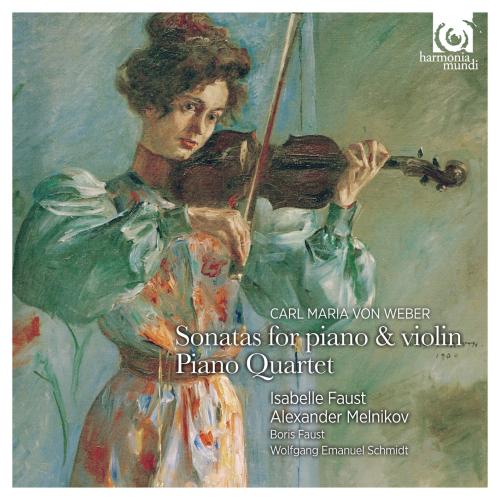
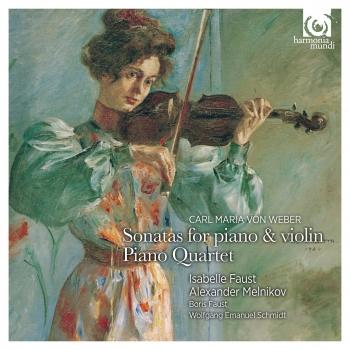
Weber: Sonatas for piano & violin - Piano Quartet Isabelle Faust & Alexander Melnikov
Album info
Album-Release:
2013
HRA-Release:
01.10.2013
Album including Album cover Booklet (PDF)
- 1 I. Allegro con fuoco 03:47
- 2 II. Largo 01:15
- 3 III. Polacca 03:42
- 4 I. Air Russe - Allegretto moderato 02:11
- 5 II. Rondo - Presto 02:28
- 6 I. Moderato 04:18
- 7 II. Rondo - Vivace 01:49
- 8 I. Allegro con fuoco 09:37
- 9 II. Adagio ma non troppo 07:00
- 10 III. Menuetto. Allegro 02:19
- 11 IV. Finale. Presto 07:42
- 12 I. Carratere Espagnolo - Moderato 03:19
- 13 Sonata Op.10 No.2 in G major - II. Adagio 02:40
- 14 Sonata Op.10 No.2 in G major - III. Air Polonais - Rondo Allegro 02:01
- 15 I. Tema dell'Opera Silvana - Andante con moto 05:52
- 16 II. Finale - Siciliano - Allegretto 02:17
- 17 I. Allegro 03:29
- 18 II. Romanze - Larghetto 01:34
- 19 III. Rondo - Amabile 02:49
Info for Weber: Sonatas for piano & violin - Piano Quartet
The unjustly neglected piano quartet (J76) was completed in September of the year 1809, which the 22-year-old Weber spent in Stuttgart. It was originally offered to the publisher Hans Georg Nägeli, but he rejected it, advising the composer that it created wanton ‘confusion in the arrangement of its ideas’ and indeed too obviously imitated the ‘bizarreries’ of Beethoven. However, the work was issued a year later by the Bonn firm of Beethoven’s friend and admirer Nikolaus Simrock, whose ears were more receptive to the peculiarities of the score than Nägeli. And in the following year, 1811, Simrock once again stepped into the breach in the matter of the publication of the Six Violin Sonatas (J99–104). These were written to a tight deadline in the late summer of 1810, on commission from the Offenbach publisher Johann Anton André, who had in mind a collection of short pieces of moderate difficulty for the domestic music-making of the upper middle classes. Unhappy with the concomitant artistic limitations, Weber took the commission only half-heartedly and repeatedly complained during the compositional process of this ‘swine of a job’, which cost him ‘more sweat than the same number of symphonies’. His annoyance was all the greater when André rejected the finished work out of hand because it did not correspond to his expectations.
When Simrock finally published these pieces in Bonn in two instalments under the title 'Progressive sonatas for fortepiano with obbligato violin, composed for and dedicated to amateur musicians', with the opus number 10, Weber had only remotely followed André’s specifications. It is true that the technical demands on the performers, especially the violin, are fairly modest, but in terms of content the 6 short two- or three-movement sonatinas far outstrip mere pedagogical intentions.They were written to please amateurs, but quite as much to satisfy connoisseurs of any era.
Isabelle Faust follows up the success of recent recordings for hm [Bach volume 2, Berg and Beethoven with Claudio Abbado] with regular partner Alexander Melnikov and her brother Boris, currently principal viola of the Bremer Philharmoniker, and Wolfgang Emanuel Schmidt of whom Mstislav Rostropovich has said: ‘Wolfgang Emanuel Schmidt is one of the leading cellists of his generation, of our time’.
“Chamber music by Weber arrives as frequently as a blue moon. It’s almost as lovely, too, especially when Faust’s Stradivarius violin and Melnikov’s fortepiano duck and weave through these six pocket sonatas...Trinket music? Partly, yes; but very inventive, full of colour and surprises...The recording’s intimate, clear, and full-bodied: the musicians seem right in your living room.” (The Times)
“sensitive, expressive interpretations … They show remarkable unanimity and flair in Weber’s serene Piano Quartet, balancing Classical elegance, wit and sheer effervescence in the outer movements.” (theStrad)
Isabelle Faust, violin
Alexander Melnikov, fortepiano
Boris Faust, viola
Wolfgang Emanuel Schmidt, cello
Isabelle Faust
After early successes at the Leopold Mozart Violin Competition in Augsburg and the Paganini Competition in Genoa, Isabelle Faust soon began performing with renowned orchestras, including the Berlin Philharmonic, the Boston Symphony Orchestra, the NHK Symphony Orchestra, the Chamber Orchestra of Europe, and the Freiburg Baroque Orchestra. She has enjoyed close collaborations with conductors such as Sir Simon Rattle, Andris Nelsons, Giovanni Antonini, François-Xavier Roth, Sir John Eliot Gardiner, Daniel Harding, Philippe Herreweghe, Jakub Hrusa, Klaus Mäkelä, and Robin Ticciati. Her repertoire encompasses music from all eras, from the works of Biber and Bach to the great Classical-Romantic violin concertos and contemporary compositions. Most recently, she has premiered works by Peter Eötvös, Brett Dean, Ondřej Adámek, and Rune Glerup. Isabelle Faust's numerous recordings, including Bach's solo sonatas and partitas, the violin concertos by Berg and Beethoven with Claudio Abbado and the Berlin Philharmonic, and violin sonatas by Mozart, Beethoven, and Brahms with pianist Alexander Melnikov, have received awards such as the Gramophone Award, the Diapason d'Or, and the Choc de l'année. She is currently Artist in Residence with the SWR Symphony Orchestra.
Alexander Melnikov
graduated from the Moscow Conservatory under Lev Naumov. His most formative musical moments in Moscow include an early encounter with Svjatoslav Richter, who thereafter regularly invited him to festivals in Russia and France. He was awarded important prizes at eminent competitions such as the International Robert Schumann Competition in Zwickau (1989) and the Concours Musical Reine Elisabeth in Brussels (1991).
Known for his often-unusual musical and programmatic decisions, Alexander Melnikov developed his career-long interest in historically informed performance practice early on. His major influences in this field include Andreas Staier and Alexei Lubimov. Melnikov performs regularly with distinguished period ensembles including the Freiburger Barockorchester, Musica Aeterna and Akademie für Alte Musik Berlin.
As a soloist, Alexander Melnikov has performed with orchestras including the Royal Concertgebouw Orchestra, Gewandhausorchester Leipzig, Philadelphia Orchestra, NDR Elbphilharmonie Orchester, HR-Sinfonieorchester, Munich Philharmonic, Rotterdam Philharmonic and BBC Philharmonic, under conductors such as Mikhail Pletnev, Teodor Currentzis, Charles Dutoit, Paavo Järvi and Valery Gergiev.
Together with Andreas Staier, Alexander Melnikov recorded a unique all-Schubert programme of four-hand pieces, which they have also performed in concert. An essential part of Melnikov’s work is intensive chamber music collaboration with partners including cellist Jean-Guihen Queyras.
Alexander Melnikov’s association with the label harmonia mundi arose through his regular recital partner, violinist Isabelle Faust, and in 2010 their complete recording of the Beethoven sonatas for violin and piano won a Gramophone Award. This album, which has become a landmark recording for these works, was also nominated for a Grammy. Their most recent releases feature Brahms and Mozart sonatas for violin and piano.
Melnikov’s recording of the Preludes and Fugues by Shostakovich was awarded the BBC Music Magazine Award, Choc de classica and the Jahrespreis der Deutschen Schallplattenkritik. In 2011, it was also named by the BBC Music Magazine as one of the “50 Greatest Recordings of All Time.” Additionally, his discography features works by Brahms, Rachmaninov, Shostakovich and Scriabin. Along with Isabelle Faust, Jean-Guihen Queyras, Pablo Heras-Casado and the Freiburger Barockorchester, Melnikov recorded a trilogy of albums featuring the Schumann Concertos and Trios (published in 2015-16) and Beethoven’s Triple Concerto (2021). Other releases include a complete recording of Prokofiev’s piano sonatas and “Four Pieces, Four Pianos”, released in 2018 and highly acclaimed by critics.
In the 2021/22 season Alexander Melnikov will tour his project “Many Pianos”, where he performs a solo recital on different instruments reflecting the periods in which the works were written. In addition to concerts with the Orquestra Sinfonica do Estado de Sao Paulo, Sydney Symphony Orchestra and Basel Sympony Orchestra he is Artist in Residence at the 2022 Schwetzinger Festspiele.
Further highlights include performances at Muziekgebow Amsterdam, Wigmore Hall London and Konzerthaus Berlin, a concert tour to Japan with Andreas Staier, as well as concerts Isabelle Faust and Jean-Guihen Queyras.
Booklet for Weber: Sonatas for piano & violin - Piano Quartet