


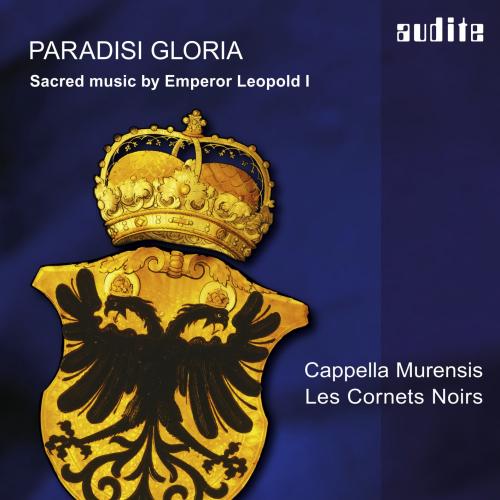
Paradisi Gloria Cappella Murensis & Les Cornets Noirs
Album info
Album-Release:
2016
HRA-Release:
20.07.2016
Label: audite Musikproduktion
Genre: Classical
Subgenre: Choral
Artist: Cappella Murensis & Les Cornets Noirs
Composer: Leopold I. (1640-1705)
Album including Album cover Booklet (PDF)
- Leopold I. (1640-1705): Stabat Mater, W 47
- 1 Sonata 00:44
- 2 Stabat mater dolorosa 02:01
- 3 Quis not potest contristari 00:39
- 4 Pro peccati suae gentis 02:45
- 5 Tui nati vulnerati 00:46
- 6 Fac me vere tecum flere 02:50
- 7 Inflammatus et accensus 00:37
- 8 Fac me cruce custodiri 00:27
- 9 Quando corpus morietur 02:08
- 10 Sonata 01:11
- 11 Vertatur in luctum cythara nostra 00:48
- 12 Lachrymantem et dolentem 02:05
- 13 Acutissimi dolores 00:52
- 14 Ritornello 00:39
- 15 Afflicitissima tristatur 00:57
- 16 Fontes lachrymarum 00:59
- 17 Dicite, filiae Sion 00:30
- 18 Fons signatus 00:40
- 19 Maerores igitur Mariae 03:29
- 20 Sonata I 00:52
- 21 Requiem aeternam I 01:28
- 22 Te decet hymnus 02:00
- 23 Requiem aeternam II 01:31
- 24 Kyrie I 00:38
- 25 Christe 00:42
- 26 Kyrie II 00:44
- 27 Sonata II 00:40
- 28 Sanctus 00:53
- 29 Pleni sunt caeli 00:39
- 30 Hosanna I 00:42
- 31 Benedictus 00:58
- 32 Hosanna II 00:44
- 33 Agnus Dei 03:14
- 34 Sonata 00:40
- 35 Lux aeterna 00:36
- 36 Cum sanctis tuis I 01:17
- 37 Requiem aeternam 01:30
- 38 Cum sanctis tuis II 01:50
- 39 Sonata I 01:31
- 40 Lectio prima: Parce mihi, Domine 04:22
- 41 Responsorium: Credo, credo 03:36
- 42 Sonata II 00:29
- 43 Lectio secunda: Taedet anima mea 04:25
- 44 Responsorium: Qui Lazarum resuscitasti 02:36
- 45 Sonata III 00:37
- 46 Lectio tertia: Manus tuae, Domine 04:07
- 47 Responsorium: Domine, quando veneris 06:42
Info for Paradisi Gloria
A well-regarded composer in his own right, Leopold I transformed the Viennese court into a centre of European culture. The beautiful settings he wrote for the burials of his first two wives, as well as his music for the Feast of the Seven Sorrows of the Blessed Virgin Mary, are testament to the Emperors musical talent. Born in 1641 in Vienna as the second son of Emperor Ferdinand II, Leopold I was initially destined for a theological career and hence received a suitable education to this end. He was nominated as successor to his father, who had died the previous year, as Holy Roman Emperor in 1658 in Frankfurt only after the death of his elder brother, Ferdinand. He reigned until his death in 1705 as a controversial ruler, because he was indecisive and less interested in politics than in music, feast days, religion, and hunting. He inherited a gift for music from his father and was inculcated with the love of music by him; Ferdinand III had prepared the way as a poet of Italian texts and composer. Leopold devoted himself to music and to the musicians of his Hofkapelle (Court Chapel) with even greater commitment. As a child he was taught the harpsichord by the court organist Marcus Ebner and probably received lessons in composition from the Hofkapellmeister (Director of Music at the Court Chapel) Antonio Bertali.
Sixty-nine of Leopold Is numerous autonomous compositions have survived. Most of them are smaller works of church music, but we know of at least an ordinary mass and a requiem, ten oratorios and sepolcri (oratorios before the Holy Sepulchre), an Italian opera and an act of a further one, two serenatas, two Spanish intermezzos and six theatre works in addition nevertheless. We also know of one further opera of his composing, but only one aria from it has survived. Beyond this, though, the emperor contributed individual arias or scenes to most of the over 200 operas that were performed during his reign. This album gives an overview of the liturgical compositions that he penned. The idea that Leopold composed sad melodies particularly aptly, as a diplomat reported, is confirmed by the compositions recorded here, the texts of which all concern death either that of Jesus Christ or the human one.
„Monarchs don't always make great composers, though Henry VIII did pretty well....Leopold cultivates minor-mode choral writing, but in the fine Requiem at the heart of this disc he lets the sun shine in with brief sections in the major, rather like his contemporary Heinrich Biber's Requiem.“ (Nicholas Kenyon, The Observer)
Cappella Murensis
Les Cornets Noirs
Johannes Strobl, musical director
Cappella Murensis
The Cappella Murensis was founded by Johannes Strobl in 2002 as the professional vocal ensemble of the Abbey Church of Muri. According to the musical task in hand, the Cappella Murensis performs as an ensemble of vocal soloists, a chamber choir, or a Gregorian choir. One of the main focuses of Johannes Strobl and the Cappella Murensis is church music of the 16th to the 18th centuries, which is particularly suited to performance in the Abbey Church of Muri. In this period, the contribution of his- torical organs belongs of course de facto to the musical practice: alongside all forms of polychorality, particular attention is devoted to the connection between organ music and Gregorian chant that forms part of the Benedictine heritage of the Abbey Church of Muri.
With the Cappella Murensis, Johannes Strobl regularly organises performances of liturgical compositions that have been re-discovered in Swiss monasteries, which are also documented in radio recordings. Thus the ensemble has performed at the Festi- val international des musiques sacreés in Fribourg, at the International Bach Festival in Schaffhausen, in the banqueting hall of the monastery at Einsiedeln, in St. Gallen Cathedral, and at the Early Music Festival in Utrecht.
In collaboration with Thilo Hirsch and the ensemble arcimboldo, the Cappella Murensis has previously issued a recording of Johann Valentin Rathgeber’s “Missa solennis in D” op. 12/12 with audite. A second SACD, “Polychoral Splendour”, with polychoral works by Heinrich Schütz and Giovanni Gabrieli, was awarded the distinc- tion of the International Classical Music Award 2013.
Les Cornets Noirs
In recent years the instrumental ensemble Les Cornets Noirs, which specialises in Italian and German Early Baroque music, has made a name for itself internationally. Founded in 1997 by Gebhard David and Bork-Frithjof Smith, the main interest of the group lies in solo and ensemble literature for the cornett (It. cornetto, Fr. cornet – also called “black cornett” because of its leather covering), which experienced its hey-day from the middle of the 16th to the late 17th century north and south of the Alps.
Les Cornets Noirs were prize winners in the concours musica antiqua at the Festival van Vlaanderen Brugge 2000. Since then, the ensemble has performed at festivals in Switzerland, Austria, Germany, the Czech Republic, Poland, France, Luxemburg, Italy, and Portugal, both with their own programmes and in collaboration with vocal groups for the performance of large-scale Early Baroque works by Giovanni Gabrieli, Heinrich Schütz, Claudio Monteverdi, Georg Muffat, Heinrich Ignaz Franz Biber, and their contemporaries.
Les Cornets Noirs have also already issued two successful recordings with audite („Echo & Risposta“ and „Polychoral Splendour“).
Johannes Strobl
The Austrian-born musician Johannes Strobl received his rst piano and organ lessons at the music school of Spittal an der Drau with Hermann Zeyß. He graduated from the Hochschule für Musik und Darstellende Kunst “Mozarteum” in Salzburg with Heribert Metzger and was awarded distinctions in both his teaching and soloist di- ploma in organ and his advanced degree in Catholic Church Music. This was followed by comprehensive studies in Early Music at the Schola Cantorum Basiliensis with Jean-Claude Zehnder (organ), Jörg-Andreas Bötticher (harpsichord), Jesper Chris- tensen ( gured bass) and Rudolf Lutz (improvisation), and additional masterclasses with Michael Radulescu, Luigi Ferdinando Tagliavini, Harald Vogel, Almut Rössler and James David Christie.
Johannes Strobl was a prize winner at the Paul Hofhaimer competition in Innsbruck in 1998. His musical activities as a soloist and ensemble player have taken him to many European countries and further a eld to Israel, Japan, the US, Brasil, and Argentina.
Since 2001, Johannes Strobl has been employed as Director of Music of the Catholic parish of Muri in the Swiss canton of Aargau. In this role, he oversees the important historical organs of the church of the former Benedictine monastery and is artistic director of a distinguished concert series. He also teaches Improvisation and Liturgical Organ Playing at the Hochschule Luzern in the music faculty’s department of church music.
Booklet for Paradisi Gloria