






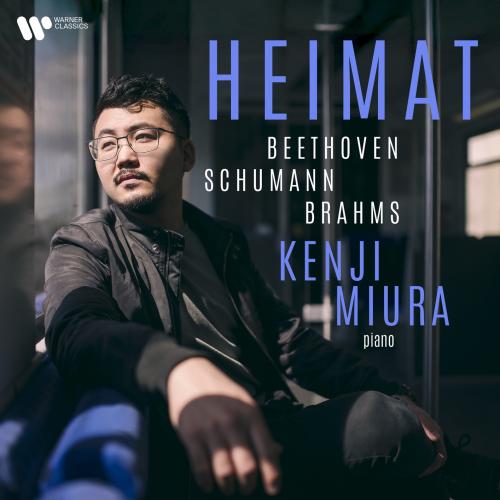
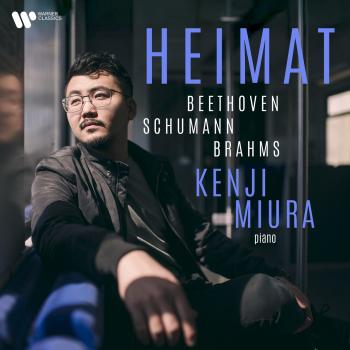
Heimat: Beethoven, Schumann & Brahms Kenji Miura
Album info
Album-Release:
2026
HRA-Release:
23.01.2026
Label: Warner Classics
Genre: Classical
Subgenre: Instrumental
Artist: Kenji Miura
Composer: Ludwig van Beethoven (1770-1827), Robert Schumann (1810-1856), Johannes Brahms (1833-1897)
Album including Album cover Booklet (PDF)
I`m sorry!
Dear HIGHRESAUDIO Visitor,
due to territorial constraints and also different releases dates in each country you currently can`t purchase this album. We are updating our release dates twice a week. So, please feel free to check from time-to-time, if the album is available for your country.
We suggest, that you bookmark the album and use our Short List function.
Thank you for your understanding and patience.
Yours sincerely, HIGHRESAUDIO
- Ludwig van Beethoven (1770 - 1827): Piano Sonata No. 23 in F Minor, Op. 57 "Appassionata":
- 1 Beethoven: Piano Sonata No. 23 in F Minor, Op. 57 "Appassionata": I. Allegro assai 09:46
- 2 Beethoven: Piano Sonata No. 23 in F Minor, Op. 57 "Appassionata": II. Andante con moto 05:57
- 3 Beethoven: Piano Sonata No. 23 in F Minor, Op. 57 "Appassionata": III. Allegro ma non troppo 05:12
- Robert Schumann (1810 - 1856): Kinderszenen, Op. 15:
- 4 Schumann: Kinderszenen, Op. 15: No. 1, Von fremden Ländern und Menschen 01:38
- 5 Schumann: Kinderszenen, Op. 15: No. 2, Kuriose Geschichte 01:08
- 6 Schumann: Kinderszenen, Op. 15: No. 3, Hasche-Mann 00:32
- 7 Schumann: Kinderszenen, Op. 15: No. 4, Bittendes Kind 00:47
- 8 Schumann: Kinderszenen, Op. 15: No. 5, Glückes genug 00:58
- 9 Schumann: Kinderszenen, Op. 15: No. 6, Wichtige Begebenheit 00:56
- 10 Schumann: Kinderszenen, Op. 15: No. 7, Träumerei 03:02
- 11 Schumann: Kinderszenen, Op. 15: No. 8, Am Kamin 00:51
- 12 Schumann: Kinderszenen, Op. 15: No. 9, Ritter vom Steckenpferd 00:45
- 13 Schumann: Kinderszenen, Op. 15: No. 10, Fast zu ernst 01:43
- 14 Schumann: Kinderszenen, Op. 15: No. 11, Fürchtenmachen 01:39
- 15 Schumann: Kinderszenen, Op. 15: No. 12, Kind im Einschlummern 01:59
- 16 Schumann: Kinderszenen, Op. 15: No. 13, Der Dichter spricht 02:38
- Johannes Brahms (1833 - 1897): 7 Fantasien, Op. 116:
- 17 Brahms: 7 Fantasien, Op. 116: No. 1, Capriccio. Presto energico in D Minor 02:24
- 18 Brahms: 7 Fantasien, Op. 116: No. 2, Intermezzo. Andante in A Minor 04:13
- 19 Brahms: 7 Fantasien, Op. 116: No. 3, Capriccio. Allegro passionato in G Minor 03:21
- 20 Brahms: 7 Fantasien, Op. 116: No. 4, Intermezzo. Adagio in E Major 05:08
- 21 Brahms: 7 Fantasien, Op. 116: No. 5, Intermezzo. Andante con grazia ed intimissimo sentimento in E Minor 03:32
- 22 Brahms: 7 Fantasien, Op. 116: No. 6, Intermezzo. Andantino teneramente in E Major 03:22
- 23 Brahms: 7 Fantasien, Op. 116: No. 7, Capriccio. Allegro agitato in D Minor 02:16
- 5 Lieder, Op. 49:
- 24 Brahms: 5 Lieder, Op. 49: No. 4, Wiegenlied (Arr. Cortot for Piano) 03:00
Info for Heimat: Beethoven, Schumann & Brahms
The concept of Heimat—the German word for ‘homeland’—is a universal and deeply personal idea. Pianist Kenji Miura explores this theme, not as a geographical fact, but as a state of being we can choose for ourselves.
A Long-Thibaud-Crespin Competition winner, Miura is an artist whose own life mirrors this global search, having lived across continents before settling in Berlin. He sees the album as a musical exploration into the concept of a chosen home.
The works on the album by three iconic German composers—Beethoven, Schumann, and Brahms—provide a musical compass for this journey. From the powerful pursuit in Beethoven's Appassionata to the profound introspection of Brahms's Seven Fantasies, the album’s narrative traces a path to understanding what it means to belong.
This musical journey has taken on an even deeper dimension as Miura embarks on his new role as a father. His choice of repertoire serves as a deeply personal reflection of this new perspective. Through the innocent vision of Schumann’s Kinderszenen, Miura re-examines the world through a child’s eyes, bringing a tender touch to iconic pieces like Träumerei. He finds a sense of profound peace in Brahms’s tender Wiegenlied, a universal lullaby that embodies the ultimate sense of comfort and security.
Through this music, Miura invites listeners to consider their own personal path to finding a Heimat—a place in the world and in music that they can call their own.
Kenji Miura, piano
Please Note: we do not offer the 192kHz version of this album, because our analysis clearly showed, that the 192kHz does not reach a frequency spectrum, that would justify to offer 192kHz. Hence we offer the 96kHz version.

Kenji Miura
As the winner of the Grand Prix and three further Special Prizes at the legendary Long-Thibaud-Crespin Competition 2019 where Martha Argerich served as President of the jury, Kenji Miura has emerged as a new type of Artist known for his sensibility and artistry. Other notable prizes include Gold Medal with Distinction at the 4th Manhattan International Music Competition, 1st Prize at International Shigeru Kawai Piano Competition 2017, 1st Prize at the Berlin Steinway Competition 2017, Outstanding Diploma and Alink-Argerich-Foundation Award at the Hamamatsu International Piano Competition 2015.
Born in Kobe, Japan in 1993, he began playing the piano at the age of 4 at his own will. He went on to study at the Purcell School of Music in London where he received a scholarship funded by the UK Government’s Music and Dance Scheme, and studied the piano with Roshan Magub and William Fong. In 2011 the Royal Academy of Music in London, University of Arts in Berlin and the prestigious Curtis Institute of Music in Philadelphia accepted him as a student, whereupon he decided to continue his studies under the guidance of Klaus Hellwig in Berlin. In the summer of 2012, he left the music world and spent over a year working in Japan. In his spare time he volunteered to work with children in need. In April 2014, he made his return to the piano and since studies at Hochschule für Musik “Hanns Eisler” in Berlin under the tutelage of Eldar Nebolsin. Other musical figures that guided him during his studies include Charles Rosen, Dimitri Alexeev, Pascal Devoyon, Laurent Boullet, Peter Nagy and Claudio Martinez Mehner.
His many invitations around the world include Wigmore Hall in London, Philharmonie and Konzerthaus in Berlin, Radio France Auditorium in Paris, Queen Elizabeth Hall and Purcell Room at the Southbank Centre in London.
Past and upcoming engagements include appearances with Orchestre National de France, Moscow Virtuosi, New Japan Philharmonic Orchestra and Osaka Philharmonic Orchestra under renowned conductors such as Vladimir Spivakov, Hubert Soudant, Jesko Sirvend, Kahchun Wong and Junichi Hirokami. Appearances at major festivals including Klavierfestival Ruhr, International Keyboard Festival in New York, Festival Chopin de Lyon, Festival International de Musique Dinard, Vilnius Piano Festival, Chopin Festival in Tokyo and Argerich’s Meeting Point in Beppu by Argerich Arts Foundation.
Booklet for Heimat: Beethoven, Schumann & Brahms