




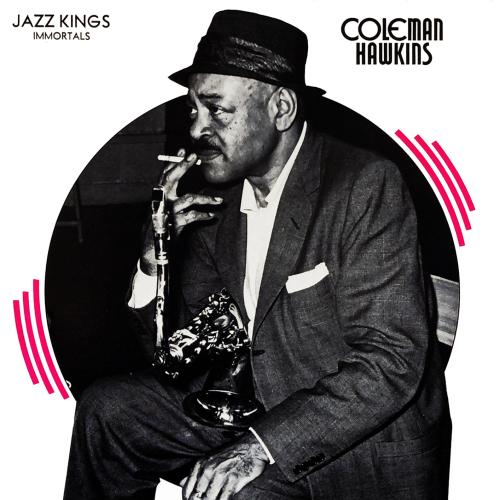
Coleman Hawkins (Remastered) Coleman Hawkins
Album info
Album-Release:
1965
HRA-Release:
09.03.2021
Album including Album cover
- 1 Runnin' Wild 03:21
- 2 I'll Never Be The Same 07:16
- 3 Blue Room 04:46
- 4 When Your Lover Has Gone 05:00
- 5 The Breeze And I 03:16
- 6 What's New 05:51
- 7 I'll String Along With You 04:51
- 8 My Own Blues 06:08
Info for Coleman Hawkins (Remastered)
Coleman Hawkins was the first important tenor saxophonist and he remains one of the greatest of all time. A consistently modern improviser whose knowledge of chords and harmonies was encyclopedic, Hawkins had a 40-year prime (1925-1965) during which he could hold his own with any competitor.
Coleman Hawkins started piano lessons when he was five, switched to cello at age seven, and two years later began on tenor. At a time when the saxophone was considered a novelty instrument, used in vaudeville and as a poor substitute for the trombone in marching bands, Hawkins sought to develop his own sound. A professional when he was 12, Hawkins was playing in a Kansas City theater pit band in 1921, when Mamie Smith hired him to play with her Jazz Hounds. Hawkins was with the blues singer until June 1923, making many records in a background role and he was occasionally heard on instrumentals. After leaving Smith, he freelanced around New York, played briefly with Wilbur Sweatman, and in August 1923 made his first recordings with Fletcher Henderson. When Henderson formed a permanent orchestra in January 1924, Hawkins was his star tenor. ...
Coleman Hawkins, tenor saxophone
Eddie Bert, trombone
Ernie Royal, trumpet
Sidney Gross, guitar
Earl Knight, piano, organ
Wendell Marshall, double bass
Osie Johnson, drums
Digitally remastered
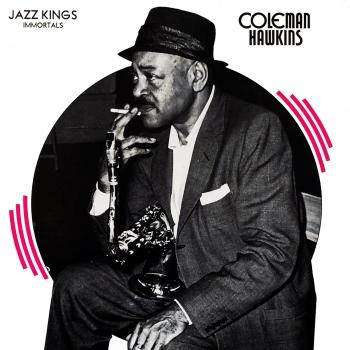
Coleman Hawkins
was born in St. Joseph Missouri in 1904. He attended High School in Topeka Kansas, and subsequently had two years of college music education at Washburn College. Shortly after this period, he would relocate to New York City, where he would begin a long and prosperous tenure with Fletcher Henderson’s Orchestra. He would come in contact with Louis Armstrong during this time, and it would have an incredible impact on Hawkins. He would later go on to tour extensively in Europe before returning to America for another long stretch. Coleman Hawkins is thought of as the first person to bring the tenor saxophone to prominence in jazz music. There were players before him, but he is often credited as being the first to demand that the instrument be taken seriously. His virtuosic approach to improvisation, often consisting of advanced harmonies and arpeggios, was among the first styles to be tailored precisely to the tenor sax. Coleman Hawkins would also go on to be a pioneer of the bebop style, associating with musicians like Dizzy Gillespie, Thelonious Monk, Max Roach, Sonny Rollins, Charlie Parker and others.
This album contains no booklet.