




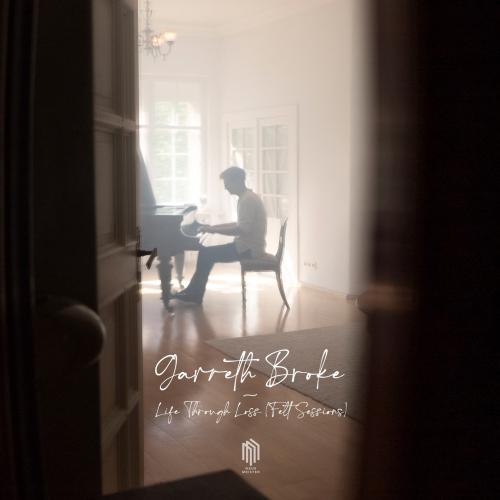
Life Through Loss (Felt Sessions) Garreth Broke
Album info
Album-Release:
2026
HRA-Release:
28.08.2026
Label: Neue Meister
Genre: Classical
Subgenre: Instrumental
Artist: Garreth Broke
Composer: Garreth Broke (1985)
Album including Album cover
- Garreth Broke: Beautiful Ache (Felt Sessions):
- 1 Broke: Beautiful Ache (Felt Sessions) 02:03
- Bittersweet (Felt Sessions):
- 2 Broke: Bittersweet (Felt Sessions) 03:00
- Photograph (Felt Sessions):
- 3 Broke: Photograph (Felt Sessions) 02:38
- Mourn (Felt Sessions):
- 4 Broke: Mourn (Felt Sessions) 02:14
- (Don't) Change (Felt Sessions):
- 5 Broke: (Don't) Change (Felt Sessions) 01:55
- Concrete Bunks (Felt Sessions):
- 6 Broke: Concrete Bunks (Felt Sessions) 03:30
- Just Another Day (Without You) (Felt Sessions):
- 7 Broke: Just Another Day (Without You) (Felt Sessions) 02:32
- Never Enough Time (Felt Sessions):
- 8 Broke: Never Enough Time (Felt Sessions) 02:30
Info for Life Through Loss (Felt Sessions)
With Life through Loss – Felt Sessions, British-German pianist and composer Garreth Broke returns to eight selected pieces from his deeply personal album Life through Loss, revealing them from a new and more intimate perspective.
Recorded on an upright piano with felt placed between the hammers and strings, these new versions bring the listener closer to the instrument than ever before. The softened attack, warm resonance and subtle mechanical details create a sense of immediacy—as though Broke were playing quietly in the same room. Rather than recreating the entire album, the Felt Sessions focus on a carefully chosen collection of pieces whose emotional character lends itself particularly well to this stripped-back setting.
Based in Frankfurt, Broke has earned recognition not only as a composer and pianist but also through his work as a grief companion. His original music, streamed millions of times and released on respected labels such as 1631 Recordings, Moderna and Bigo & Twigetti, is characterised by an unusual sensitivity towards the complexities of human emotion.
At the heart of Life through Loss lies Broke’s own experience of grief alongside his volunteer work supporting people dealing with loss. The original album explores feelings that rarely exist in isolation: pain and gratitude, longing and love, guilt and remembrance.
“Grief doesn’t end; it just changes,” Broke says. The Felt Sessions offer another perspective on that idea. Rather than simply revisiting the compositions, Broke allows them to change with him.
The stripped-back sound of the upright felt piano shifts the emotional focus of the pieces. Melodies that previously unfolded within a broader contemporary classical sound world now feel almost like private thoughts. Notes emerge gently, linger for a moment and disappear again, leaving silence to become an equally important part of the music.
Across eight pieces—“Beautiful Ache,” “Bittersweet,” “Photograph,” “Mourn,” “(Don’t) Change,” “Concrete Bunks,” “Just Another Day (Without You)” and “Never Enough Time”—Broke revisits some of the album’s most personal reflections on grief, memory and change. Removed from the broader sound world of the original record, the compositions take on a different character: quieter, warmer and more immediate.
“Bittersweet” and “Photograph,” for example, carry deeply personal connections to Broke’s late mother, while “Just Another Day (Without You)” captures the sudden intrusion of grief into an otherwise ordinary moment. “Concrete Bunks” confronts the strange physical reality of burial, and “Never Enough Time” reflects on the painful awareness that moments shared with the people we love are always finite. In their new felt-piano form, these ideas feel less like statements and more like private recollections.
The felt piano aesthetic feels particularly natural within Broke’s musical language. His compositions have always favoured restraint over grand gestures, drawing on contemporary and modern classical music as well as influences ranging from Yann Tiersen and Ludovico Einaudi to the Romanticism of Mendelssohn and Schubert. Here, that restraint is taken even further.
There is no attempt to make the music larger than the emotions it represents. Instead, the muted piano brings out small details: the resonance of a chord, the space between two phrases, the gentle sound of the instrument itself. The result is warmer and more tactile, with an atmosphere that feels closer to a private performance than a traditional studio recording.
Critics have praised Broke as a “sensitive and profound artist” (PianoDao), noted that his music is “genuinely uplifting” (Stationary Travels), and highlighted how he “cuts through the noise of overwrought emotions and cheap platitudes, and speaks the heart directly, reminding people through the beauty of music and art that others have been there too” (No Dead Guys).
That quality is at the centre of the Felt Sessions. Broke does not try to resolve grief or provide easy answers. Instead, the music creates a space in which conflicting emotions are allowed to exist alongside one another.
“Without love, there is no grief,” Broke says.
In these intimate new recordings, that connection between love, memory and loss feels particularly close. Life through Loss – Felt Sessions transforms the selected compositions without changing what lies at their core: music about remembering, continuing and slowly finding a way forward.
It is therefore not simply a smaller version of the original album. It is a closer one: eight carefully selected pieces stripped back to their emotional core, performed with the warmth and intimacy of an upright felt piano.
Garreth Broke, upright felt piano
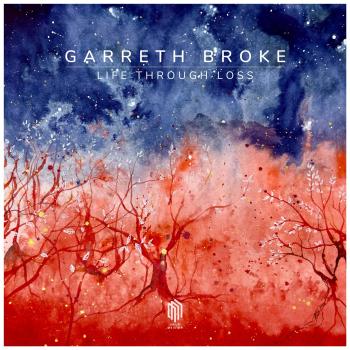
Garreth Brooke
is a graduate pedagogue and a composer based in Frankfurt, Germany.
Although his years of musical training were fairly classical, from beginning to learn the piano at 6, until obtaining his university degrees (which included work on representations of sexuality in the operas of Benjamin Britten), his life path is more atypical. Indeed, he has to his credit several experiences in the charitable world in particular as a volunteer on organic farms, a student in environmental conservation and a worker for a youth hostel association during 4 years. These gave him more discernment, perspective and depth at an age when one is typically still wondering about one’s own future.
These days his time is divided between musical composition, his work as a teacher and the charity project “Upright”, which publishes contemporary piano sheet music.
This album contains no booklet.