



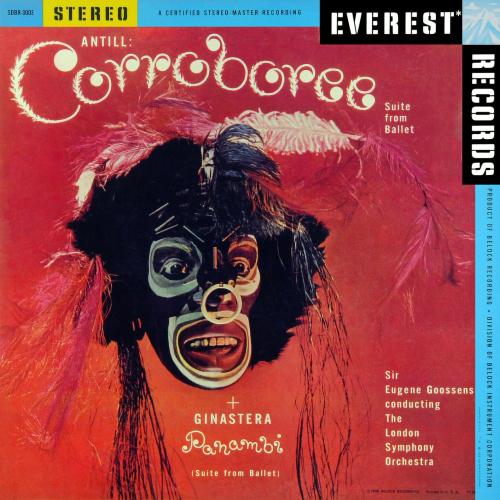
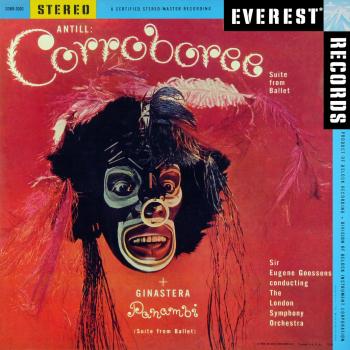
Antill: Corroboree - Ginastera: Panambi (Transferred From The Original Everest Records Master Tapes) London Symphony Orchestra & Sir Eugene Goossens
Album info
Album-Release:
2013
HRA-Release:
14.01.2026
Label: Everest
Genre: Classical
Subgenre: Orchestral
Artist: London Symphony Orchestra & Sir Eugene Goossens
Composer: John Antill (1904-1986), Alberto Ginastera (1916-1983)
Album including Album cover Booklet (PDF)
I`m sorry!
Dear HIGHRESAUDIO Visitor,
due to territorial constraints and also different releases dates in each country you currently can`t purchase this album. We are updating our release dates twice a week. So, please feel free to check from time-to-time, if the album is available for your country.
We suggest, that you bookmark the album and use our Short List function.
Thank you for your understanding and patience.
Yours sincerely, HIGHRESAUDIO
- John Antill (1904 - 1986): Corroboree, Suite from the Ballet:
- 1 Antill: Corroboree, Suite from the Ballet: I. Welcome Ceremony (Remastered 2013) 02:55
- 2 Antill: Corroboree, Suite from the Ballet: II. Dance to the Evening Star (Remastered 2013) 08:52
- 3 Antill: Corroboree, Suite from the Ballet: III. A Rain Dance (Remastered 2013) 02:35
- 4 Antill: Corroboree, Suite from the Ballet: IV. Procession of the Totems (Remastered 2013) 02:25
- 5 Antill: Corroboree, Suite from the Ballet: V. Closing Fire Ceremony (Remastered 2013) 07:53
- Alberto Ginastera (1916 - 1983): Panambi, Ballet Suite: I
- 6 Ginastera: Panambi, Ballet Suite: I. Moonlight on the Parana (Remastered 2012) 05:35
- 7 Ginastera: Panambi, Ballet Suite: II. Invocation of the Powerful Spirits (Remastered 2012) 01:12
- 8 Ginastera: Panambi, Ballet Suite: III. Lament of the Maidens and Rondo of the Maidens (Remastered 2012) 02:29
- 9 Ginastera: Panambi, Ballet Suite: IV. Dance of the Warriors (Remastered 2012) 03:23
Info for Antill: Corroboree - Ginastera: Panambi (Transferred From The Original Everest Records Master Tapes)
In 1947, Sir Eugene Goosens gave the first performance of this composition that documents the Australian Aboriginal dance known as a 'Corroboree'. In 1960, Goosens and the London Symphony Orchestra recorded for Everest this magnificent - possibly the best ever - performance of Corroboree, even better than the famous EMI recording of the same piece from 1977.
The original 3-track, half-inch tape captured it all with definition and clarity that is rarely matched. This, of course, comes from a source tape somewhat removed from the original tape, but the clarity of this transfer suggests it is not far from the stereo edit master mixed from that original. Bob doesn't say one way or the other. I encourage you to get this album and hear it for yourself. If you are proud of the audio system you assembled, this recording will give it a nice workout. Plus, the music is great.
The numerous symphonic poems and ballet scores of the 20th century have particularly appealed to reissue producers, as the then still young medium of the gramophone record was pushed to its limits by these often highly onomatopoeic works – still exciting in terms of sound today, but often secondary in musical terms. The main work on this album is a notable exception: John Antill's ‘Corroboree’ is based on an ancient Aboriginal music and dance ritual that the composer was allowed to attend as a boy. Antill went much further in his interpretation than most of his contemporaries, who used conventional orchestral means. The percussionists in particular have their work cut out for them in Corroboree, as the work builds from a meditative beginning to a completely chaotic ecstasy that demands everything from the orchestra. Antill has transformed the harmonies, which sound quite foreign to our ears, into a coherent and exciting orchestral work that condenses the original seven-scene ballet into four movements. Eugene Goossens has his London Symphony Orchestra well under control; paradoxically, it is precisely the seemingly chaotic passages that are so dynamic and impressive thanks to the conductor's complete control." (HiFiTest.de)
London Symphony Orchestra
Sir Eugene Goossens, conductor
Digitally remastered
Eugene Goossens/strong>
was born into a family of musicians: his grandfather (who moved to Britain from Belgium in 1873) and father, both called Eugene, were prominent conductors, mainly of opera; Eugene’s brother Leon was one of the most distinguished oboists of the twentieth century, his sisters Marie and Sidonie were harpists, and another brother, Adolph, who was killed in the First World War, played the horn.
Eugene Goossens (III) was born in London on 26 May 1893, though the family home was in Liverpool. At the age of eight he was sent to boarding school in Bruges, and at ten he began to study music in the Conservatory there, as his grandfather had done; from the age of thirteen he attended the Liverpool College of Music. In 1907 he went to the Royal College of Music in London, studying violin and, from 1910, composition, with Sir Charles Villiers Stanford and with Charles Wood.
He had begun to conduct as a student, and in 1913 he conducted one of Sir Henry Wood’s Promenade Concerts at the Queen’s Hall. Initially, though, he earned his living as a violinist, playing in several string quartets. In January 1916 (a heart condition having saved him from war service) he stood in for Beecham at the first performances of Stanford’s opera The Critic, and thus began a fruitful relationship with Beecham as protégé and deputy.
In 1921 he established an orchestra for five concerts of modern music, one of which (7 June 1921) included the first UK performance of The Rite of Spring, in the presence of Stravinsky, Diaghilev and Massine. Diaghilev responded by engaging Goossens to conduct the Ballets Russes. In 1923 Goossens was appointed conductor of the Rochester Philharmonic in upstate New York, and in 1931 he became conductor of the Cincinnati Symphony Orchestra, remaining there until 1946. The next year he took up the position of director of the New South Wales Conservatory of Music, a post he held until 1956, by which time he was also chief conductor of the Sydney Symphony Orchestra. He was knighted in 1955. He resigned his posts in 1956 and spent the rest of his career working free-lance until his death on 13 June 1962.
Although Goossens’ first compositions were small-scale – piano pieces, songs, chamber music – he was writing confidently for orchestra from early on, producing the Variations on a Chinese Theme (1911), Miniature Fantasy for strings (1911), Perseus, a symphonic poem (1914), and Ossian, a symphonic prelude (1915). At this stage his music generally shows the influence of the French school, Debussy in particular. His First Symphony was completed in 1940, in Cincincatti, and the Second Symphony was premiered in 1946. Goossens composed two operas, Judith (1925) and Don Juan de Mañara (1934), a massive oratorio, Apocalypse (1951), and a generous quantity of other works, orchestral, chamber, instrumental. His music was lost from sight for some years after his death but began to re-emerge from the mid-1990s with recordings from the Australian Broadcasting Corporation.
Booklet for Antill: Corroboree - Ginastera: Panambi (Transferred From The Original Everest Records Master Tapes)