

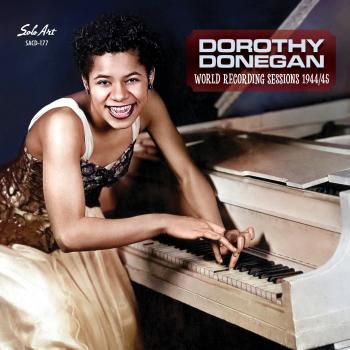
World Recording Sessions 1944/45 (Mono Remastered) Dorothy Donegan
Album info
Album-Release:
2025
HRA-Release:
25.12.2025
Album including Album cover
- 1 Don't Blame Me 03:15
- 2 St. Louis Blues 02:50
- 3 Dorothy Digs 02:35
- 4 The Goon Walks 02:50
- 5 Embraceable You 03:26
- 6 Stardust 03:04
- 7 The Minute Waltz (unissued) 02:32
- 8 Prelude in C# Minor 02:47
- 9 Body and Soul 03:07
- 10 All the Things You Are 03:47
- 11 Timothy Bounce 01:41
- 12 Dorothy Donegan Boogie 01:56
- 13 Hungarian Rhapsody 03:01
- 14 The Man I Love 03:11
- 15 After You've Gone 02:12
- 16 Oh, Lady Be Good 03:36
- 17 Dorothy's Boogie Woogie 02:47
- 18 Honeysuckle Rose 03:00
- 19 Body and Soul (Take 1 Alt) 02:24
- 20 Body and Soul (Take 2 Alt) 03:21
- 21 All The Things You Are (Take 3 Alt) 02:43
- 22 Timothy Bounce (Take 1 Alt) 01:41
Info for World Recording Sessions 1944/45 (Mono Remastered)
Dorothy Donegan's 1944-1945 recordings, particularly those on Decca Records, showcase her virtuosity blending classical, boogie-woogie, bop, and stride, featuring tracks like "Minuet in G" (Paderewski), "Don't Blame Me," and "Dorothy Rocks," highlighting her classical training alongside fiery jazz improvisation, with these early works establishing her reputation in Chicago clubs and leading to her role in the film Sensations of 1945.
Dorothy Donegan was born in Chicago, Illinois, on April 6, 1922, Dorothy Donegan was trained as a classical pianist, Donegan was an eclectic virtuoso who played stride, boogie-woogie, bop, swing and classical piano styles, sometimes all in the same chorus. She started piano lessons at the age of 8 in her hometown, taking lessons from Alfred M. Simms and later, Walter Dyett (who also taught Dinah Washington, Gene Ammons and Von Freeman among others).
She made her first recordings in 1942 and was sensational in the film "Sensations of 1945" with Cab Calloway but didn't catch on. She was popular, however, in the clubs around her native Chicago. She became a protege of Art Tatum who called her, "the only woman who could make me practice." Donegan would say of Tatum, "(He) was supposed to be blind... I know he could see women."
She was the first African-American to perform in Chicago's Orchestra Hall in 1943. She said of her performance, "In the first half I played Rachmaninoff and Grieg and in the second I drug it through the swamp-played jazz." But despite her prodigious talent she remained in obscurity, releasing only a largely ignored albums from 1954-1963. It would not be until the 80's that she would receive notice in the jazz world with the release of a recording done at the 1987 Montreux Jazz Festival at the age of 65. Her recordings from that point on until her last in 1995 would continue to receive critical acclaim.
Most critics who saw her would say that to experience her as a performer she was best seen live. She had a flamboyant style, often dancing while she played, twisting into contortions, while she combined spontaneous medleys of unrelated songs in several different styles all at once. A New York Times critic said of her, "her flamboyance helped her find work in a field that was largely hostile to women. To a certain extent it was also her downfall; her concerts were often criticized for having an excess of personality."
Donegan made no bones about speaking out against the sexism she experienced and felt that her insistence on being paid the same as male musicians had limited her career. She received an American Jazz Master fellowship from the National Endowment of the Arts in 1992 and an honorary doctorate from Roosevelt University in 1994. She died of lung cancer in 1998.
Dorothy Donegan
Digitally remastered
No biography found.
This album contains no booklet.