


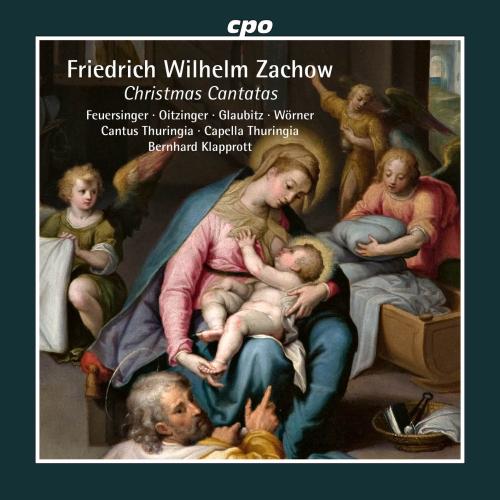
Zachow: Christmas Cantatas Feuersinger, Oitzinger, Glaubitz, Wörner, Cantus Thuringia, Capella Thuringia & Bernhard Klapprott
Album info
Album-Release:
2026
HRA-Release:
23.10.2026
Label: CPO
Genre: Classical
Subgenre: Choral
Artist: Feuersinger, Oitzinger, Glaubitz, Wörner, Cantus Thuringia, Capella Thuringia & Bernhard Klapprott
Composer: Friedrich Wilhelm Zachow (1663-1712)
Album including Album cover Booklet (PDF)
- Friedrich Wilhelm Zachow (1663 - 1712): Vom Himmel kam der Engel Schar TV 31 - 1. Coro:
- 1 Zachow: Vom Himmel kam der Engel Schar TV 31 - 1. Coro: Vom Himmel kam der Engel Schar 01:41
- Vom Himmel kam der Engel Schar TV 31 - 2. Aria (Soprano):
- 2 Zachow: Vom Himmel kam der Engel Schar TV 31 - 2. Aria (Soprano): Zu Bethlehem, in Davids Stadt 00:58
- Vom Himmel kam der Engel Schar TV 31 - 3. Aria (Bass):
- 3 Zachow: Vom Himmel kam der Engel Schar TV 31 - 3. Aria (Bass): Des sollt ihr billig fröhlich sein 01:20
- Vom Himmel kam der Engel Schar TV 31 - 4. Recitative (Tenor):
- 4 Zachow: Vom Himmel kam der Engel Schar TV 31 - 4. Recitative (Tenor): Was kann euch tun die Sündʼ und Tod 01:17
- Vom Himmel kam der Engel Schar TV 31 - 5. Aria (Alto):
- 5 Zachow: Vom Himmel kam der Engel Schar TV 31 - 5. Aria (Alto): Er kann und will euch lassen nicht 01:14
- Vom Himmel kam der Engel Schar TV 31 - 6. Coro:
- 6 Zachow: Vom Himmel kam der Engel Schar TV 31 - 6. Coro: Zuletzt müsst ihr doch haben recht 01:21
- Es wird eine Rute aufgehen TV 8 - 1. Coro:
- 7 Zachow: Es wird eine Rute aufgehen TV 8 - 1. Coro: Es wird eine Rute aufgehen aus dem Stamm Isai 01:58
- Es wird eine Rute aufgehen TV 8 - 2. Aria (Alto):
- 8 Zachow: Es wird eine Rute aufgehen TV 8 - 2. Aria (Alto): Heil der Erden, mein Verlangen 04:00
- Es wird eine Rute aufgehen TV 8 - 3. Chorale:
- 9 Zachow: Es wird eine Rute aufgehen TV 8 - 3. Chorale: Des ewʼgen Vaters einig Kind 00:54
- Es wird eine Rute aufgehen TV 8 - 4. Aria (Soprano):
- 10 Zachow: Es wird eine Rute aufgehen TV 8 - 4. Aria (Soprano): Kommʼ angenehme Friedensnacht 03:59
- Es wird eine Rute aufgehen TV 8 - 5. Chorale:
- 11 Zachow: Es wird eine Rute aufgehen TV 8 - 5. Chorale: Das ewʼge Licht geht da herein 00:52
- Es wird eine Rute aufgehen TV 8 - 6. Aria (Bass):
- 12 Zachow: Es wird eine Rute aufgehen TV 8 - 6. Aria (Bass): Ihr Sterne, senkt euch in die Krippen 02:58
- Es wird eine Rute aufgehen TV 8 - 7. Coro:
- 13 Zachow: Es wird eine Rute aufgehen TV 8 - 7. Coro: Da die Zeit erfüllet war 01:18
- Es wird eine Rute aufgehen TV 8 - 8. Aria (Tenor):
- 14 Zachow: Es wird eine Rute aufgehen TV 8 - 8. Aria (Tenor): Gesegnet sei der werte Tag 02:45
- Es wird eine Rute aufgehen TV 8 - 9. Chorale:
- 15 Zachow: Es wird eine Rute aufgehen TV 8 - 9. Chorale: Heutʼ schleußt er wieder auf die Tür 00:53
- Die Herrlichkeit des Herrn TV 6 - Sonata:
- 16 Zachow: Die Herrlichkeit des Herrn TV 6 - Sonata 00:41
- Die Herrlichkeit des Herrn TV 6 - 1. Aria:
- 17 Zachow: Die Herrlichkeit des Herrn TV 6 - 1. Aria: Die Herrlichkeit des Herren ist offenbaret worden 01:01
- Die Herrlichkeit des Herrn TV 6 - 2. Aria:
- 18 Zachow: Die Herrlichkeit des Herrn TV 6 - 2. Aria: Und alles Fleisch miteinander siehet 01:21
- Die Herrlichkeit des Herrn TV 6 - 3. Aria:
- 19 Zachow: Die Herrlichkeit des Herrn TV 6 - 3. Aria: Kommt, lasst uns schauen mit Begier 04:57
- Die Herrlichkeit des Herrn TV 6 - 4. Aria:
- 20 Zachow: Die Herrlichkeit des Herrn TV 6 - 4. Aria: Die Herrlichkeit des Herren ist offenbaret worden 01:08
- Uns ist ein Kind geboren TV 29 - 1. Solo|Coro:
- 21 Zachow: Uns ist ein Kind geboren TV 29 - 1. Solo|Coro: Uns ist ein Kind geboren|Gelobet seist du, Jesu Christ 02:59
- Uns ist ein Kind geboren TV 29 - 2. Recitative (Tenor):
- 22 Zachow: Uns ist ein Kind geboren TV 29 - 2. Recitative (Tenor): Ich liege da, in Windeln eingehüllt 01:10
- Uns ist ein Kind geboren TV 29 - 3. Chorale:
- 23 Zachow: Uns ist ein Kind geboren TV 29 - 3. Chorale: Des ewʼgen Vaters einigʼs Kind 01:14
- Uns ist ein Kind geboren TV 29 - 4. Aria (Soprano)|Chorale:
- 24 Zachow: Uns ist ein Kind geboren TV 29 - 4. Aria (Soprano)|Chorale: Das ewʼge Wort ward Fleisch|Den aller Welt Kreis nie beschloss 02:02
- Uns ist ein Kind geboren TV 29 - 5. Aria (Alto)|Chorale:
- 25 Zachow: Uns ist ein Kind geboren TV 29 - 5. Aria (Alto)|Chorale: Das ewʼge Wort ward Gast|Der Sohn des Vaters, Gott von Art 01:43
- Uns ist ein Kind geboren TV 29 - 6. Aria (Tenor)|Chorale:
- 26 Zachow: Uns ist ein Kind geboren TV 29 - 6. Aria (Tenor)|Chorale: Das ewʼge Wort ward Licht|Das ewʼge Licht geht da herein 02:02
- Uns ist ein Kind geboren TV 29 - 7. Aria (Bass)|Chorale:
- 27 Zachow: Uns ist ein Kind geboren TV 29 - 7. Aria (Bass)|Chorale: Das ewʼge Wort ward arm|Er ist auf Erden kommen arm 01:37
- Uns ist ein Kind geboren TV 29 - 8. Chorale:
- 28 Zachow: Uns ist ein Kind geboren TV 29 - 8. Chorale: Das hat er alles uns getan 00:49
- Uns ist ein Kind geboren TV 29 - 9. Recitative (Alto):
- 29 Zachow: Uns ist ein Kind geboren TV 29 - 9. Recitative (Alto): O Jesu, dir sei Preis und Dank gesagt 01:39
- Uns ist ein Kind geboren TV 29 - 10. Chorale:
- 30 Zachow: Uns ist ein Kind geboren TV 29 - 10. Chorale: O Patris caritas 02:41
- Preiset mit mir den Herrn TV 21 - 1. Sinfonia|Coro:
- 31 Zachow: Preiset mit mir den Herrn TV 21 - 1. Sinfonia|Coro: Preiset mit mir den Herren 02:16
- Preiset mit mir den Herrn TV 21 - 2. Recitative (Tenor):
- 32 Zachow: Preiset mit mir den Herrn TV 21 - 2. Recitative (Tenor): So geht die Zeit dahin 00:25
- Preiset mit mir den Herrn TV 21 - 3. Aria (Tenor):
- 33 Zachow: Preiset mit mir den Herrn TV 21 - 3. Aria (Tenor): Unsʼre Zeit ist wie der Wind 03:37
- Preiset mit mir den Herrn TV 21 - 4. Recitative (Tenor):
- 34 Zachow: Preiset mit mir den Herrn TV 21 - 4. Recitative (Tenor): Jedoch, was schadet uns der schnelle Zeitenlauf? 00:30
- Preiset mit mir den Herrn TV 21 - 5. Aria (Soprano):
- 35 Zachow: Preiset mit mir den Herrn TV 21 - 5. Aria (Soprano): Weil Gottes Auge vor uns wacht 02:42
- Preiset mit mir den Herrn TV 21 - 6. Aria (Alto):
- 36 Zachow: Preiset mit mir den Herrn TV 21 - 6. Aria (Alto): Drum preiset alle Welt 01:53
- Preiset mit mir den Herrn TV 21 - 7. Aria (Bass):
- 37 Zachow: Preiset mit mir den Herrn TV 21 - 7. Aria (Bass): Der Herr ist Sonnʼ und Schild 03:11
- Preiset mit mir den Herrn TV 21 - 8. Coro:
- 38 Zachow: Preiset mit mir den Herrn TV 21 - 8. Coro: Israel, hoffe auf den Herren 01:20
Info for Zachow: Christmas Cantatas
Georg Friedrich Händel could hardly have wished for a better teacher than Friedrich Wilhelm Zachow, the longtime organist of St. Mary's Church in Halle. Born into a family of Stadtpfeifer and given the broadest possible musical training by his father in the venerable traditions of the guild, the native of Cölln on the Spree possessed the full range of musical skills needed to give a gifted young musician a thorough grounding in both the fundamentals of the craft and the art of sacred composition. This should not suggest, however, that Friedrich Wilhelm Zachow was merely one of the countless competent minor masters who routinely discharged their duties at the organ and in front of the choir. His cantatas reveal a composer keenly attuned to the musical currents of his time, reflecting them in his own works while adding innovations of his own, yet never losing sight of the Lutheran chorale tradition that makes the works recorded here instantly recognizable as Christmas music to this day.
Miriam Feuersinger, soprano
Margot Oitzinger, mezzo-soprano
Benjamin Glaubitz, tenor
Dominik Wörner, bass
Cantus Thuringia
Capella Thuringia
Bernhard Klapprott, conductor

Miriam Feuersinger
Austrian-born soprano Miriam Feuersinger—a recipient of both the ECHO Klassik and OPUS KLASSIK awards—is one of the leading sopranos in the field of sacred Baroque music. Her primary musical and thematic focus lies in the cantatas and Passion settings of J.S. Bach and his contemporaries, a passion reflected in her active international concert career. Since 2014, she has co-organized the concert series "Bach Cantatas in Vorarlberg" alongside cellist Thomas Platzgummer.
The soprano is a regular guest at renowned Bach-focused institutions, including the Bachstiftung Trogen (Switzerland), "All of Bach" (Netherlands), and the Bachakademie Stuttgart (Germany). She also frequently appears at festivals such as the Bachfest Leipzig (Germany), Bachfesttage Köthen (Germany), Bachtage Rostock (Germany), Bachcelona (Spain), the "Abendmusiken" series at the Predigerkirche (Switzerland), and the Bach-Biennale Weimar (Germany), among others. Her musical repertoire further encompasses a broad spectrum of sacred music—ranging from the Baroque era to the late Romantic period—as well as the genre of *Lied* (art song).
Miriam Feuersinger has collaborated with conductors such as Jordi Savall, Vaclav Luks, Hans-Christoph Rademann, Rudolf Lutz, Jörg-Andreas Bötticher, Lorenzo Ghielmi, Ton Koopman, Sigiswald Kuijken, and Christoph Prégardien. Her performance partners include ensembles such as the Freiburg Baroque Orchestra, Collegium Vocale Gent, Collegium 1704, Holland Baroque, Il Gardellino, Capricornus Consort Basel, Les Cornets Noirs, the Basel Chamber Orchestra, the Vorarlberg Symphony Orchestra, and Concerto Stella Matutina, to name but a few.
Her work has been recognized with awards such as the “Preis der deutschen Schallplattenkritik 2/2014” (German Record Critics’ Award), the “ECHO Klassik 2014,” the “Ö1 Pasticcio-Preis 5/2017,” and the “OPUS Klassik 2022.” Her new CD, featuring solo soprano cantatas by J. S. Bach, was released in early 2022 on the Christophorus label.
Margot Oitzinger
Born in Graz, Austria, Margot Oitzinger studied concert singing at the University of Music and Performing Arts in her hometown, graduating with distinction. Even during her studies, she decided to specialize in Early Music, attending masterclasses and seminars with Emma Kirkby, Peter Kooij, and Jill Feldman.
Margot Oitzinger is highly sought after as both a concert singer and an opera performer, with a repertoire spanning from the Renaissance to the early Classical period.
Her professional life includes both polyphonic and early Baroque ensemble singing—with groups such as “Les Solistes de Collegium Vocale Gent” (under Philippe Herreweghe), “Abendmusiken in der Predigerkirche” (under Jörg-Andreas Bötticher), and “sette voci” (under Peter Kooij)—as well as solo performances of works by High Baroque masters.
She performs at major concert venues—such as the Wiener Musikverein, Concertgebouw Amsterdam, Palau de la Música in Barcelona, Concertgebouw Brugge, Suntory Hall in Tokyo, Arsenal Metz, Prinzregententheater in Munich, Thomaskirche in Leipzig, Église Saint-Roch in Paris, Muziekcentrum Utrecht, Frauenkirche in Dresden, and Alte Oper in Frankfurt—under the direction of renowned conductors including Philippe Herreweghe, Jordi Savall, Philippe Pierlot, Philippe Rousseau, Masaaki Suzuki, John Butt, Andrea Marcon, Michi Gaigg, Lorenzo Ghielmi, Christoph Prégardien, Konrad Junghänel, and Rudolph Lutz. Under the direction of the latter, she participated in the complete recording of J. S. Bach’s vocal works on DVD.
Benjamin Glaubitz
received his initial musical training as a member of the Dresdner Kreuzchor. He went on to study voice at the Dresden University of Music under Prof. Margret Trappe-Wiel, subsequently completing a master class program with Kammersänger Prof. Olaf Bär. In addition, he participated in master classes led by Charlotte Lehmann, Kammersänger Peter Schreier, Kammersänger Dietrich Fischer-Dieskau, Lothar Odinius, and Gerold Huber. He has performed with ensembles including the Akademie für Alte Musik Berlin, Hamburg Philharmonic, Tonhalle Orchestra Zurich, Staatskapelle Dresden, Staatskapelle Halle, Dresden Philharmonic, Dresden Baroque Orchestra, Lautten Compagney Berlin, Bach-Collegium Stuttgart, Collegium 1704 (Prague), Symphony Prague, Hong Kong Sinfonietta, Ensemble Resonanz, Copenhagen Phil, Dortmund Philharmonic, Leipzig Gewandhaus Orchestra, Netherlands Bach Society (at the Concertgebouw, Amsterdam), Helsinki Baroque Orchestra, Trondheim Symphony Orchestra, Vox Luminis, the Tölz Boys' Choir, the Dresden Kreuzchor, and the St. Thomas Choir of Leipzig (Thomanerchor). He has sung under the direction of conductors such as Antonius Adamske (at the Elbphilharmonie, Hamburg), Hörður Áskelsson (at Harpa, Reykjavík), Hansjörg Albrecht, Karl-Friedrich Beringer (both at the Philharmonie, Munich), Fabio Bonizzoni, Sylvain Cambreling, Alessandro De Marchi (at the Hamburg State Opera), Justin Doyle, Gabriel Feltz, Iván Fischer (at the Konzerthausorchester Berlin), Ludwig Güttler, Aapo Häkkinen, Wolfgang Katschner, Ekkehard Klemm (at the Semperoper), Andrzej Kosendiak (at NFM Wrocław), Joachim Krause (at the Tonhalle, Zurich), Roderich Kreile, Václav Luks, Frank Markowitsch, Ebbe Munk, Tomáš Netopil (for *Doktor Faust* at the Semperoper), Markus Poschner (with the Dresden Philharmonic), Hans-Christoph Rademann, Helmuth Rilling (in Stuttgart, Chile, and Hong Kong), Gotthold Schwarz, Holger Speck (at the Hamburg State Opera), Andreas Spering, Eckehard Stier, Jörg-Peter Weigle, and Achim Zimmermann (at the Konzerthaus, Berlin). His work—both in solo recitals and in concerts with ensembles such as Collegium Vocale Gent—has taken him to numerous musical centers across Europe, Asia, and North and South America.
Bernhard Klapprott
performs internationally as a soloist, continuo player, and ensemble director. Several of his CDs have received awards, including the ECHO KLASSIK and the German Record Critics' Award (*Preis der Deutschen Schallplattenkritik*). He serves as a professor of harpsichord/historical keyboard instruments and basso continuo at the FRANZ LISZT University of Music Weimar and the University of the Arts Bremen, and also teaches in masterclasses internationally.
His discography includes, among other works, the complete keyboard music of Thomas Tomkins (harpsichord, virginal, organ; MDG), South German keyboard music from around 1600 (clavicytherium; Aeolus), keyboard music by Luzzasco Luzzaschi and Ercole Pasquini (harpsichord; dhm/Sony), keyboard sonatas by Georg Anton Benda (clavichord; Aeolus), and organ works by Johann Sebastian Bach (part of a complete recording cycle on organs by Andreas and Johann Andreas Silbermann; Aeolus), as well as various recordings as an ensemble director and continuo player.
In 1999, together with Christoph Dittmar, he founded the ensemble Cantus Thuringia & Capella. The group has gained recognition through numerous concerts and recordings—focusing particularly on Central German repertoire from the 16th to the 18th centuries—as well as through the staging of theatrical works that incorporate historical acting techniques. In this context, he initiated the project MUSIKERBE THÜRINGEN ("Musical Heritage of Thuringia"), which is dedicated to research, live performances, CD recordings, and the preparation of musical editions.
In addition to his work with early music, he has composed several pieces, some of which have been published by Bärenreiter-Verlag (in their contemporary music series).
Since 2024, he has served as Artistic Director of the international summer concert series "Night Organ by Candlelight" (*Nachtorgel bei Kerzenschein*), held at the historic organ built by Gerhard von Holy (1711) in St. Bartholomew’s Church in Dornum (East Frisia).
His teaching career has taken him to the University of Dortmund and the music conservatories in Detmold and Herford; he has also led masterclasses and delivered guest lectures on performance practice across Europe and the United States. In 1994, he was appointed Professor at the FRANZ LISZT University of Music Weimar. He also teaches harpsichord and historical keyboard instruments at the University of the Arts Bremen.
Bernhard Klapprott studied harpsichord with Hugo Ruf and Bob van Asperen, and organ with Michael Schneider and Ewald Kooiman. He further honed his skills in masterclasses, studying *basso continuo* with Jesper Christensen and organ with Michael Radulescu. He completed his studies in Cologne—earning degrees in harpsichord, organ, and church music—and in Amsterdam, where he received a concert diploma in harpsichord with distinction.
In 1991, he was awarded first prize at the 10th International Organ Competition (focusing on Bach and Mozart) at the Festival van Vlaanderen in Bruges.
Booklet for Zachow: Christmas Cantatas