




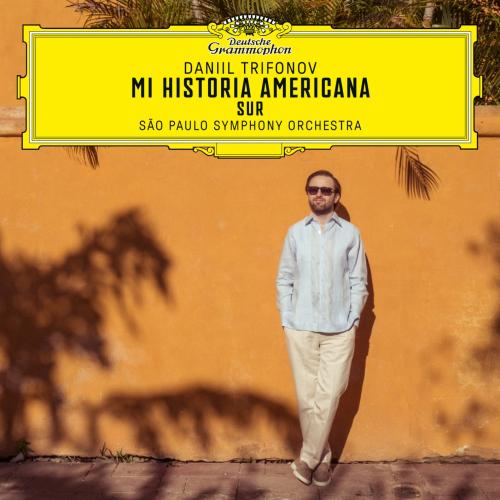
Mi Historia Americana: Sur Daniil Trifonov
Album info
Album-Release:
2026
HRA-Release:
02.10.2026
Label: Deutsche Grammophon (DG)
Genre: Classical
Subgenre: Instrumental
Artist: Daniil Trifonov
Composer: Ary Barroso (1903-1964), Gabriela Lena Frank (1972), Osvaldo Golijov (1960), Alberto Ginastera (1916-1983), Heitor Villa-Lobos (1887-1959), Michel Camilo (1954), Oscar Lorenzo Fernandez (1897-1948), Ernesto Lecuona (1895-1963)
Album including Album cover Booklet (PDF)
I`m sorry!
Dear HIGHRESAUDIO Visitor,
due to territorial constraints and also different releases dates in each country you currently can`t purchase this album. We are updating our release dates twice a week. So, please feel free to check from time-to-time, if the album is available for your country.
We suggest, that you bookmark the album and use our Short List function.
Thank you for your understanding and patience.
Yours sincerely, HIGHRESAUDIO
- Ary Barosso (1903 - 1964): Aquarela do Brasil:
- 1 Barosso: Aquarela do Brasil (Arr. Grau for Piano, Percussion & Orchestra) 04:33
- Gabriela Lena Frank (b.1972): Sonata Andina:
- 2 Frank: Sonata Andina: I. Allegro Aymara 05:51
- 3 Frank: Sonata Andina: II. Himno Inca 03:37
- 4 Frank: Sonata Andina: III. Adagio Illariy 05:43
- 5 Frank: Sonata Andina: IV. Finale Saqsampillo 06:27
- Juan Francisco García (1892 - 1974): Sambumbia No.1:
- 6 García: Sambumbia No. 1, "Rapsodia Dominicana" 08:53
- Alberto Ginastera (1916 - 1983): Piano Sonata No. 2, Op. 53:
- 7 Ginastera: Piano Sonata No. 2, Op. 53: I. Allegramente 04:23
- 8 Ginastera: Piano Sonata No. 2, Op. 53: II. Adagio sereno - Scorrevole - Ripresa dell'Adagio 05:13
- 9 Ginastera: Piano Sonata No. 2, Op. 53: III. Ostinato Aymara 04:01
- Michel Camilo (b. 1954): Suntan:
- 10 Camilo: Suntan (Transcr. Trifonov for Piano) 06:22
- Ernesto Lecuona (1895 - 1963): Y la negra bailaba!:
- 11 Lecuona: Y la negra bailaba! 02:09
- La Comparsa:
- 12 Lecuona: La Comparsa 02:03
- Osvaldo Golijov (b. 1960), Gonzalo Grau (b. 1972): Cuadros del Sur:
- 13 Golijov, Grau: Cuadros del Sur: I. Promenade 1 01:25
- 14 Golijov, Grau: Cuadros del Sur: II. Candomblé 02:48
- 15 Golijov, Grau: Cuadros del Sur: III. Promenade 2 00:56
- 16 Golijov, Grau: Cuadros del Sur: IV. Lejanía 02:08
- 17 Golijov, Grau: Cuadros del Sur: V. Promenade 3 01:07
- 18 Golijov, Grau: Cuadros del Sur: VI. La fé 02:44
- 19 Golijov, Grau: Cuadros del Sur: VII. Promenade 4 00:18
- 20 Golijov, Grau: Cuadros del Sur: VIII. Caribe 04:11
- 21 Golijov, Grau: Cuadros del Sur: IX. Promenade 5 00:14
- 22 Golijov, Grau: Cuadros del Sur: X. Yoruba 01:49
- 23 Golijov, Grau: Cuadros del Sur: XI. Fuelle - Respiros 05:26
- 24 Golijov, Grau: Cuadros del Sur: XII. Sudor y costa 02:03
- 25 Golijov, Grau: Cuadros del Sur: XIII. Promenade 6 00:37
- 26 Golijov, Grau: Cuadros del Sur: XIV. Calles 03:26
- 27 Golijov, Grau: Cuadros del Sur: XV. Gran Promenade Final 01:59
- Heitor Villa-Lobos (1887 - 1959): Valsa da dor:
- 28 Villa-Lobos: Valsa da dor 04:50
- Rafael "Bullumba“ Landestoy (1925 - 2018): El vals de Santo Domingo:
- 29 Landestoy: El vals de Santo Domingo 04:16
- Alberto Ginastera: Milonga, Op. 3/1:
- 30 Ginastera: Milonga, Op. 3/1 03:08
- Daniil Trifonov (b. 1991): Tango:
- 31 Trifonov: Tango 02:44
- Rafael "Bullumba“ Landestoy: Estudio en zamba:
- 32 Landestoy: Estudio en zamba 01:14
- Camargo Guarnieri (1907 - 1993): Dança negra:
- 33 Guarnieri: Dança negra 03:19
- Heitor Villa-Lobos: Bachianas Brasileiras No. 4, W264:
- 34 Villa-Lobos: Bachianas Brasileiras No. 4, W264: I. Prelúdio. Introdução 04:49
- 35 Villa-Lobos: Bachianas Brasileiras No. 4, W264: II. Coral. Canto do Sertão 05:54
- 36 Villa-Lobos: Bachianas Brasileiras No. 4, W264: III. Ária. Cantiga 05:50
- 37 Villa-Lobos: Bachianas Brasileiras No. 4, W264: IV. Dansa. Miudinho 02:59
- Oscar Lorenzo Fernândez (1897 - 1948): Suite brasileira No. 1:
- 38 Fernândez: Suite brasileira No. 1: II. Suave acalanto 03:24
- Osvaldo Golijov: Levante:
- 39 Golijov: Levante (Arr. Brunetti for Piano) 04:27
Info for Mi Historia Americana: Sur
A musical journey through Latin America: With his new album Mi Historia Americana – Sur, star-pianist Daniil Trifonov presents the second volume of his musical journey across the Americas.
"Latin American music has a quality all its own: nature as a source of inspiration, traditional dances and songs, as well as sounds of faith." (Daniil Trifonov)
On the album, he shares a wide-ranging selection of his Latin American and Caribbean musical discoveries. Through both solo and orchestral works, Trifonov’s travels take him from Cuba and the Dominican Republic to Brazil, Peru and Argentina, on what is, in many senses, his most personal album to date. “Like the region itself,” says Trifonov, “the repertoire is vast and full of variety. There are many pieces that are popular in the region yet unfamiliar in other parts of the world. I wanted to present a picture of the musical richness this literature has to offer.”
The album’s two orchestral works—*Aquarela do Brasil* and *Cuadros del Sur*—were recorded in São Paulo in February 2026, while Trifonov was performing this repertoire in Brazil. He was accompanied by members of the São Paulo Symphony Orchestra (OSESP) and the Venezuelan multi-instrumentalist, arranger, and musical director Gonzalo Grau.
"Mi Historia Americana – Sur" opens with Gonzalo Grau’s arrangement of Ary Barroso’s popular song "Aquarela do Brasil". Grau also arranged "Cuadros del Sur" (“Pictures of the South”) for Trifonov’s project—a work commissioned by OSESP, Deutsche Grammophon, the Orchestre Philharmonique de Radio France, and the Aspen Music Festival. The music draws upon "La Pasión según San Marcos", a work for choir and orchestra by the Argentine composer Osvaldo Golijov. In terms of form, Grau took inspiration from Mussorgsky’s "Pictures at an Exhibition", alternating between contrasting sections from Golijov’s "Pasión" and a recurring “Promenade” theme. Trifonov and the orchestra gave the world premiere in February; this release marks the first recording of the work. With OSESP, a Brazilian ensemble appears on the Deutsche Grammophon label for the first time.
Brazil is also represented on the album by Villa-Lobos’s "Bachianas brasileiras" No. 4, as well as works by Mozart Camargo Guarnieri and Oscar Lorenzo Fernández. From Argentina come works by Ginastera—"Milonga" and the Second Piano Sonata—along with a tango composed not in Buenos Aires, but by Trifonov himself.
The pianist also found inspiration for this album during an extended stay in his wife’s home country. “My family and I spent months in the Dominican Republic during the Covid pandemic,” he says. “During that lockdown period, I finally found the peace and quiet to immerse myself in outstanding Latin American piano music.” From the Caribbean, Trifonov selected contrasting works by contemporary Dominican composer Michel Camilo and his compatriots Juan Francisco García and Rafael Bullumba Landestoy, as well as two pieces by arguably the most famous Cuban composer, Ernesto Lecuona. Peru is another stop on Trifonov’s journey, featuring Gabriela Lena Frank’s "Sonata andina". Frank, who was born in the US and has Peruvian roots, was awarded the Pulitzer Prize for Music in 2026 for her orchestral work "Picaflor: A future myth". "Like many of the composers on this album," says Trifonov, "Frank combines elements of Western classical music with folk traditions in a complex and compelling way: the solo piano in the "Sonata andina" evokes traditional Bolivian drums and Peruvian flutes, while imitating traditional Latin American guitars and instruments such as the marimba. It is a richly colorful musical tapestry."
"Daniil Trifonov’s new album is bursting with virtuosity" ★★★★★ (Financial Times on My American Story – North)
Daniil Trifonov, piano
Members of the São Paulo Symphony Orchestra




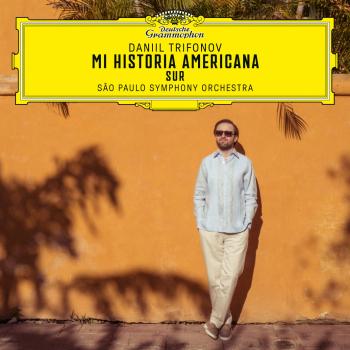
Daniil Trifonov
Talent contests are unpredictable, that's why we watch them. Even the ones that are rigged by judges or manipulated by media owners manage to command our attention for the possibility, faint as it may be, that a genius will emerge from nowhere to assert an irrefutable superiority and claim the crown.
That's not quite how it panned out at the 2011 International Tchaikovsky Competition in Moscow. A state event bedevilled from the outset by every kind of chicanery was being cleaned up by the conductor Valery Gergiev and the retired Van Cliburn boss Richard Rodzinski. Their remedy was to stream every session online, worldwide, so the public could form a view at the same time as the judges. From the first round, as we tuned in, it became apparent that there was only going to be one piano winner.
Daniil Trifonov, 20 years old, displayed the artistry and authority of a seasoned master. Less a competition than a coronation, the Tchaikovsky awarded Trifonov not just the first prize and gold medal, but the audience award, a Mozart citation and the admiration of Gergiev, who demanded to conduct his first live recording. If ever there was a runaway winner, this was it.
Trifonov had come third nine months earlier in the Chopin competition in Warsaw and first, weeks before, in the Arthur Rubinstein in Tel Aviv. He was well on his way to an international career. But what we saw and heard in Moscow was a manner of playing that set him, by an invisible cordon, six inches apart from every other living pianist. To describe what he does is not easy. Martha Argerich speaks of a 'demonic element', modified by a unique tenderness. I observed an ethereal detachment, allied to an almost preternatural symbiosis with his audience.
Some weeks after the competition, the lights went out in a new concert hall in Guildford, where Trifonov was playing with the London Symphony Orchestra. The conductor dropped his arms and the orchestra, ears to the soloist, played through to the end. Then, in pitch darkness, Trifonov played solo Chopin, forging a transcendent connection with his audience that none will ever forget.
What has impressed me most is his ability to connect the dots and find coherence in apparently disparate pieces. Where many play the Chopin Etudes as a run of five-finger exercises, Trifonov finds narrative, tells a story, introduces us to a class of difficult characters and tense situations. Hearing him play the Opus 10 set at London's Wigmore Hall, I knew that this was a pianist I wanted to hear for the rest of my life.
Who is Daniil Trifonov? The only child of a pair of musicians who met as university students in the central Russian city of Nizhny Novgorod (formerly Gorky), he took up a pencil at five years old and started composing. This may have been in imitation of his father, who writes Masses for the Russian Orthodox church, but tests showed that the boy had perfect pitch and he was sent to the best piano teacher in the region.
Having played a concerto at the age of eight, he upped sticks with his family and moved to Moscow so that he could study at the Gnessin School with Tatiana Zelikman, a rigorist who traces her piano lineage to Heinrich Neuhaus, tutor of Richter, Gilels and the rest of the Russian legends.
After nine years, Zelikman sent him to Cleveland to finish his studies with Sergei Babayan, another third-generation Neuhaus pupil. Consistency, tradition and authenticity were the bywords of Trifonov's education. In Cleveland, he knuckled down and worked hard. Babayan told him no pianist had won the Tchaikovsky Competition playing a Chopin concerto. After the victory, instead of hitting the concert trail, Trifonov returned to his teacher to start work on new pieces. 'There is never a time when the teaching has to stop,' says Trifonov.
The only blip in his progress came when, at 13, he slipped on ice on the way to a Zelikman lesson and broke his arm, putting him out of piano action for three weeks. The accident, one suspects, was a huge trauma, but also an affirmation. Trifonov talked about the lay-off to Elijah Ho, of the San Francisco Examiner: 'It was absolute torture for me,’ he confessed. 'Basically, this wasn’t a moment about realizing technique or other things, but about how important music was to me. It was so uncomfortable and so stressful to not be able to play...'
Torn from infancy between composing and playing, this was perhaps the moment when Daniil Trifonov realised that playing mattered most to him in terms of self-expression. That said, he continues to compose, taking lessons at the Cleveland Institute of Music and working on his own scores whenever time permits. In a telephone conversation from Tel Aviv, where he returns often by popular request, he tells me that he is writing a piano concerto. He does not let a day pass without touching the piano.
But there's plenty else he's working on, besides. Maurice Ravel’s Miroirs, those shimmering illusions of unattainable beauty, and Arnold Schoenberg's Three Pieces, opus 11, the foundation stones of musical expressionism. He heard the Schoenberg on a Deutsche Grammophon recording by Maurizio Pollini and was smitten. His mind works in eclectic ways, his fingers at their own pace. He broached the Rachmaninov D minor Concerto last season and will follow up soon with the C minor, playing the tougher work first. For his recital debut on DG, recorded live at Carnegie Hall, he plays Liszt's massive B minor Sonata and Chopin's Preludes, opus 28.
But the core of the album is music by Scriabin: the Second Sonata in G sharp minor, also known as the 'Sonata-Fantasy'. Scriabin was a speciality of the tormented Neuhaus, whose wife left him for Boris Pasternak, a Scriabin pupil; when Pasternak died, Neuhaus’s pupil Sviatoslav Richter played Scriabin all night on an upright piano beside the body. The linearity of Russian music is imbued in Trifonov as a matter of first principles.
Success has not gone to his head. Shy, courteous, quick to smile, Daniil Trifonov may never be the life and soul of the party or a public entertainer in the Arthur Rubinstein mould. What he brings to the keyboard is himself, a sensational technique and a sense of destiny. Watch, and you will see that he was born to play. Listen, and be amazed.
Booklet for Mi Historia Americana: Sur