

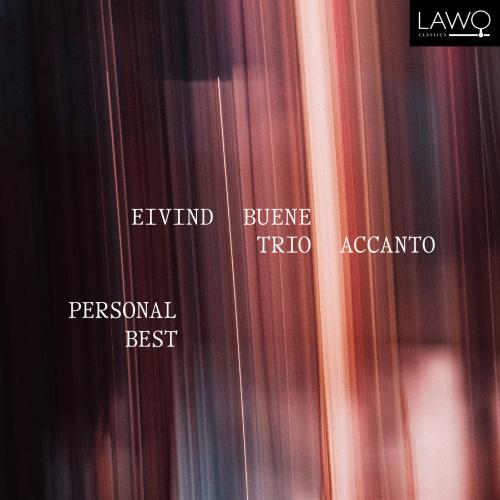
Personal Best Trio Accanto & Eivind Buene
Album info
Album-Release:
2025
HRA-Release:
20.03.2026
Label: Lawo Classics
Genre: Classical
Subgenre: Modern Composition
Artist: Trio Accanto & Eivind Buene
Composer: Eivind Buene (1973)
Album including Album cover
- Eivind Buene (b. 1973): Personal Best:
- 1 Buene: Personal Best: No. 1, Christian's collage 04:26
- 2 Buene: Personal Best: No. 2, I Saw Him Bring People to Tears 05:25
- 3 Buene: Personal Best: No. 3, Marcus' collage 03:54
- 4 Buene: Personal Best: No. 4, The Body is Not a Mistake 03:40
- 5 Buene: Personal Best: No. 5, Nic's collage 04:13
- 6 Buene: Personal Best: No. 6, It's Already Quite a Long Time 05:10
- Serious Songs:
- 7 Buene: Serious Songs: No. 1, We Try 04:06
- Interlude I:
- 8 Buene: Interlude I 01:35
- Serious Songs:
- 9 Buene: Serious Songs: No. 2, Under the Sun 02:34
- Interlude II:
- 10 Buene: Interlude II 01:20
- Serious Songs:
- 11 Buene: Serious Songs: No. 3, O Death 03:39
- Interlude III:
- 12 Buene: Interlude III 02:45
- Serious Songs:
- 13 Buene: Serious Songs: No. 4, Riddles, Mirrors, Silent Rooms 02:56
Info for Personal Best
Looking at Trio Accanto on stage, you see three very accomplished musicians playing together in a somewhat unconventional combination of instruments. But you also see an ensemble that embody a history of New Music, as collective and as individuals, having performed an enormous amount of repertoire from the last four decades. Writing for these musicians means to engage with this history, these bodies – both in a metaphorical and physical sense – that register so much of our recent past. For me, it also means engaging with my personal history, since I have listened to these musicians in various constellations for more than twenty years.
This embodied history – obliquely shared – was the starting point for my investigation in Personal Best. In earlier times we would have met and workshopped together, but instead we started out in long conversations, one-on-one, on Zoom. I asked the musicians about their instruments, their childhood, their philosophies, their families. I also I asked them to send me their favourite recordings with their own playing. Being unable to interact, physically, in the rehearsal studio, this became my way of gaining 'intimacy' with the ensemble. Later, as music began to emerge, the sounds and gestures responded to our conversations, and to the different recordings they had sent. I treated the recordings, encompassing a wide range of composers and styles, as found material from recent strata on the archaeological site of music. They became excavated fragments that evoke moments in the trio’s professional past, closely related to their personal histories. Nic Hodges phrases it beautifully in the piece: «I look through the pieces I've played, and it's an autobiography in a certain way, isn't it?».
The voice of the musician is an important element in Personal Best, in several meanings of the word. Fragments of our digital conversations seep into the piece, as the players share their stories and ideas in generous and unguarded ways. The speaking voice originates deep inside us, and the vocal presence draw awareness to the reality of the body on stage. Marcus Weiss simply states that «The body is not a mistake», and I agree. The playing body is not a transparent conveyer of music, it is a subjective force in the musical moment, mediating the sonic, the social and the philosophical. In Personal Best this subjectivity is highlighted in sections where the musicians improvise with sound collages of fragments from their recorded history. Maybe we can call it a form of autoethnography, where the players confront their own projections, and react to them in real time.
The collages are played from vinyl records, a format referring both to the players’ early experiences with recorded music and to sound as a physical matter. Recordings remind us that music is a history of interpretation and performance – not only of works and composers. The technology of recording was also the first real challenge to the 'now' of musical performance. The negotiation of the 'now' is an ongoing discussion, at the heart of live electronics, and a discussion the Experimentalstudio has been a vital part of since its beginning fifty years ago. If one regards the Experimentalstudio as an entity with its own subjective history, its own memories, its own desires, it also becomes a site for archaeological excavation. For Personal Best I have searched in the hardware past of the studio, and limited the live electronics to classic methods like ring modulators, filters, signal generator, pitch shifters, scavenged from archives and storage rooms.
This hardware is of course a form of ‘obsolete’ technology – ‘obsolete’ in quotation marks, because in the instant they sound on stage they become part of the present. Let us call it a synchronization of Non-synchronous forms, when mechanical instruments meet analogue methods in the digital domain. Embodied time meets clock-time, human gesture meet machine-gesture, personal histories meet technological change. The synchronization tends to blurry the lines between such dichotomies, and maybe this ability – to hold diverging temporalities together in a single performance space, a single auditory moment – is one of the finest aspects of what we call music.
Trio Accanto
Eivind Buene, vocals
Trio Accanto
Consisting of Marcus Weiss (saxophone), Stefan Wirth (piano) and Christian Dierstein (percussion), Trio Accanto is a group of three internationally prominent soloists bound together by a unique approach to chamber music. The ensemble has been praised for its "mastery" and "world-class interpretations.”
The trio was originally founded in 1994 by Yukiko Sugawara, Marcus Weiss, and Christian Dierstein. From 2013 to 2025, the pianist of the ensemble was Nicolas Hodges. Since 2025, Stefan Wirth has joined the group as pianist.
The scoring of saxophone, piano, and percussion is common in jazz but was a rarity in classical music—leading to the description "a jazz trio that does not play jazz"—until Trio Accanto turned this situation around, stimulating close to one hundred composers to write new works over the years. Major figures such as Mark Andre, Georges Aperghis, Aldo Clementi, Michael Finnissy, Vinko Globokar, Georg Friedrich Haas, Toshio Hosokawa, Helmut Lachenmann, Brice Pauset, Rolf Riehm, Wolfgang Rihm, Rebecca Saunders, Salvatore Sciarrino, Martin Smolka, Christian Wolff, and Walter Zimmermann have contributed to the trio's repertoire, along with a substantial list of younger composers from around the world. A rigorous and increasingly broad-ranging programme of commissions continues, including works by Lisa Illean, Misato Mochizuki, Eivind Buene, Beat Furrer, Evan Johnson, and Mikel Urquiza.
Trio Accanto has performed at festivals in Donaueschingen, Witten, Darmstadt, Hanover, Cologne, Munich, Freiburg, Huddersfield, Basel, and Saarbrücken, as well as at Eclat (Stuttgart), Munich Biennale, Maerzmusik (Berlin), Salzburg Festival, Wien Modern, Tage für Neue Musik (Zurich), and further afield in Madrid, Seville, Chicago, Viitasaari (Finland), and at the Takefu Festival (Japan).
The trio's CD recordings have appeared on Kairos, HatHut, Edition Zeitklang, Assai, Verso, and Wergo. Recent releases on Wergo include Funambules, featuring music by Aperghis, Riehm, Schöllhorn, and Prins; Songs and Poems, featuring music by Clementi, Dohmen, Rihm, Thomalla, and Zimmermann; and other stories, featuring music by Finnissy, Kuwabara, Lachenmann, Schüttler, and Smolka. The most recent is a disc of music by Christian Wolff, featuring the half-hour Trio IX – Accanto, along with a group of recent Exercises, some also written especially for Trio Accanto. Future releases include Evan Johnson’s Plan and section of the same reservoir on the label Another Timbre, recorded after a series of performances in Autumn 2021.
This album contains no booklet.