


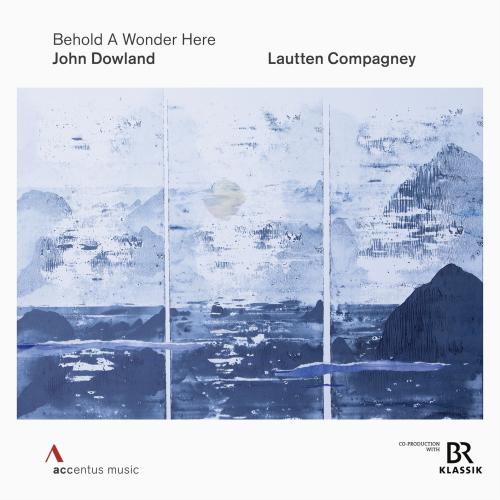
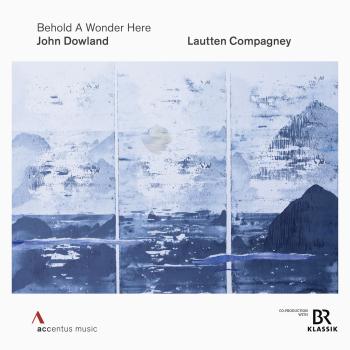
Behold A Wonder Here - John Dowland Lautten Compagney & Wolfgang Katschner
Album info
Album-Release:
2026
HRA-Release:
25.09.2026
Label: Accentus Music
Genre: Classical
Subgenre: Vocal
Artist: Lautten Compagney & Wolfgang Katschner
Composer: John Dowland (1562-1626)
Album including Album cover Booklet (PDF)
- John Dowland (1563 - 1626): Come again:
- 1 Dowland: Come again 03:30
- Were every thought an eye:
- 2 Dowland: Were every thought an eye 02:10
- Praise blindness eyes, for seeing is deceit:
- 3 Dowland: Praise blindness eyes, for seeing is deceit 01:52
- A shepherd in a shade his plaining made:
- 4 Dowland: A shepherd in a shade his plaining made 02:53
- My thoughts are wingd with hopes:
- 5 Dowland: My thoughts are wingd with hopes 02:47
- Clear or cloudy sweet as April showring:
- 6 Dowland: Clear or cloudy sweet as April showring 02:15
- The King Of Denmark's Galliard:
- 7 Dowland: The King Of Denmark's Galliard 02:24
- His golden locks time hath to silver turned:
- 8 Dowland: His golden locks time hath to silver turned 03:39
- Stay time a while thy flying:
- 9 Dowland: Stay time a while thy flying 02:47
- Time Stands Still:
- 10 Dowland: Time Stands Still 04:24
- O sweet woods, the delight of solitarinesse:
- 11 Dowland: O sweet woods, the delight of solitarinesse 07:14
- Mr Dowland‘s Midnight:
- 12 Dowland: Mr Dowland‘s Midnight 02:01
- Flow my teares, fall from your springs:
- 13 Dowland: Flow my teares, fall from your springs 03:58
- Now, O now, I needs must part:
- 14 Dowland: Now, O now, I needs must part 05:47
- My Lady Hundsdon’s Puffe:
- 15 Dowland: My Lady Hundsdon’s Puffe 01:48
- Fine knacks for ladies:
- 16 Dowland: Fine knacks for ladies 04:08
- The lowest trees have tops:
- 17 Dowland: The lowest trees have tops 01:59
- Unquiet thoughts:
- 18 Dowland: Unquiet thoughts 03:40
- Behold a wonder here:
- 19 Dowland: Behold a wonder here 02:56
- Humour say what makst thou here:
- 20 Dowland: Humour say what makst thou here 03:06
- Lady if you so spite me:
- 21 Dowland: Lady if you so spite me 03:02
- What poor astronomers are they:
- 22 Dowland: What poor astronomers are they 02:14
- Can she excuse my wrongs:
- 23 Dowland: Can she excuse my wrongs 03:29
Info for Behold A Wonder Here - John Dowland
John Dowland’s Songs and Ayres are among the most important song collections of the European Renaissance. They combine a distinctive musical language with an extraordinary poetic expressiveness: intimate love songs, profound melancholy, subtle humor and moments of unexpected lightness unfold into a richly varied panorama of human emotion.
400 years after Dowland's death, the Lautten Compagney Berlin turns to this unique universe in a carefully curated selection drawn from his five songbooks presented on their new album Behold a wonder here. Iconic works such as Flow my tears, Come again, Time stands still and the title piece Behold a wonder here are placed alongside less frequently heard songs, revealing the remarkable breadth and depth of Dowland’s art.
The richly colored ensemble – vocal consort, Renaissance lute, theorbo, Renaissance guitar, cittern, orpharion, viol consort as well as organ and harpsichord – creates a multi-layered sonic world in which every nuance of the music becomes audible. With their distinctive sense of timbre, clarity of text and stylistic precision, the Lautten Compagney Berlin brings these masterpieces to life with freshness, elegance and expressive power.
Behold a wonder here presents John Dowland as a composer of timeless modernity, whose songs continue to move listeners through their emotional depth, melodic beauty and immediate expressive force. This recording reveals the richness of the English Renaissance in all its colors.
Julia Böhme, Mezzo-soprano
Kathleen Danke, Soprano
Anna Moritz, Soprano
Mirko Ludwig, Tenor
Cornelius Uhle, Bass
Lautten Compagney
Wolfgang Katschner, Musical Director

Wolfgang Katschner
studied classical guitar at the Hanns-Eisler Academy of Music in Berlin and lute at the University of Music and Performing Arts in Frankfurt am Main.
In 1984, together with Hans-Werner Apel, he founded the lautten compagney BERLIN in what was then East Berlin. Today it is one of the leading and most innovative German ensembles of historically informed performance practice, which maintains an extensive international presence with performances and projects from Berlin.
Wolfgang Katschner conceives and plans the lautten compagney's content, its creative work processes and its integration into the historical repertoire. This includes extensive preparatory and research work. The results of these complex and labour-intensive studies are the trademark of the lautten compagney and account for its specific sound as well as the great variety of programmes and projects.
In addition to his work with the lautten compagney, Wolfgang Katschner also works successfully as a guest conductor at German opera houses. For example, he was musical director of the "Winter in Schwetzingen" in 2012-2016. After guest appearances in Bonn (Handel's "Rinaldo" and "Giulio Cesare") and Oldenburg (Hasse's "Siroe"), he has been responsible for three opera productions at the Nuremberg State Theatre since 2018: Monteverdi's "Ulisse" at the end of the 2017/18 season and Handel's "Serse" in November 2018, as well as a highly acclaimed premiere of Cavalli's "La Calisto" at the end of 2019. In the 2020/2021 season, he will conduct Monteverdi's L'Orfeo at the Semperoper in Dresden.
Wolfgang Katschner is also increasingly involved in the training of young artists. He was a guest professor at the Hanns Eisler Academy of Music in Berlin, at the SingFest in Hong Kong, artist in residence at BarockVokal in Mainz, worked with singers at the Franz Liszt Academy of Music in Weimar in 2018 and 2019, and will conduct a student production of Handel's Alcina at the Carl Maria von Weber Academy of Music in Dresden in spring 2020.
Lautten Compagney
The history of historically informed performance practice in the GDR has not yet been written - astonishing, considering that two of today's most important German ensembles were founded in the early 1980s in East Berlin, the lautten compagney BERLIN and the Akademie für Alte Musik. While in the West, playing on period instruments was inexorably pushing its way out of the niche and into the concert halls thirty or forty years ago, it was not yet part of official culture in the GDR. Those who wanted to deal with such things usually did so alongside their work in the orchestra.
Wolfgang Katschner and Hans-Werner Apel, on the other hand, were still students of classical guitar when they met at the East Berlin Academy of Music "Hanns Eisler" and discovered their common interest in early music. They delved into old manuscripts and prints, scores and tablatures, the composers being William Byrd, John Dowland, Matthew Locke or William Lawes. They couldn't get anywhere with this music with their modern guitars. So they got themselves lutes and theorbos, laying the tonally intimate and delicate foundation for the lautten compagney BERLIN, which today is a multi-award-winning and one of the world's most original, exciting, imaginative and versatile early music ensembles.
The fact that singers such as Dorothee Mields, Lynne Dawson or Simone Kermes perform with the lautten compagney again and again is proof not only of their musical qualities but also of the special conceptual intelligence that drives this ensemble and Wolfgang Katschner, who still picks up the lute but has long since become conductor, artistic director and generator of ideas:
Programmes and CDs are created here that combine the familiar and the unfamiliar with dramaturgical sense and are also played with a vitality that mocks the term "early music". This brings us to the core, to what distinguishes the lautten compagney from other ensembles. It cultivates its traditions, such as the Christmas Oratorio on Boxing Day or the Bach Passions on Good Friday. It performs a deeply moving Marian Vespers and has celebrated great successes with Handel operas.
But such repertoire works shine in a special, contemporary light with the lautten compagney, because in such performances the ensemble also tells of countless artistic adventures beyond these summit works. Wolfgang Katschner is not only curious about music, but also about new ways of presenting it in concert. The idea of interweaving music by Tarquinio Merula and Philip Glass, for example, was ingenious - the CD "Timeless" was awarded the ECHO for these unique and magical sounds that hover between old and new. With the AEQUINOX Festival in Neuruppin, the lautten compagney has had its own individual platform for experimentation since 2010.
The lautten compagney does not seek abstract truths about the past and is not interested in competitive virtuosity - even if it were available to it. It makes music for today's listeners. If the light-hearted slogan "historically informed, interpreted in a contemporary way" applies at all to an ensemble, then it applies to the lautten compagney.
The fact that historically informed performance practice only ever allows approximations to what once was is cause for frustration for some and for academic philology, which is pursued all the more doggedly. For the lautten compagney, this uncertainty opens up creative freedom, not only conceptually but also interpretatively. There is a very particular grip on sound, often also a very particular humour, which gives the performances and recordings of this ensemble an unmistakable tone.
When the rhythm becomes so light-footed that the music begins to swing, the old seems very close. But at the same time, across the centuries, with all the seriousness of that time, a sound touches us whose warmth and love, whose wisdom and humanity carries and enriches us.
Booklet for Behold A Wonder Here - John Dowland