




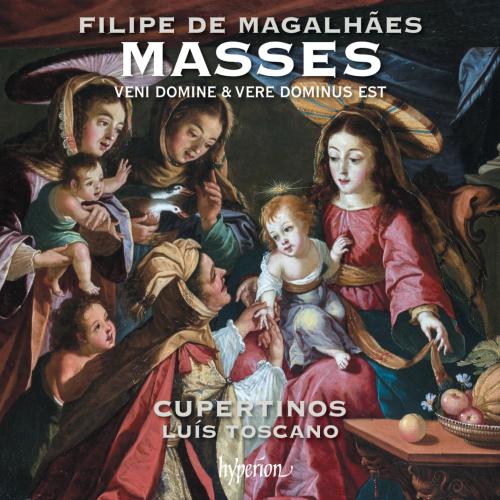
Magalhães: Missa Veni Domine & Missa Vere Dominus est Cupertinos & Luís Toscano
Album info
Album-Release:
2023
HRA-Release:
01.09.2023
Label: Hyperion
Genre: Classical
Subgenre: Choral
Artist: Cupertinos & Luís Toscano
Composer: Filipe de Magalhães (1563-1652)
Album including Album cover Booklet (PDF)
I`m sorry!
Dear HIGHRESAUDIO Visitor,
due to territorial constraints and also different releases dates in each country you currently can`t purchase this album. We are updating our release dates twice a week. So, please feel free to check from time-to-time, if the album is available for your country.
We suggest, that you bookmark the album and use our Short List function.
Thank you for your understanding and patience.
Yours sincerely, HIGHRESAUDIO
- Filipe de Magalhães (1571 - 1652): Exsurge, quare obdormis Domine?:
- 1 Magalhães: Exsurge, quare obdormis Domine? 03:09
- Francisco Guerrero (1528 - 1599): Veni Domine:
- 2 Guerrero: Veni Domine 04:09
- Filipe de Magalhães: Missa Veni Domine:
- 3 Magalhães: Missa Veni Domine: Ia. Kyrie I 00:53
- 4 Magalhães: Missa Veni Domine: Ib. Christe I 00:49
- 5 Magalhães: Missa Veni Domine: Ic. Christe II 00:49
- 6 Magalhães: Missa Veni Domine: Id. Kyrie II 00:59
- 7 Magalhães: Missa Veni Domine: IIa. Gloria in excelsis Deo 02:06
- 8 Magalhães: Missa Veni Domine: IIb. Qui tollis peccata mundi, miserere 02:09
- 9 Magalhães: Missa Veni Domine: IIIa. Credo in unum Deum 03:19
- 10 Magalhães: Missa Veni Domine: IIIb. Crucifixus 01:56
- 11 Magalhães: Missa Veni Domine: IIIc. Et in Spiritum Sanctum 02:23
- 12 Magalhães: Missa Veni Domine: IVa. Sanctus 01:41
- 13 Magalhães: Missa Veni Domine: IVb. Benedictus 01:26
- 14 Magalhães: Missa Veni Domine: Va. Agnus Dei I 01:52
- 15 Magalhães: Missa Veni Domine: Vb. Agnus Dei II / Veni Domine 02:01
- Filipe de Magalhães: Magnificat:
- 16 Magalhães: Magnificat: I. Magnificat anima mea Dominum 00:43
- 17 Magalhães: Magnificat: II. Et exsultavit 00:45
- 18 Magalhães: Magnificat: III. Quia respexit 01:05
- 19 Magalhães: Magnificat: IV. Quia fecit mihi magna 00:55
- 20 Magalhães: Magnificat: V. Et misericordia eius 01:18
- 21 Magalhães: Magnificat: VI. Fecit potentiam 00:53
- 22 Magalhães: Magnificat: VII. Deposuit potentes 00:58
- 23 Magalhães: Magnificat: VIII. Esurientes implevit bonis 00:49
- 24 Magalhães: Magnificat: IX. Suscepit Israel 01:09
- 25 Magalhães: Magnificat: X. Sicut locutus est 00:55
- 26 Magalhães: Magnificat: XI. Gloria Patri 00:59
- 27 Magalhães: Magnificat: XII. Sicut erat in principio 01:15
- Pierre de Manchicourt (1^510 - 1564): Vere Dominus est:
- 28 Manchicourt: Vere Dominus est: I. Vere Dominus est 03:48
- 29 Manchicourt: Vere Dominus est: II. Haec est domus Domini 03:44
- Filipe de Magalhães: Missa Vere Dominus est:
- 30 Magalhães: Missa Vere Dominus est: Ia. Kyrie I 00:53
- 31 Magalhães: Missa Vere Dominus est: Ib. Christe I 01:00
- 32 Magalhães: Missa Vere Dominus est: Ic. Christe II 00:53
- 33 Magalhães: Missa Vere Dominus est: Id. Kyrie II 01:08
- 34 Magalhães: Missa Vere Dominus est: IIa. Gloria in excelsis Deo 01:54
- 35 Magalhães: Missa Vere Dominus est: IIb. Qui tollis peccata mundi, miserere 02:33
- 36 Magalhães: Missa Vere Dominus est: IIIa. Credo in unum Deum 03:00
- 37 Magalhães: Missa Vere Dominus est: IIIb. Crucifixus 01:47
- 38 Magalhães: Missa Vere Dominus est: IIIc. Et in Spiritum Sanctum 02:30
- 39 Magalhães: Missa Vere Dominus est: IVa. Sanctus 01:48
- 40 Magalhães: Missa Vere Dominus est: IVb. Benedictus 01:40
- 41 Magalhães: Missa Vere Dominus est: Va. Agnus Dei I 01:48
- 42 Magalhães: Missa Vere Dominus est: Vb. Agnus Dei II 02:31
- Filipe de Magalhães: Commissa mea pavesco:
- 43 Magalhães: Commissa mea pavesco 03:39
Info for Magalhães: Missa Veni Domine & Missa Vere Dominus est
Filipe de Magalhães (1563-1652) was most probably a companion of Duarte Lobo (c1565-1646) and Manuel Cardoso (1566-1650) at Évora Cathedral, and was arguably the most acclaimed Portuguese composer among his contemporaries. In the extraordinary context of musical activity in Portugal during the sixteenth and seventeenth centuries, he has been pointed out as the favourite pupil of the renowned master Manuel Mendes (c1547-1605), who bequeathed his musical estate to him in exchange for an intended posthumous edition that sadly never came to fruition. By the end of the 1580s, Magalhães was already a music tutor and singer in the service of Évora Cathedral, from which he would leave for Lisbon in 1596. There, according to the pioneering historian and bibliographer Diogo Barbosa Machado (1682-1772), he was appointed ‘master of the Caza da Misericordia of Lisbon’ and, ‘with great credit to his talent’, master of the Royal Chapel—where he succeeded Francisco Garro (d1623)—from 1623 to 1641, leaving an indelible mark as one of the most esteemed Portuguese musicians.
As a pedagogue, Filipe de Magalhães is credited with having guided such distinguished composers as Estêvão de Brito (c1575-1641) and Estêvão Lopes Morago (c1575-after 1630). In 1614 he published Cantus ecclesiasticus, a book consisting mainly of plainsong dedicated to the liturgical Office of the Dead, whose success can be gauged by its continual re-publication over almost two centuries (until at least 1804), and which earned him the title of ‘distinguished master’ in the Art of plainsong, a treatise by Pedro Thalesio (c1563-c1629) published in Coimbra in 1618. Magalhães, nonetheless, had to wait until 1636 to get his two volumes of polyphonic music—the Missarum liber and Cantica Beatissimae Virginis—published in Lisbon at the workshop of Lourenço Craesbeeck. Aside from the chronological coincidence (it was a remarkable year for Craesbeeck which also saw the publication of two of the three Mass books by Manuel Cardoso), Magalhães’s two volumes are also interesting because they are dedicated, respectively, to Philip III of Portugal (Philip IV of Spain) and Dom João, at the time Duke of Braganza but who, four years later, would be proclaimed John IV, King of Portugal, thus concluding the troubled six-decade period (1580-1640) that would come to be known as the Iberian Union. ...
Cupertinos
Luis Toscano, conductor
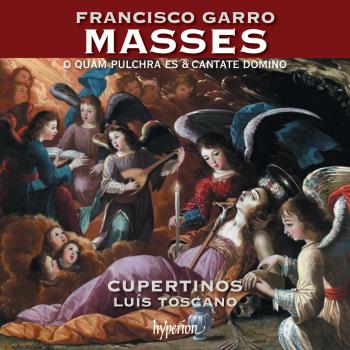
Cupertinos
Founded in 2009 by the Cupertino de Miranda Foundation (Vila Nova de Famalicão, Portugal), the vocal ensemble Cupertinos is dedicated almost exclusively to the Portuguese musical heritage of the sixteenth and seventeenth centuries, based on world-famous composers such as Duarte Lobo, Manuel Cardoso, Filipe de Magalhães and Pedro de Cristo.
Giving over fifteen concerts each year, the Cupertinos have presented around 300 works to date, including over 120 modern premieres. Several of these unpublished works have been transcribed from their original sources by members of the Cupertinos themselves under the guidance of music director Luís Toscano and musicologist Professor José Abreu (University of Coimbra and ESMAE).
Besides the International Festival of Portuguese Polyphony that they host, the Cupertinos have participated in renowned music festivals in Portugal, Spain, Italy and Germany. The group’s UK debut in the ‘Choral at Cadogan’ concert series was followed by performances at the Laus Polyphoniae festival in Antwerp and at the Wigmore Hall in London.
Since 2022 the Cupertinos have been members of REMA (Réseau Européen de Musique Ancienne), the most prominent European network dedicated to the safeguarding and dissemination of early music, with 134 members and representatives from over twenty countries.
The Cupertinos are renowned as ‘true ambassadors of Portuguese polyphony’, and this epithet has been greatly enhanced by their earlier albums, dedicated in turn to Manuel Cardoso, Duarte Lobo, Pedro de Cristo and Filipe de Magalhães. Released by Hyperion, these recordings appear regularly on classical radio stations across Europe and North America, and have been acclaimed by BBC Music Magazine, Gramophone, Choir & Organ and Chorzeit, among others. Their debut album was nominated for a Preis der deutschen Schallplattenkritik, and won a 2019 Gramophone Award in the ‘Early Music’ category. They were finalists in the 2020 ‘PLAY—Portuguese Music Awards’ and in 2021 were winners in the PLAY Best Classical Album category.
Luís Toscano
Having trained as a young chorister in the Coro dos Pequenos Cantores de Coimbra, Luís continued his musical studies at Coimbra Conservatory, while also achieving a Licentiate Diploma in Economy from Coimbra University. He subsequently obtained a Portuguese Government scholarship to research, edit and perform sixteenth- and seventeenth-century Portuguese music, and completed his Masters in Music at Aveiro University. He is now studying for a PhD in Art/Music Studies at Coimbra, where he is a researcher at the Centre for Classical and Humanistic Studies.
Critically acclaimed as ‘a major exponent of Portuguese Renaissance polyphony’ and ‘a musician of refined instinct’, Luís was until 2023 the music director and a member of Cupertinos, with whom he was awarded Gramophone’s Early Music Award in 2019.
Based in Denmark since 2024, Luís is active as director and singer, specializing in pre-Classical and contemporary repertoires. He is a co-founder of vocal ensemble Quarto Tom and a member of Ars Nova Copenhagen. He was a founding member of Coro Casa da Música, and works regularly with other prominent ensembles in Portugal, Spain, Denmark, Ireland and the United Kingdom.
Booklet for Magalhães: Missa Veni Domine & Missa Vere Dominus est