



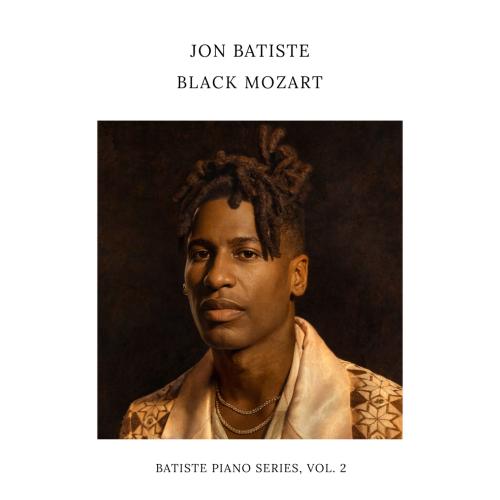
Black Mozart Jon Batiste
Album info
Album-Release:
2026
HRA-Release:
14.08.2026
Label: Jon Batiste - Black Mozart
Genre: Classical
Subgenre: Classical Crossover
Artist: Jon Batiste
Album including Album cover
I`m sorry!
Dear HIGHRESAUDIO Visitor,
due to territorial constraints and also different releases dates in each country you currently can`t purchase this album. We are updating our release dates twice a week. So, please feel free to check from time-to-time, if the album is available for your country.
We suggest, that you bookmark the album and use our Short List function.
Thank you for your understanding and patience.
Yours sincerely, HIGHRESAUDIO
- 1 Facile-Batiste 04:55
- 2 Alla Blues 02:49
- 3 Alla Turc Movement 03:16
- 4 Shine 02:27
- 5 Twinkle 02:23
- 6 Processional 02:52
- 7 Country Zart 02:50
- 8 Molto 02:16
- 9 Molto In Cayo Hueso 07:35
- 10 Gospel Andante 03:55
Info for Black Mozart
The second installment of the Batiste Piano Series sees multi-Grammy® and Oscar® winner Jon Batiste reinterpret Wolfgang Amadeus Mozart’s most beloved melodies as Black American classical music, infused with influences from jazz, rags, stride, blues and stomps. The result is a vibrant conversation without words - not about genre, but pure expression.
“Wolfgang Amadeus Mozart, a pioneering genius and eccentric innovator who created his own musical language yet honored his predecessors, a master of symmetry and refiner of structure and form, seamlessly combined extreme melodic simplicity with staggering complexity that challenged the conventions of his time but still had a universal appeal. His enormously vast body of work is among the most ubiquitous and reinterpreted music of all time.
But in reinterpretation you must not strip the music of its essence—that conversation between its mathematical construction, rhythmic structure and melodic innocence. If you alter one element of that special alchemy the wrong way, it loses its potency and identity. Like Thelonius Monk, for me a latter-day example of all the same qualities, Mozart was a meticulous metaphysician who created a special blend of logical mastery that still somehow defies explanation.
Mozart didn’t have large pendulum swing eras where his musical approach shifted dramatically. He absorbed what was in his orbit while the core of his approach remained consistent. Somehow his music was always modern.
He also absorbed everything that led to him. He was the obvious successor of Johann Sebastian Bach: both were keyboardists, supreme improvisers, providers of melody in all registers and purveyors of the percussive left hand. If Bach was a foundation, Mozart was a bridge that eventually led to the modern age.
M is for Modern. Metaphysical. Melodic. Mathematical. Momentous. Monolithic. Manifestation. Masses of people this music continues to touch.
M is a bridge in spiritual symbolism too, between the material and spiritual realms. It’s the 13th letter of the alphabet, a numerological 4 (1 + 3) representing stability, structure, and order but off-balance enough to crescendo forward. The nickname Amadeus is the Latin translation of Mozart’s baptismal middle name, Theophilus, both meaning “loved by God” or “lover of God.”
M is also for Music. Pure music. It exists in the material world but creators like Mozart already have one foot on another plane of existence, just passing through.
A key aspect of Mozart’s music of immense potency is how accessible and elementary it is—humble, singable melodies not overwritten—capturing the essence of childhood. There is an innocence to the sound that you can hear even without any understanding of music.
Even still, my first impressions of Mozart’s music weren’t completely favorable. It felt a little too “stuffy” for me and didn’t immediately capture my imagination.
Then my mentor Alvin Batiste helped open my ears. He took his love for Mozart’s melodic approach and composed a twelve-bar blues tune based on the vernacular, embedding that influence into a foundational Black American idiomatic form. This was the seed planted that eventually got me to love his music too.
Basically, he took what he loved about Mozart and reimagined it as Black American classical music.
I found this music when I was a kid and some twenty years later I am still reimagining to extend the implications I see within it.
I reimagined Mozart “Black” in the tradition of Mr. Batiste, imbuing it with influences from jazz, rags, stride, blues, stomps but still maintaining its core essence of modern classical music. Like my last album in this series, Beethoven Blues, this is a conversation without words, not about genre but about commonality, improvisation, expression, and innocence, in that spiritual realm where M really lives.” – Jon Batiste
Jon Batiste, piano
Arranged and produced by Jon Batiste
Recorded by Kaleb Rollins at Jefferson Parish Studios
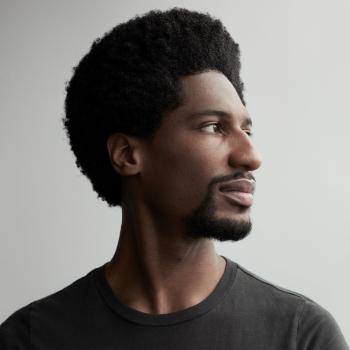
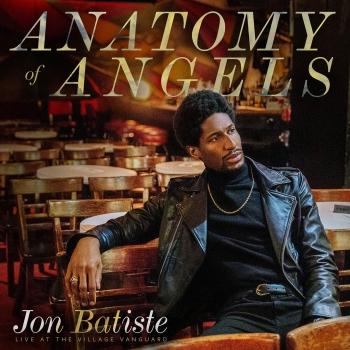
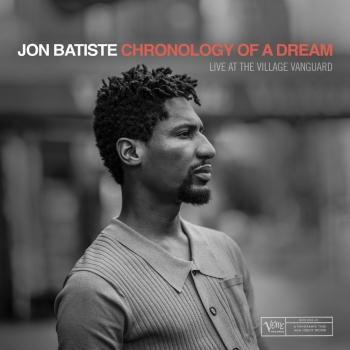
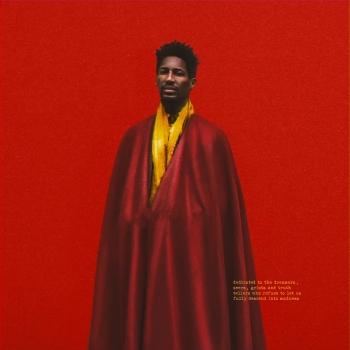
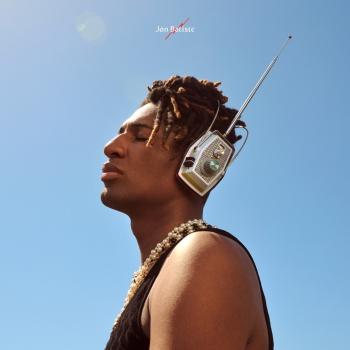
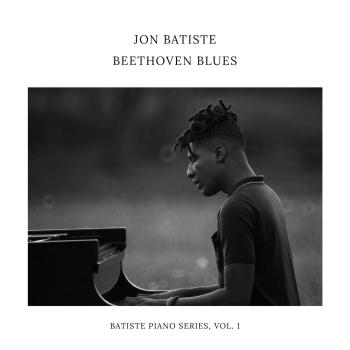
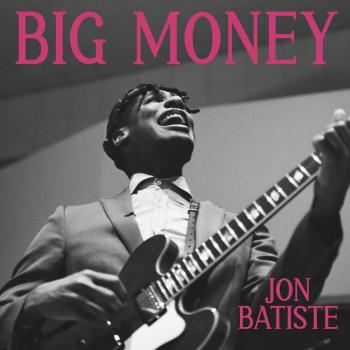
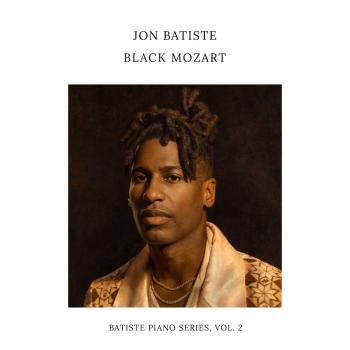
Jon Batiste
“I think we each need to identify what the thing is that we were born to do,” says Jon Batiste. “Everybody has something they are born with and are representing—but a lot of times we run from that, from what comes most naturally. But once you find that, then you can learn and add different flavors and spices, and really grow with what you are and who you are.”
The title of HOLLYWOOD AFRICANS comes from a 1983 painting by the great African-American artist Jean-Michel Basquiat, and the reference is significant. “Basquiat is an example of someone drawing from all his influences,” Batiste says, “who benefited from the sacrifices of those who came before him, but displayed that we have so much more to do—even though we’ve come a long way. It’s a critique of things we have had to go through, but that have allowed people like me and him the opportunities to do the things we’ve been able to do.
With HOLLYWOOD AFRICANS, Batiste dives deep into his own personal and cultural heritage, weaving an intimate and emotional tapestry out of original material and American standards that carries the listener from the early jazz of New Orleans to the present day. Guiding the acclaimed singer, composer, multi-instrumentalist, and leader of the group Stay Human—since 2015 the house band of The Late Show with Stephen Colbert—was legendary producer T Bone Burnett, whose numerous accolades include Album of the Year Grammys for the O Brother Where Art Thou? soundtrack and Raising Sand by Robert Plant and Alison Krauss.
“The goal was just to collaborate on something that felt authentic to both of us,” says Batiste. “What we came up with was an intimate, stripped-down portrait of who I am, and the lineage of musicians and performers who are really vital to my work and to his. On this record, I want us to bop, dance, laugh and cry to the sound of the music while we remember our black heroes and wield the superpowers they left us with. Because of them, I don't have to wear a mask. I get to be who I am.”
The pair met at a birthday party for Bono in Los Angeles. The guests—Pharrell, Herbie Hancock, Beck—all sat at a long table and everybody performed a song as a gift to the U2 singer. After playing his offering with Stay Human, Batiste started talking to Burnett, and recognized their kindred musical spirits. Batiste joined a session that Burnett was producing for folk singer Rhiannon Giddens, and they started making plans for a more extensive project.
A year later, as Batiste was getting ready to take over his role on the Late Show, they went into Esplanade Studios in New Orleans. “It’s an old church converted into a studio, with amazing acoustics,” says Batiste. “The sound has a special quality, almost like you’re sitting under the piano. It was a joy to capture that sound, and then it was off to the races.”
They got forty tracks down in two days—initially, songs by many of Batiste’s heroes: Duke Ellington, Nat King Cole, Nina Simone, and early New Orleans composers like Jelly Roll Morton. “A lot of those didn’t make the final cut,” he says, “but it let us tap into that tradition of people who were both high artists and entertainers.”
Born in Kenner, Louisiana (check the opening instrumental, “Kenner Boogie”) Batiste is a member of one of the biggest and most important musical families of the New Orleans area. He started playing drums with the Batiste Brothers Band at age 8, before switching to piano a few years later. HOLLYWOOD AFRICANS, his sixth album (in addition to multiple EPs), represented an opportunity to explore his own history.
“The styles are a lot of things I grew up hearing, studying, trying to internalize,” he says. “And being the bandleader of a late-night show, that fraternity is important, too—musicians who have studied their craft and found a way to translate that into a unique personality.”
Burnett helped steer the ship as Batiste cut each song in one or two takes.
“T Bone set a certain ethos in the recording process that seeps into the record,” says Batiste. “It’s not a tangible thing you can measure, but a way to explore the artistry. He allowed me to be who I am and capture it sonically in a way that was most representative of that.” (He notes that Burnett even gave him a story by Zora Neale Hurston about the African-American folk hero High John the Conqueror to help “evoke the lineage we were trying to draw from.”)
After the 2015 sessions, they reconnected for another day in 2017 and then two more in May of 2018, keeping a focus on Batiste alone at the piano. “The idea was to strip everything down, go back to basics,” he says. “When you strip something down to rawest form, the essence of it shines through.” He believes that this is why, though the album was recorded over such a long time, it still feels unified and not dated; “You’re getting who I am at the core.”
The classic songs on HOLLYWOOD AFRICANS include the New Orleans standard “Saint James Infirmary,” “Smile,” “The Very Thought of You,” and Louis Armstrong’s iconic “What a Wonderful World,” which is slowed down to a soothing crawl; Batiste asks the audience to close their eyes when he plays the song onstage. “I took something Pops was known for and restated it, made it into a meditation about where the world is today,” he says. “The drone I play in my left hand helps get you focused.”
Batiste doesn’t feel intimidated by taking on such hallowed material. “I do understand why someone might feel that way,” he says, “but I just feel so authentically part of that history, I can approach it without apprehension. I feel it more as a calling—maybe not a responsibility, but a privilege to have insight into that lineage and represent it properly.”This is just the beginning.
I hope to write the next chapter of black American Music alongside my generation.
Quickly, though, Batiste started to write more songs of his of own. He points to “Is It Over” and “Don’t Stop” as examples of the fusion of influences to which he aspired. “They feel original, but drawing from those root elements—folk, gospel, jazz, blues, even classical music—and transforming them into something new. ‘Mr. Buddy’ is another one, a really vulnerable performance that mixes the different elements in one of the most unique ways on the record, and also works as a song.”
Three years after the initial New Orleans sessions, Batiste (with the help of arranger Harvey Goldberg) determined that he wanted to add some overdubs to a few of the tracks. “A record really is different from a live performance, “ he says, “so I wanted to create an atmosphere around some of the records to enhance the emotions.”
“It’s a great statement right now,” he continues. “With so much division in the world, we can remember the contributions of great artists as a way to help unify us.”
This album contains no booklet.