




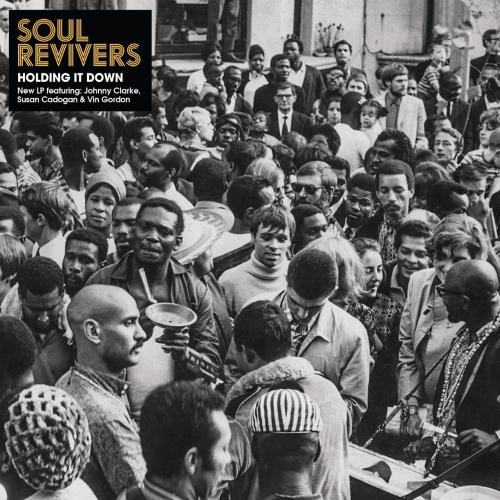
Holding It Down Soul Revivers
Album info
Album-Release:
2026
HRA-Release:
28.08.2026
Album including Album cover
- 1 The Good Book 04:17
- 2 No Place 03:52
- 3 Everything Is Everything 03:20
- 4 A Thousand Years 04:02
- 5 Serious Time 03:59
- 6 Stable Way 04:05
- 7 Like A Lion 03:49
- 8 Come Back To Me 04:41
- 9 Holding It Down 03:37
Info for Holding It Down
Acid Jazz presents the new album from Soul Revivers 'Holding It Down', featuring Johnny Clarke, Susan Cadogan, Vin Gordon and others.
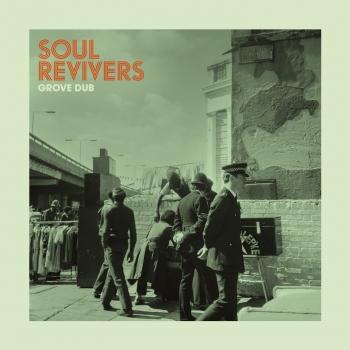
Soul Revivers is an ambitious and collaborative project from David Hill and Nick Manasseh, bringing together icons of Jamaican music with some of London’s finest musical talent, steeped in West London’s reggae heritage. After their critically acclaimed 2022 album 'On The Grove' and subsequent dub version 'Grove Dub', they return with the new album Holding It Down.
After 'On The Grove'’s impressive set of collaborations with the likes of Ken Boothe, Ernest Ranglin and Devon Russell, 'Holding It Down' features a further roster of legends. Johnny Clarke, one of reggae’s founding fathers, performs the lead track, written with Manasseh and Hill for the record, 'The Good Book', as well as his earlier composition 'Come Back To Me', originally recorded by Neil ‘Mad Professor’ Fraser in 1985, and given the Soul Revivers treatment.
Fellow Jamaicans, vocalists Susan Cadogan and Earl 16, and trombonist Vin Gordon, bring their exceptional talents to three further tracks: No Place, Serious Time and Everything Is Everything respectively. Also featured is Sandra Cross, a stalwart of the UK reggae scene, who appears A Thousand Years and Like A Lion.
While shining a light on key figures from the pillars of reggae, Soul Revivers are defined as much by their contemporary vision and vitality, working with some of the finest musicians from the wider London music scene. Appearing on Stable Way is bandleader and trumpeter Sheila Maurice-Grey (aka Ms. Maurice) and Anoushka Nangay from Kokoroko (who previously appeared on On The Grove standalone 45, Coconut Rock).
Recorded at Nick Manasseh’s The Yard studio, the rhythm section includes Manasseh (bass), with Adrian ‘Kenz’ McKenzie (drums), Will Rast (keyboards), James Shepherd and Wayne Almond (guitars), alongside horns Colin Humphries and Dougal Caston.
Soul Revivers prove once again they are exemplifiers of world class reggae, expertly drawing on its history, while incorporating contemporary artistry and new sounds, to create something fresh and timeless.
Fittingly released to coincide with the 2026 Carnival, it is an institution close to the hearts of Soul Revivers - Nick having played there on the Manasseh sound system in the 1990s, while David runs the official Carnival after-parties at the The Tabernacle - as they continue to expand West London’s reggae connections.
Ernest Ranglin
Ernest Ranglin was born June 19, 1932, and grew up in the small town of Robin’s Hall in the Parish of Manchester, a rural community in Jamaica.
Ranglin’s destiny was set from an early age when two of his uncles showed him the rudiments of playing the guitar. Ranglin learned how to play by imitating his uncles, but he was soon to be influenced by the recordings of the great American jazz guitarist Charlie Christian. He moved to Kingston, ostensibly to finish his studies at Bodmin College, but his true lessons came from guitar books and late-night sessions watching the Jamaican dance bands of the time.
In 1948 he joined his first group, the Val Bennett Orchestra, playing in the local hotels. By the early fifties, he was a member of Jamaica’s best- known group, the Eric Deans Orchestra, touring around the Caribbean and as far north as the Bahamas.
The big bands gave Ranglin the chance to learn how to orchestrate and arrange. The constant touring and meeting musicians from other traditions also gave Ranglin a wider vision. Once, for instance, in Nassau his performance was heard by Les Paul, who gave Ranglin a guitar in admiration of his talents. In 1958 Ranglin was leading his own quintet, playing the leading hotels in Kingston and the resorts on the north of the Island. One engagement in Montego Bay was a show caught by a young would-be record producer named Chris Blackwell. Immediately impressed by Ranglin’s extraordinary talents, Blackwell offered him the chance to make a record.
The album featured pianist Lance Heywood with Ernest Ranglin. It was the very first release by Island Records and the start of a long association between Ranglin and Blackwell. In 1959 Ranglin had hired bassist Cluett Johnson as part of a studio group called Clue J and His Blues Blasters. This was a very different kind of style to the big bands: it was traditional Jamaican music superseded by a tough urban stance influenced by the pervading sounds of American R&B. Ranglin and Johnson recorded several instrumentals for producer Clement “Coxsone” Dodd. The first of these tunes, “Shuffling Bug,” is widely regarded as the first example of ska, the shuffle rhythm which exaggerated the ‘”jump beat” heard on New Orleans’ R&B records of the fifties.
Ska became the bedrock of Jamaican popular music, leading to Rock Steady, Reggae, Ragga and all the innovations the island has brought into the global mainstream. In 1962 the James Bond film Dr. No was being filmed in Jamaica and Ranglin hired Carlos Malcolm, music director for JBC, to assist in composing music for the scenes set in Jamaica. Around that time, Ranglin was also the bassist on many early Prince Buster hits, including the 1963 ska hit “Wash Wash”.
Ranglin’s fluent and versatile guitar style, coupled with his arrangement skills, meant he was in constant demand right through the ska era, working with the likes of Prince Buster and Baba Brooks among others. Around this time Chris Blackwell had a song he thought could be a pop smash.
Blackwell brought in young Jamaican singer Millie Smalls and Ranglin to London; where they recorded “My Boy Lollipop” which, in the spring of that year, reached No. 2 in the U.K. chart. It then went on to become a worldwide hit and the first time ska had infiltrated into the vocabulary of pop music! Ranglin was also employed by Duke Reid as an A&R man for Reid’s Treasure Isle label as well as fulfilling the same role for the labels Federal and Gay Feet. His solo releases during this period saw him return to his jazz roots with the albums Wranglin (1964) and Reflections (1965), both issued by Island.
He was also involved with Merritone, a subsidiary record label started by Federal. In 1964 Ranglin was in London with Chris Blackwell, who asked if Ranglin would play Ronnie Scott’s Jazz Club. Initially the manager was reluctant, but allowed Ranglin to perform and the reception the audience gave to his performance was overwhelming. Ranglin was invited to become this popular venue’s resident guitarist.
He stayed for nine months, backing numerous guest artists as well as appearing on stage with the Ronnie Scott Quartet and Quintet. Ranglin’s tenure at Ronnie Scott’s brought him to the attention of U.K. Jazz audiences. Ranglin took first place in the guitar category of Melody Maker’s 1964 Reader’s Jazz poll. Upon his return to Jamaica he found himself once again doing session work with Coxsone Dodd.
He was involved in the recording of The Wailers’ track “It Hurts to Be Alone” released by Island Records. Ranglin was also music director for the recording of The Melodians’ song “Rivers of Babylon.” The closing years of the sixties found Ranglin working with the Jamaican producers Lee “Scratch” Perry and Clancy Eccles; both of whom were instrumental in developing and establishing the new genre of reggae. Ranglin played on the Eccles-produced “Say What You’re Saying” by Eric “Monty” Morris, which is one of the earliest records to feature reggae drumming. In 1973 the Jamaican government awarded Ranglin the Order of Distinction for his contribution to music. Ranglin toured with Jimmy Cliff in the dual role of music director and guitarist, which resulted in the 1976 album “In Concert: The Best of Jimmy Cliff.” Ranglin was also the lead guitarist on the Lee ‘Scratch’ Perry recording sessions for the 1977 album “Heart of the Congos” album by The Congos. In recent years, Ernest Ranglin has gone back to his roots and has made various cross-cultural collaborations and concept albums.
In 2002 Ranglin was awarded an Honorary Doctorate Degree from the University of the West Indies for his outstanding contribution to the development of music in Jamaica. In 2006 he was the subject of a documentary “Roots of Reggae: The Ernest Ranglin Story” produced and written by Arthur Gorson. In 2008 Ranglin was inducted into the Jamaican Music Hall of Fame.
Ranglin shows no signs of slowing down and he continues to unselfishly give himself to the music, his fans and his collaborators, including the band he played and recorded two albums in the summer of 2011, and 2013, called Avila. Their music blends Ranglin’s beautiful ska reggae energy with an expansive new sound from this international supergroup of musicians.
This band includes drummer Inx Herman, (Hugh Masekela, Paul Simon, Sting, Mickey Hart Band, Hamsa Lila), bassist Yossi Fine, (Gil Evans, John Scofield, Kenny Kirkland, Lou Reed, Rubén Blades, Stanley Jordan) and keyboard ace Jonathan Korty (Vinyl, Electric Apricot). Their first album was done in in three days of feverish creativity, emerging with the eponymous title ‘Avila,’ a record that won international kudos for its creative fusion of styles. During the sessions, the band forged a deep musical and personal bond. The project went so well that Ranglin and the band decided to get right back to the studio and do it all over again to record Bless Up, featuring 11 new Ranglin compositions.
This time around, Ranglin and the band had more time to experiment with different rhythms, textures and flavors; they brewed up one of the finest albums Ranglin’s ever made. Ranglin, now 83 years young, is still going strong with plans for more live shows. He continues to write songs and says he is loving every second he gets to spread soulful music with people all around the world. (Source: reggaeville.com)
This album contains no booklet.