







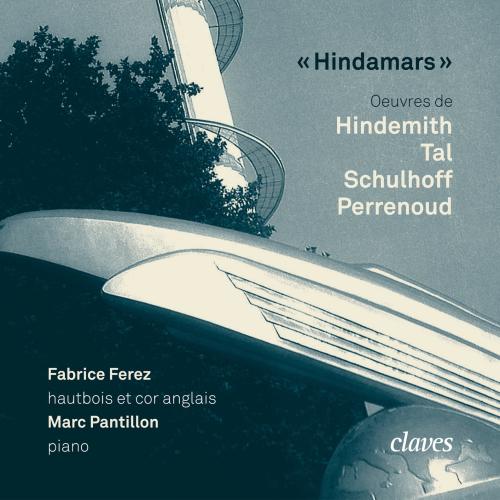
HINDAMARS Marc Pantillon & Fabrice Ferez
Album info
Album-Release:
2026
HRA-Release:
22.05.2026
Label: Claves Records
Genre: Classical
Subgenre: Instrumental
Artist: Marc Pantillon & Fabrice Ferez
Composer: Erwin Schulhoff (1894-1942), Paul Hindemith (1895-1963)
Album including Album cover Booklet (PDF)
- Erwin Schulhoff (1894 - 1942): Hot Sonata pour saxophone alto et piano (Arr. pour cor anglais et piano de Fabrice Ferez):
- 1 Schulhoff: Hot Sonata pour saxophone alto et piano (Arr. pour cor anglais et piano de Fabrice Ferez): I. 04:19
- 2 Schulhoff: Hot Sonata pour saxophone alto et piano (Arr. pour cor anglais et piano de Fabrice Ferez): II. 02:06
- 3 Schulhoff: Hot Sonata pour saxophone alto et piano (Arr. pour cor anglais et piano de Fabrice Ferez): III. 03:51
- 4 Schulhoff: Hot Sonata pour saxophone alto et piano (Arr. pour cor anglais et piano de Fabrice Ferez): IV. 05:01
- Marc Perrenoud (b. 1981): Trois pièces pour hautbois (cor anglais) et piano:
- 5 Perrenoud: Trois pièces pour hautbois (cor anglais) et piano: I. Hindamars 03:01
- 6 Perrenoud: Trois pièces pour hautbois (cor anglais) et piano: II. Blue Hope 03:50
- 7 Perrenoud: Trois pièces pour hautbois (cor anglais) et piano: III. Les Trois Tours 02:47
- Paul Hindemith (1895 - 1963): Sonate pour cor anglais et piano:
- 8 Hindemith: Sonate pour cor anglais et piano 12:04
- Josef Tal (1910 - 2008): Sonate pour hautbois et piano:
- 9 Tal: Sonate pour hautbois et piano 07:31
- Paul Hindemith: Sonate pour hautbois et piano:
- 10 Hindemith: Sonate pour hautbois et piano: I. Munter 04:05
- 11 Hindemith: Sonate pour hautbois et piano: II. Sehr langsam. Lebhaft. Sehr langsam, wie zuerst. Wieder lebhaft. 08:35
Info for HINDAMARS
Trilogy: Our focused work on rare or previously unpublished repertoire connected to World War II – a pivotal period in the history of music and the lives of composers – has resulted in two acclaimed recordings: In memoriam Pavel Haas VDE Gallo 1426 and At the Heart of the 20th Century, Claves 1810.
After exploring Central European and French composers, we now turn to the Germanic sphere in this third, carefully crafted album. The possibility of continuing to create music during the rise of the Brown Plague, and the experience of exile – be it in the USA, Switzerland, the USSR or Palestine – are the major themes underlying this programme which completes our trilogy. The notion of ‘degenerate music’, as defined by the Nazi regime at the 1938 Düsseldorf exhibition, applies both to Hindemith’s modernism and to the early days of jazz, that so-called ‘Negro’ music that flourished in Paris and Weimar-era Berlin.
Hindemith’s forced exile in 1939
Hindemith explored the sonata form in an extraordinary manner throughout some twenty works, experimenting with various instrumental combinations, and showing a particular fondness for less commonly used wind instruments. His sonatas for oboe (1938) and English horn (1941) mark the years preceding his departure for Switzerland and subsequently the United States. As a prominent German modernist composer during the Weimar Republic, Hindemith and his opera Mathis der Maler became focal points in debates over the role of art under Nazism. Supported by Furtwängler for his defence of artistic freedom, yet immediately blacklisted by Goebbels and considered too conservative by Weill and Brecht – with whom he had nevertheless composed the radio play The Lindbergh Flight – Hindemith took advantage of his international fame as a soloist and teacher to flee the regime, settling first in the United States and later back in Switzerland.
During a concert he attended at New York’s Cotton Club, Hindemith, himself an incredibly gifted musician (concertmaster of the Frankfurt Orchestra, violist with the Amar Quartet, organiser of the Donaueschingen Festival, and the first composer to sign an exclusive contract with the prestigious Schott publishers in Mainz for his entire body of work) – marvelled at the talent of the jazz musicians:
“Three hours of music featuring the wildest things I’ve ever heard, trumpets running riot, a veritable orgy of rhythm and sound where everything proceeds with incredible virtuosity”.
Schulhoff, a genius struck down by Nazism
A Jew, a homosexual and a communist, Schulhoff died of tuberculosis in 1942 whilst still attempting to compose symphonies in Nazi prisons. This Czech virtuoso pianist was introduced to Dvořák as a child prodigy and his compositional talent was recognised by both Reger and Debussy, from whom he took lessons. He was forever marked by his experiences as a soldier in the First World War. Like Hindemith – whose father died in the war before he himself was called to the front – Schulhoff was driven to a certain aesthetic radicalism by the absurdity and unspeakable violence of these battles. He met the painter and caricaturist George Grosz while on the front and joined the Dada movement with him in 1918. He composed the first work consisting entirely of rests nearly thirty years before Cage, and set the Communist Manifesto to music. Like Hindemith in Donaueschingen, he programmed the music of Berg, Schoenberg and Webern in the Atelier de la musique nouvelle: a series of concerts he launched in Dresden in the 1920s. Having played jazz and translated it into his own compositional idiom since 1919, he responded to a commission from Kurt Weill for one of Berlin’s first subscription radio stations by composing his Hot-Sonate in 1930. Originally written for an F saxophone, it lends itself particularly well to an adaptation for the English
horn, which is also pitched in F. Schulhoff took Soviet citizenship following the 1938 Munich Agreement. His love of jazz, the only form of music he could continue to practise clandestinely, and his strong ties to the early days of radio broadcasting, for which he worked in Ostrava and Brno until his imprisonment, set him apart as a highly original composer with a diverse and flamboyant output.
Josef Tal, exile in Palestine
A demanding teacher and rigorous theorist, Hindemith spent his life passing on his love for the art of sound. Josef Tal was one of his students, along with many others in pre-war Berlin. Sensing that the tide of history was turning, he emigrated to Palestine under the British Mandate in 1934. Trained as an oboist at Fritz Flemming’s renowned German school, he composed a sonata for his favourite instrument after the war, which remains unpublished. It clearly references Hindemith through the use of themes in fourths, a solid arched structure in one movement, and a strict yet richly colourful style of writing. The oboe line also evokes the chanting style favoured in the synagogue by the composer’s father, a rabbi who was deported and killed by the Nazis. Tal achieved success and produced an impressive body of work that blossomed with the establishment of the State of Israel: four operas, six symphonies, avant-garde pieces incorporating electronics, and three string quartets. He was involved with all the major Israeli musical institutions and became a leading musical figure in this new nation.
Jazz and contemporary music
As we did with Bruno Giner and Philippe Hersant for the two previous albums, we asked a contemporary composer to share his insights on this project. We commissioned a new piece for our duo from Marc Perrenoud, a magnificent jazz pianist born in Berlin, deeply involved in the Swiss music scene and son of a renowned principal oboist with the Orchestre de la Suisse Romande.
Marc Pantillon, piano
Fabrice Ferez, oboe
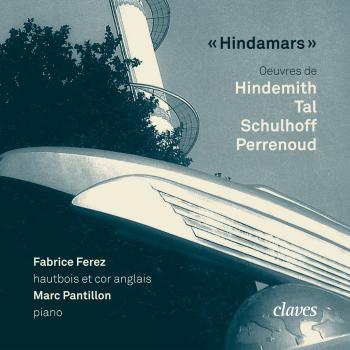
Marc Pantillon
Born into a well-known family of musicians in Neuchâtel, Marc Pantillon was raised in an environment filled with music where it was only natural to begin studying the piano at a very early age under the tutelage of his parents. He did not study with anyone else until after he earned his diploma at the age of 20. As the recipient of a grant from Migros, he was able to study with Hans Petermandl at the Hochschule für Musik in Vienna, where he earned a diploma in virtuosity "with honors" in 1983. In the same year he won great attention as a finalist at the Bösendorfer Competition, likewise in Vienna.
Marc Pantillon then had the chance to continue his studies with Paul Badura-Skoda, who took great interest in his development, encouraging him to seriously consider a career as a soloist. The prize as Soloist of the Swiss Musicians’ Association in 1987 served as the starting point for this career. Since then he has appeared frequently in recital and as a soloist with orchestra; he is likewise a chamber musician in great demand. Marc Pantillon teaches professional piano classes at both the Neuchâtel and Lausanne Conservatories.
His first solo recording ( "C Minor", Gallo ), warmly received by critics, was soon followed by other compact discs with partners such as the Moravian Chamber Orchestra, Spanish tenor Ruben Amoretti and oboist Roland Perrenoud. He now works for the famous swiss firm Claves, recently recording the six trios by Ignaz Lachner, a recital of pieces for piano by Stephen Heller and a programm of romantic music for viola and piano with Anna Barbara Dütschler.
A passionate botanist and bird-watcher, Marc Pantillon lives in the village of Môtiers, where nature has remained untouched and forests have hardly changed since Jean-Jacques Rousseau once roamed there...
Booklet for HINDAMARS