





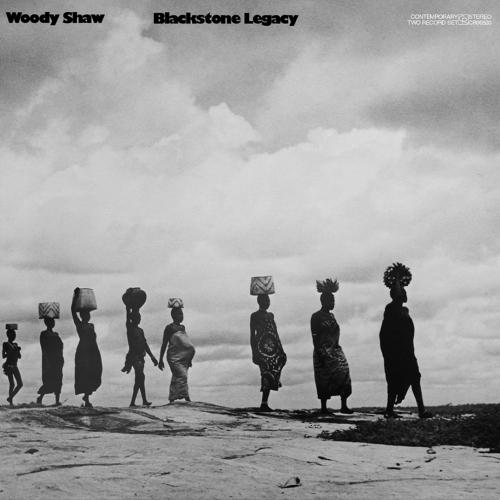
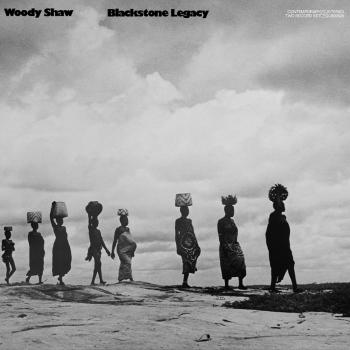
Blackstone Legacy (Remastered) Woody Shaw
Album info
Album-Release:
1971
HRA-Release:
15.09.2023
Album including Album cover
I`m sorry!
Dear HIGHRESAUDIO Visitor,
due to territorial constraints and also different releases dates in each country you currently can`t purchase this album. We are updating our release dates twice a week. So, please feel free to check from time-to-time, if the album is available for your country.
We suggest, that you bookmark the album and use our Short List function.
Thank you for your understanding and patience.
Yours sincerely, HIGHRESAUDIO
- 1 Blackstone Legacy 16:08
- 2 Think On Me 10:49
- 3 Lost And Found 11:57
- 4 New World 18:30
- 5 Boo-Ann's Grand 14:35
- 6 A Deed For Dolphy 08:59
Info for Blackstone Legacy (Remastered)
This one's bound to get you all very excited. Craft Recording's Jazz Dispensary series is honored to release a HiRes-Remaster of Blackstone Legacy, the 1971 debut from influential trumpeter Woody Shaw. An elusive grail for many cratediggers, this double album release marks the first reissue of the album in more than 50 years. Showcasing the musician's virtuosic talents as a bandleader, composer and improviser, this politically charged, postmodern classic also boasts impeccable performances by Gary Bartz, Lenny White, Ron Carter, Bernie Maupin, Clint Houston and George Cables.
A pioneering figure in modern jazz, Woody Shaw (1944-1989) was revered for his unique harmonic approach and innovative technical abilities on the trumpet. Raised in Newark, NJ, Shaw began performing as a teenager, gaining formative experience as a sideman for the legendary saxophonist Eric Dolphy and spending over a year in Paris, where he honed his craft in clubs across Europe. In the mid-'60s, Shaw returned to the US, where he worked alongside such greats as Horace Silver, McCoy Tyner, Chick Corea, Andrew Hill, Max Roach and Art Blakey. By the turn of the decade, however, Shaw was eager to branch out on his own.
Balancing the past with the future, Shaw sought to honor his bebop roots, while embracing the avant-garde. His debut as a leader, Blackstone Legacy, embodied that stylistic bridge. Recorded in December 1970 and released the following year on Contemporary Records, the album featured some of the era's most exciting talents, including funk-jazz icon Gary Bartz (alto and soprano saxophone), veteran bassist Ron Carter and fusion pioneer Lenny White (drums), plus such innovators as Bernie Maupin (tenor saxophone, bass clarinet) and Clint Houston (electric bass), as well as the esteemed keyboardist George Cables, whose work as a composer is also highlighted on two of the LP's tracks ("Think On Me" and "New World").
In the album's liner notes, Shaw spoke to Hentoff about his intentions behind the record.
"We're trying to express what's happening in the world today as we — a new breed of young musicians — feel it. I mean the different tensions in the world, the ridiculous war in Vietnam, the oppression of poor people in this, a country of such wealth. . . . We're all also trying to reach a state of spiritual enlightenment in which we're continually aware of what's happening but react in a positive way. The music in this album, you see, expresses strength — confidence that we'll overcome these things."
Shaw added that the album was dedicated to the era's youth, as well as to "the freedom of Black people all over the world." He continued, "The ‘stone' in the title is the image of strength. I grew up in a ghetto . . . I've seen all of that, and I've seen people overcome all of that. This music is meant to be a light of hope, a sound of strength and of coming through."
Woody Shaw, trumpet
Gary Bartz, alto and soprano saxophone
Bennie Maupin, tenor saxophone, bass clarinet, flute
George Cables, piano, electric piano
Ron Carter, bass
Clint Houston, bass
Lenny White, drums
Digitally remastered
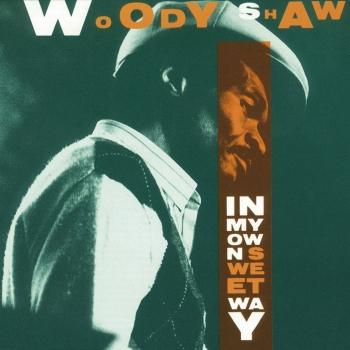

Woody Shaw, Jr.
was born in Laurinburg, NC on Christmas Eve (December 24th), 1944. His father, Woody Shaw Sr., was a lead singer in the legendary gospel group known as the Diamond Jubilee Singers. Woody's father also attended Laurinburg Institute, which was the alma mater of trumpet legend Dizzy Gillespie. It was to these strong roots that trumpeter-composer Woody Shaw attributed his deep sense of pride, cultural awareness and spiritual devotion to music.
At the age of six months old, Woody Jr.'s parents moved to Newark, NJ where he spent most of his childhood. Woody attended Cleveland Junior High School and joined the Junior Elks, Junior Mason, and George Washington Carver Drum and Bugle Corps where he picked up the bugle at an early age. At Cleveland Junior High School, he met an accomplished trumpet teacher, Mr. Jerome Ziering, and during this time, at age 11, he began studying classical trumpet while listening to Dizzy Gillespie, Louis Armstrong, Harry James, and later Clifford Brown. Mr. Ziering wanted Woody to attend The Juilliard School of Music to become a classical trumpeter so he trained young Shaw to become a virtuoso on his instrument. Although he never reached Juilliard, Woody attended the famed Arts High in Newark, which was attended by many legendary jazz artists, such as Wayne Shorter, Sarah Vaughan, organist Larry Young, and many others. Woody began working professionally at age 14.
Woody sat in all the local clubs as a teenager, sitting-in with leading artists who frequented the city's major venues, such Kenny Dorham, Hank Mobley, Lou Donaldson, Roy Haynes and others who occasionally worked in or around Newark, New Jersey. Along with playing in the local youth bands, this gave him a solid basis in the jazz and African American musical tradition.
1960s
After playing with famed Latin percussionist Willie Bobo in a band with Chick Corea and saxophonist Joe Farrell, Woody joined the band of legendary saxophonist Eric Dolphy in 1963. It was under the tutelage of Dolphy that Woody would be encouraged to pursue his own musical voice. Dolphy's complex compositions provided Shaw with a new harmonic concept and different way of looking at music which would shape his approach to the trumpet for years to come. In May of 1963, Woody made his first recorded debut on Eric Dolphy's Iron Man.
In 1964, at age 19, Woody moved to Paris to work with Dolphy's band, but Dolphy had passed away, so he wound up living there for a year and half while working with people like Bud Powell, Kenny Clarke, Johnny Griffin, Dexter Gordon, Nathan Davis, Donald Byrd, and other expatriates in Europe. While in Paris, Woody received an invitation to return to the U.S. to join the Horace Silver Quintet, and, in 1965, Woody made his first album for Blue Note Records on Horace Silver's classic - Cape Verdean Blues.
Later that year Woody made what would be his first major recording as a composer and trumpeter on organist Larry Young's cult classic, Unity, which featured Joe Henderson on tenor sax and Elvin Jones on drums. Woody wrote three of the six tunes on Unity, entitled "Zoltan," "Beyond All Limits," and "The Moontrane," all of which have become standards. The years following would see Woody working as a sideman for Blue Note and touring with such legends as Jackie McLean, Booker Ervin, Hank Mobley, Art Blakey, Max Roach, Andrew Hill, Joe Henderson, Joe Zawinul, Bobby Hutcherson, Herbie Hancock, McCoy Tyner, and many others (see official discography).
1970s
In 1970, Woody made his first album as a leader entitled Blackstone Legacy (Contemporary), which featured Gary Bartz, Bennie Maupin, Ron Carter, and Lenny White. Shortly thereafter, he recorded a second album entitled Song of Songs and around this time moved to San Francisco where he worked closely with Bobby Hutcherson and others, frequenting the famed Keystone Korner club.
In 1974, Woody returned to the East Coast and signed with Muse Records (now High Note) and recorded several albums such as The Moontrane (1974), Love Dance (1975), Little Red's Fantasy (1976) Live at the Berliner Jazztage (1976), and Iron Men (1977, a tribute to Eric Dolphy and Andrew Hill featuring Arther Blythe, Muhal Richard Abrams and Anthony Braxton). All of Woody Shaw's Muse recordings were reissued in The Complete Muse Sessions of Woody Shaw in 2013.
In 1976, Woody also made his first major commercial debut for Columbia Records with Dexter Gordon appearing on Dexter's resurgent album Homecoming (1976), followed by Sophisticated Giant (1977), and Gotham City (1981). In 1977, by way of an endorsement from Miles Davis, and through his association with Dexter Gordon - who Woody had helped reintroduce to the American jazz scene - Woody received his first major record contract and was signed with Columbia Records.
He then went on to record five historic albums of his own: Rosewood (1977), Stepping Stones (1978), Woody III (1979), For Sure (1980) and United (1981). The recent Complete Columbia Albums Collection of Woody Shaw (co-produced and project-directed by his son, Woody Shaw III) showcases all of Woody's work from this period including additional unissued material. Musicians included on Woody's Columbia recordings include Victor Lewis, Carter Jefferson, Onaje Allan Gumbs, Clint Houston, Stafford James, Joe Henderson, Rene McLean, Mulgrew Miller, Larry Willis, Steve Turre and others.
1980s
Throughout the 1980s, Woody toured with various ensembles which included musicians such as Kenny Garrett (Woody appears as a guest on Kenny Garrett's debut album Introducing Kenny Garrett), Terri Lyne Carrington, David Williams, Ronnie Burrage, Kirk Lightsey, Ray Drummond, and Cedar Walton. He also recorded a series of albums for Blue Note with his close friend and fellow trumpet legend Freddie Hubbard.
During this period, Woody conducted numerous workshops and clinics around the world. Between the years of 1984 and 1986, Woody traveled all over Europe and to the Middle East and South Asia on the United States Information Service tour where he visited such countries as India, Egypt, the Sudan, and Russia.
After several years of mounting health complications, Woody Shaw suffered fatally from kidney failure and passed away on May 10th, 1989 at the young age of 44. Yet despite a fairly short and challenging life fraught with various health problems, the brilliance of his legacy and the beauty of his music continues to inspire people all over the world. Woody Shaw lives on through his many close friends, students, and thousands of musicians and music lovers who discover, listen to, and explore his life's work everyday. His legacy is preserved and maintained by his son and namesake, Woody Louis Armstrong Shaw III, who controls all creative, legal, archival and administrative aspects of the Shaw Legacy.
Woody Shaw, Jr. is today considered to be the last major innovator in the lineage of 20th-century trumpet that began with Joe "King" Oliver, Jabbo Smith, Louis Armstrong, and which extended on through the likes of Harry James, Bunny Berigan, Cootie Williams, Roy Eldridge, Dizzy Gillespie, Fats Navarro, Miles Davis, Kenny Dorham, Clifford Brown, Lee Morgan, Booker Little, Donald Byrd, and Freddie Hubbard. Inspired heavily by saxophonists John Coltrane and Eric Dolphy and pianist McCoy Tyner, as well as by various world musics and European classical composers, Woody Shaw extended the lineage of jazz while systematically advancing the improvisational language of modern trumpet playing. Rooted deeply within the spiritual and intellectual dimensions of both African American and European classical forms (what he termed "Afro-European" musics), and invested in exploring an array of world cultures and systems of thought, Woody Shaw pioneered a new approach to structured improvisational composition in which the totality of his influences would gradually find uncompromising expression.
Musicians whose lives and careers have been directly impacted by Woody Shaw's work (through interaction, exposure, or direct instruction) include such notables as Wallace Roney, Randy Brecker, Tom Harrell, Dave Douglas, and Terence Blanchard, as well as Wynton Marsalis, Chris Botti, and Ingrid Monson, and countless others, the latter three of whom received grants from the National Endowment of the Arts to study with Woody Shaw during the 1980s.
This album contains no booklet.