



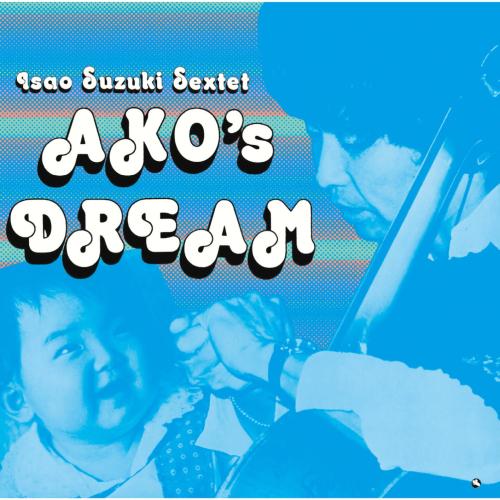
AKO'S DREAM (Remastered) Isao Suzuki Sextet
Album info
Album-Release:
1976
HRA-Release:
21.10.2026
Album including Album cover
I`m sorry!
Dear HIGHRESAUDIO Visitor,
due to territorial constraints and also different releases dates in each country you currently can`t purchase this album. We are updating our release dates twice a week. So, please feel free to check from time-to-time, if the album is available for your country.
We suggest, that you bookmark the album and use our Short List function.
Thank you for your understanding and patience.
Yours sincerely, HIGHRESAUDIO
- 1 Ako's Dream 09:36
- 2 Isao Family 08:13
- 3 Feel Like Makin' Love 08:30
- 4 Seven Come Eleven 08:59
Info for AKO'S DREAM (Remastered)
Originally released in 1976, Ako’s Dream finds Isao Suzuki expanding his classic trio into a sextet, delivering one of his most expressive and dynamic recordings. Blending deep grooves, modal structures, and lush melodies, the album exemplifies Suzuki’s warm tone on both bass and cello.
One of the wonderfully creative 70s sets from Japanese stringman Isao Suzuki – an artist who also plays bass, but who works here on jazz cello – for a very unusual approach! The set has Suzuki's work on the light strings matched in a combo with lead guitar from Kazumi Watanabe – who's nicely restrained here, and falls in with Isao's strings at a level that's quite different than his own material of the time.
Watanabe's lead is augmented by further rhythm guitar work by Kazumasa Akiyama, and the resulting mix of stringed instruments creates a sound that sounds pretty darn groovy in some parts – lightly leaping along with some Fender Rhodes from Tsuyoshi Yamamoto. The best track is the album's long funky remake of "Feel Like Making Love", which begins with a spacey intro, then leaps into an almost-breakbeat reading of the track that features some great electric piano work in a classic MPS mode
Motohiko Hamase, bass, electric bass
Isao Suzuki, cello
Akira Doi, drums
Kazumasa Akiyama, guitar
Kazumi Watanabe, guitar
Tsuyoshi Yamamoto, piano, electric piano, synthesizer
Recorded October 19 & 27, 1976 at Epicurus Studio, Tokyo
Engineered by Yoshihiko Kannari
Produced by Takeshi Fujii
Digitally remastered by Bernie Grundman
Isao Suzuki
was born on January 2, 1933, in Tokyo. He attended a Louis Armstrong All Stars concert in December 1953, an experience that shaped his decision to pursue jazz. In 1956, Suzuki began his professional career playing double bass on United States military bases in Tokyo. He developed foundational skills in bebop while performing with prominent Japanese musicians including Sadao Watanabe, Hidehiko Matsumoto, and Shotaro Moriyasu. From 1965 to 1969, Suzuki led his own ensemble and consolidated his position as a bandleader within Tokyo’s developing jazz scene. Suzuki moved to New York City in 1969 and spent two transformative years immersed in the jazz circuit. He recorded and performed as a sideman with Charles Mingus, Thelonious Monk, Ella Fitzgerald, Ron Carter, Jim Hall, and Paul Desmond. Suzuki also spent approximately one year with Art Blakey’s Jazz Messengers, an experience he credited as formative to his understanding of jazz discipline. He returned to Japan in 1971 after Art Blakey’s arrest at a Canadian airport ended the engagement. Upon returning to Japan, Suzuki became a catalyzing force in Japanese jazz and signed with Three Blind Mice Records. His breakthrough album “Blow Up” (1973) featured drummer George Otsuka, pianist Kunihiko Sugano, and bassist Takashi Mizuhashi. The album won the Jazz of Japan Award and Swing Journal’s Jazz Disc Award. Suzuki showcased distinctive mastery of both double bass and cello, employing pizzicato lines and unconventional techniques including scratched cello and found percussion on tracks such as “Aqua Marine.” This established Three Blind Mice’s audiophile engineering standard and became a cornerstone of Japanese modern jazz. During the 1970s, he led a prolific recording career across multiple labels, releasing over 47 albums that decade. Key albums included “Blue City” (1974) with pianist Kunihiko Sugano and guitarist Kazumi Watanabe, and “Black Orpheus” (1976), a trio with pianist Tsuyoshi Yamamoto. Suzuki’s later work demonstrated remarkable stylistic range and instrumental mastery. He expanded his palette to include piccolo bass and continued leading ensembles while collaborating with international artists. His 1986 album “Approach” featured percussionist Masahiko Togashi, keyboardist Hideo Ichikawa, and guitarist Akira Shiomoto. On “Self-Portrait” (1980), Suzuki performed on over 20 instruments, underscoring his versatility across diverse jazz contexts. He opened a jazz club in Osaka in 1987. Suzuki received the Fumio Nanri Prize in 2008 in recognition of his contributions to Japanese jazz. He died on March 8, 2022, in Kawasaki at age 89 from COVID-19.
This album contains no booklet.