



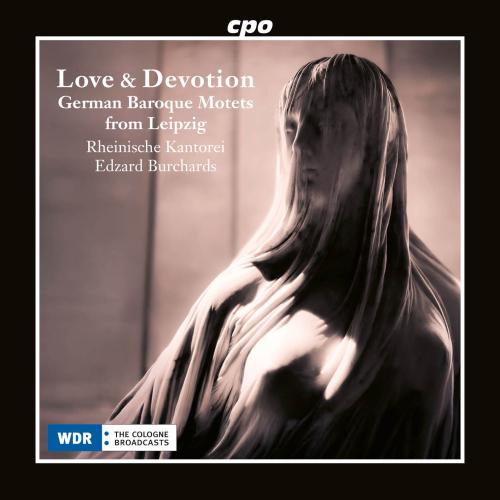
Love & Devotion - German Baroque Motets from Leipzig Rheinische Kantorei & Edzard Burchards
Album info
Album-Release:
2026
HRA-Release:
31.07.2026
Label: CPO
Genre: Classical
Subgenre: Chamber Music
Artist: Rheinische Kantorei & Edzard Burchards
Composer: Johann Sebastian Bach (1685-1750), Georg Philipp Telemann (1681-1767), Sebastian Knüpfer (1633-1676), Werner Fabricius (1633-1679), Tobias Michael (1592-1657), Johann Schelle (1648-1701), Johann Friedrich Doles (1715-1797), Johann Ludwig Krebs (1713-1780), Johann Adam Hiller (1728-1804)
Album including Album cover Booklet (PDF)
- Georg Philipp Telemann (1681 - 1767), Johann Sebastian Bach (1685 - 1750): Jauchzet dem Herrn, alle Welt à 8 (BWV Anh. 160 /TWV 8:10):
- 1 Telemann, Bach: Jauchzet dem Herrn, alle Welt à 8 (BWV Anh. 160 /TWV 8:10) 11:28
- Sebastian Knüpfer (1633 - 1676): Mein Gott, betrübt ist meine Seele:
- 2 Knüpfer: Mein Gott, betrübt ist meine Seele 03:54
- Johann Schelle (1648 - 1701): Komm, Jesu, komm:
- 3 Schelle: Komm, Jesu, komm 03:41
- Sebastian Knüpfer: Erforsche mich, Gott:
- 4 Knüpfer: Erforsche mich, Gott 04:13
- Werner Fabricius (1633 - 1679): Vater, in deine Hände:
- 5 Fabricius: Vater, in deine Hände 05:09
- Tobias Michael (1592 - 1657): In Angst und Not:
- 6 Michael: In Angst und Not 04:48
- Johann Schelle: Jesus Christus ist des Gesetzes Ende:
- 7 Schelle: Jesus Christus ist des Gesetzes Ende 04:49
- Johann Friedrich Doles (1715 - 1759): Herr, wer bin ich:
- 8 Doles: Herr, wer bin ich 07:56
- Johann Ludwig Krebs (1713 - 1780): Erforsche mich, Gott:
- 9 Krebs: Erforsche mich, Gott 05:10
- Johann Adam Hiller (1728 - 1804): Alles Fleisch ist wie Gras:
- 10 Hiller: Alles Fleisch ist wie Gras 05:37
Info for Love & Devotion - German Baroque Motets from Leipzig
Since the 17th century, Leipzig has been regarded as a unique musical metropolis of Europe. Even as far back as the early Baroque period, this civic and university city seemed more lively than elsewhere. There was an opera house and various collegia musica, but people also sang and danced in the market square, the alleyways and on the dance floors.
The Leipzig St Thomas Cantorate was one of the most prestigious and significant musical posts in Germany during the 17th and 18th centuries. From Sethus Calvisus through to Johann Hermann Schein, Tobias Michael, Sebastian Knüpfer, Johann Schelle and Johann Kuhnau, a musical ‘belle époque’ endured, which was to reach its zenith with Johann Sebastian Bach’s appointment in 1723. Furthermore, there were other brilliant musicians amongst the citizens of Leipzig, such as the St Nikolai organist Johann Rosenmüller or the university’s music director, Werner Fabricius. The music for the services at the two main churches, St Thomas and St Nikolai, was composed in the modern concertante style, which had been adopted from Italy since the beginning of the 17th century. The works featured lavish instrumentation and were of a ceremonial nature.
At that time, the motet was already considered outdated. However, for the numerous liturgical occasions (weddings, funerals, etc.), this genre was nevertheless frequently employed. The unrivalled Dresden court Kapellmeister Heinrich Schütz (1585–1672) demands in his legendary preface to the famous collection *Geistliche Chor-Music 1648*—which he dedicated at the time to the St Thomas Choir under the direction of his pupil Tobias Michael—‘… of every aspiring German composer [...] / that / before proceeding to the concertante style / they should first crack this hard nut (within which the true core / and the true foundation of good counterpoint are to be found) / and pass their first test therein….”
The younger colleagues took the old master’s words to heart and demonstrate in this programme that they had learnt the ‘necessary requisites’ of composition and internalised the ‘nutritious core’ of music, enabling them to write polyphonic music in the pure contrapuntal style – still very much alive by the middle of the century – without violating the sacrosanct compositional rules of the 16th century.
Of course, the great Thomaskantor Johann Sebastian Bach must not be omitted here. His widely renowned motets form the retrospective crowning glory of this fading form. The little-known ‘Jauchzet dem Herrn alle Welt’ BWV Anh.160 is a two-choir, three-movement pastiche motet and an arrangement by Bach: the first movement is based on a composition by Telemann that can no longer be traced today, the second on the chorale chorus ‘Nun lob, mein Seel, den Herren’ (BWV 28); the third movement was probably added only after Bach’s death and was originally part of a Christmas cantata by Telemann.
The motets and strophic arias in this programme captivate with their stirring melodic and harmonic structure. Despite the austere content, which mostly deals with the last things, the music is life-affirming, and the relationship between text and music achieves great vividness through the creative use of musical figures. (Alexander Schneider)
Rheinische Kantorei
Continuo Ensemble
Edzard Burchards, conductor
Rheinische Kantorei
Since its inception, the Rheinische Kantorei has been dedicated to interpretations based on the principles of historically informed performance practice. The voices are distinguished by a bright, radiant tone, impeccable intonation, perfect ensemble blend, meticulously crafted diction, transparency, and lightness. These qualities define the ensemble’s character, establishing it as a leading vocal interpreter of early music. Its stylistic expertise allows solo roles to be cast from within the choir itself. The ensemble’s size ranges from eight to thirty-two singers. Its repertoire is not limited to Renaissance or Baroque music; works from the Classical and Romantic eras also feature in its concert programs. A particular focus is placed on performing lesser-known works; many of these were discovered by Hermann Max and rescued from oblivion. In addition to live performances, these works are made accessible to a wide audience through recordings. The ensemble impresses in both concerts and recordings with its text-driven approach—a quality particularly evident in its performances of oratorios and operas alongside the orchestra *Das Kleine Konzert*. The Rheinische Kantorei and *Das Kleine Konzert* receive ensemble funding for the periods 2020–2022 and 2024–2026 as part of the "Culture Strengthening Initiative" of the Ministry of Culture and Science of North Rhine-Westphalia.
Edzard Burchards
was born in Oldenburg in 1966. After completing his secondary education, he initially studied educational science at the Karlsruhe University of Education. In 1991, he began conducting studies under Prof. Martin Schmidt and Michael Procter at the Karlsruhe University of Music, while also attending masterclasses in conducting and historically informed performance practice with Tõnu Kaljuste, Martin Gester, Karlheinz Stockhausen, and Eric Ericson. Even during his university studies, Edzard Burchards embarked on an active concert career as both a conductor and a singer, participating in numerous CD and radio recordings. As an ensemble singer, he is regularly invited to perform with groups such as Collegium Vocale Gent, the Balthasar-Neumann-Chor, Vocalconsort Berlin, Al Ayre Español, and other international ensembles. In 1998, Burchards assisted his teacher and friend—the English choral conductor and musicologist Michael Procter (who passed away in 2012)—in founding the ensemble Hofkapelle, with the aim of performing Renaissance music in an authentic manner. Through this ensemble, he was able to engage deeply with music from the period between 1450 and 1650 as a singer, gaining extensive knowledge of its theoretical foundations. Burchards shares his expertise through seminars for experienced choral singers, where music from the Renaissance and early Baroque periods is studied and subsequently performed in church services or concerts.
Booklet for Love & Devotion - German Baroque Motets from Leipzig