

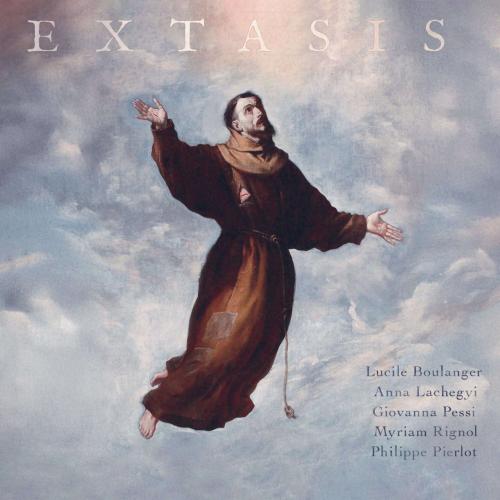
Album info
Album-Release:
2025
HRA-Release:
12.12.2025
Label: FLORA
Genre: Classical
Subgenre: Chamber Music
Artist: Lucile Boulanger, Anna Lachegyi, Giovanna Pessi, Myriam Rignol, Philippe Pierlot
Composer: Sebastián Aguilera de Heredia (1561-1627), Antonio de Cabezón (1510-1566), Juan Bautista Cabanilles (1644-1712), Francisco Correa de Arauxo (1584-1654)
Album including Album cover Booklet (PDF)
- Francisco Correa de Arauxo (1584 - 1654): Facultad organica:
- 1 Arauxo: Facultad organica: No. 15. Tiento de quarto tono, FO 15 (Version for Consort of 4 Viols) 05:15
- Sebastián Aguilera de Heredia (1561 - 1627): Salve primer tono por de la sol re (Version for Consort of 4 Viols):
- 2 Heredia: Salve primer tono por de la sol re (Version for Consort of 4 Viols) 02:56
- Antonio de Cabezón (1510 - 1566): Obras de musica para tecla, arpa y vihuela:
- 3 Cabezón: Obras de musica para tecla, arpa y vihuela: No. 79. Diferencias sobre "El Canto del Caballero" (Version for Consort of 4 Viols and Harp) 02:58
- 4 Cabezón: Obras de musica para tecla, arpa y vihuela: No. 78. Diferencias sobre "La Gallarda Milanesa" (Version for Consort of 4 Viols and Harp) 02:30
- Francisco Correa de Arauxo: Facultad organica:
- 5 Arauxo: Facultad organica: No. 23. Tiento sobre la primera parte de la "Batalla de Morales", FO 23 (Version for Consort of 4 Viols) 06:53
- 6 Arauxo: Facultad organica: No. 46. Tiento de medio registro de tiple de el mismo(séptimo) tono, FO 46 (Version for Solo Harp) 05:15
- Juan Bautista Cabanilles (1644 - 1712): Pasacalles de primer tono, WSC 48 (Version for Consort of 4 Viols and Harp):
- 7 Cabanilles: Pasacalles de primer tono, WSC 48 (Version for Consort of 4 Viols and Harp) 02:26
- Francisco Correa de Arauxo: Facultad organica:
- 8 Arauxo: Facultad organica: No. 13. Tiento de primero tono, FO 13 (Version for Consort of 4 Viols) 05:52
- 9 Arauxo: Facultad organica: No. 16. Segundo tiento de quarto tono [por elami] a modo de canción, FO 16 (Version for Consort of 4 Viols) 04:48
- 10 Arauxo: Facultad organica: No. 36. Tiento de medio registro de tiple de décimo tono, FO 36 (Version for Consort of 4 Viols) 05:25
- Juan Bautista Cabanilles: Folias primer tono, WSC 152 (Version for Consort of 4 Viols and Harp):
- 11 Cabanilles: Folias primer tono, WSC 152 (Version for Consort of 4 Viols and Harp) 05:45
- Tiento de falsas cuarto tono, WSC 11 (Version for Solo Harp):
- 12 Cabanilles: Tiento de falsas cuarto tono, WSC 11 (Version for Solo Harp) 03:34
- Pasacalles de cuarto tono, WSC 102 (Version for Consort of 4 Viols and Harp):
- 13 Cabanilles: Pasacalles de cuarto tono, WSC 102 (Version for Consort of 4 Viols and Harp) 02:16
- Francisco Correa de Arauxo: Facultad organica:
- 14 Arauxo: Facultad organica: No. 18. Quarto tiento de quarto tono, FO 18 (Version for Consort of 4 Viols) 05:29
- 15 Arauxo: Facultad organica: No. 69. Tres glosas sobre el canto llano de la Immaculada Concepción, FO 69 (Version for Consort of 4 Viols) 03:55
- 16 Arauxo: Facultad organica: No. 5. Tiento de quinto tono, FO 5 (Version for Consort of 4 Viols) 04:45
Info for Extasis
Is there any word that could better capture the state into which we are immersed by the hypnotic and haunting music of Francisco Correa de Arauxo? Ecstasy held a central place in Spain's Siglo de Oro. Mystics and artists alike sought to portray its many faces, from searing pain to rapturous delight. It spoke of transcendence, sensuality, powerful emotion, and inner contradiction—all traits of the emerging Baroque spirit that runs through Correa de Arauxo's work.
Blending with Correa's work on this recording are other compositions from Iberic masters, like Cabezon and Cabanilles, all written for organ.
The viol consort and harp bring softness, intimacy and transparency, glorifying the meditative and expressive aspect of these pieces.
Philippe Pierlot, tre viol
Myriam Rignol, tenor viol
Anna Lachegyi, bass viol
Lucile Boulanger, bass viol
Giovanna Pessi, triple harp
Lucile Boulanger
had her first viola da gamba lessons at the age of five with Christine Plubeau, before continuing her studies with Ariane Maurette and later with Jérôme Hantaï. After further studies in Paris and Cergy she was accepted for Christophe Coin’s class at the Conservatoire national supérieur de musique et de danse de Paris, where she was awarded a diploma with distinction in 2009.
She has been a prize-winner at several international competitions including the International Viola da gamba Competition Bach–Abel in Köthen, the Società Umanitaria di Milano and Musica Antiqua Bruges.
Much sought-after as a chamber music partner, she has performed with numerous soloists and ensembles including Philippe Pierlot, François Lazarevitch (Les Musiciens de Saint Julien), Christophe Rousset, Alexis Kossenko and Hugo Reyne, and has also played with larger ensembles such as Ensemble Correspondances (Sebastien Daucé), Les Talens Lyriques (Christophe Rousset) and Pygmalion (Raphael Pichon).
Another focus is her involvement with several consorts, in particular the Ricercar Consort (P. Pierlot), L’Achéron (F. Joubert-Caillet) and Musicall Humors (J. Léonard).
She also regularly gives recitals. Her two duo CDs with the fortepianist and harpsichordist Arnaud De Pasquale on the Alpha label (a Bach recording in 2012, followed by an album of C.P.E. Bach and Graun in 2015) have received several awards in France: the Diapason découverte, Choc Classica, Coup de Cœur Charles Cros, ffff Télérama…
At the end of 2018 her debut CD on the Harmonia Mundi label was released with works by Forqueray.
Myriam Rignol
Originally from Perpignan, where she began her musical education, Myriam Rignol studied at the CNSMD de Lyon, the Hochschule für Musik in Cologne and the Royal Conservatory of Brussels. She is regularly invited to appear as a soloist or with ensembles or orchestras in many countries, and has won many international prizes, including First Prize at the 2010 International Early Music Competition in Yamanashi (Kōfu, Japan) and Second Prize and Audience Prize at the International Musica Antiqua Competition 2011 in the MA Festival (Bruges).
She is a founder member of the ensemble Les Timbres with violinist Yoko Kawakubo and harpsichordist Julien Wolfs, which received First Prize and the Best Contemporary Creation Prize at the prestigious Bruges Chamber Music Competition (2009). The group now performs regularly throughout Europe and in Japan and has made several recordings.
A qualified teacher of early music (CA), she founded in 2011 the viola da gamba class at the Conservatoire du Grand Besançon, where she currently gives classes.
Anna Lachegyi
is an active member of the early music scene in Europe, both as a viola da gamba and cello player. She was born in Hungary into a family of musicians and ever since she started to play the cello at the age of five, chamber music and early music have played a significant part in her life. She currently lives in the Netherlands where she obtained her master diploma at the Royal Academy of Music in The Hague in the class of Mieneke van der Velden and Philipp Pierlot.
She has been invited to play at various festivals in the Netherlands and across Europe, dividing her time between solo, chamber music and orchestral playing in renowned ensembles such as Ricercar Consort, Hespérion XXI, Netherlands Bach Society or Orfeo Orchestra.
Next to her career as a performer, she is a devoted teacher as well, regularly giving master classes on both the viola da gamba and baroque cello in Hungary and Romania.
Philippe Pierlot
was born in Liège. After teaching himself the guitar and the lute, he turned to the viola da gamba, which he studied with Wieland Kuijken. He is active in the fields of chamber music, oratorio and opera, and divides his activities between the viola da gamba and conducting. He has edited and revived the operas Il ritorno d’Ulisse (Monteverdi – a production by William Kentridge regularly staged around the world for the past twenty years) and Sémélé (Marin Marais), and Bach’s St Mark Passion. He enjoys bringing about unexpected encounters with the viola da gamba by commissioning contemporary works or revisiting folk traditions. His most recent CDs have been devoted to cantatas by Bach, Buxtehude’s Membra Jesu nostri and pieces by Marin Marais. In addition to recitals and concerts with his ensemble, he especially enjoys working with Jordi Savall and the ensemble Hespèrion XXI.
He attaches special importance to encouraging and promoting young artists. About fifteen years ago, along with colleagues, he founded a record label that invites musicians to produce their personal projects. He resides in the Belgian town of Spa, where since the autumn of 2015 he has organised an international seminar focusing on the viola da gamba, the Printemps Baroque de Spa festival and a short series of summer concerts at which young creative artists can present their vision of early music today.
Philippe Pierlot teaches masterclasses and courses at Spa and is a professor at the Royal Conservatory in Brussels.
Giovanna Pessi
was born in Basel, Switzerland, and began playing the harp at age 7. At the age of 13, she began to play on an instrument by Erard, built in 1800. The experience with this historical harp, its light touch, and unique sound, motivated her to focus her studies towards early music and historical instruments. From 1993 to 1995, Giovanna Pessi studied the 18th century pedal harp with Edward Witsenburg in Den Haag. From 1994 to 2000 she studied early music and historical harps with Heidrun Rosenzweig at the Schola Cantorum Basiliensis, Switzerland. From 2000-2002, Giovanna Pessi studied with the Norwegian Lutist, Rolf Lislevand, at the “Staatliche Hochschule für Musik Trossingen”, Germany. As a soloist and accompanist specialized in early music Giovanna Pessi performed with musicians and conductors such as Rolf Lislevand, Konrad Junghänel, Philippe Pierlot, Harry Bicket, Nikolaus Harnoncourt, Marc Minkowski. Giovanna Pessi has participated in numerous recordings, amongst others she has recorded Georg Friedrich Händels harp concerto with the Ricercar Consort under the direction of Philippe Pierlot and a duo album with argentinian lute player Eduardo Egüez with music of G.Frescobaldi and other roman composers of the 17th century. From 2004 to 2010 Giovanna Pessi worked with Norwegian pianist and composer Christian Wallumrød, as a member of his sextet the Christian Wallumrød Ensemble she has recorded two albums for ECM records Munich; „The Zoo is Far“ and „Fabula Suite Lugano“. She has been exploring contemporary music on the baroque harp ever since. After appearing on several recordings of the label ECM Records Giovanna Pessi released her first own project „If Grief Could Wait“ on ECM Records in October 2011.
Booklet for Extasis