




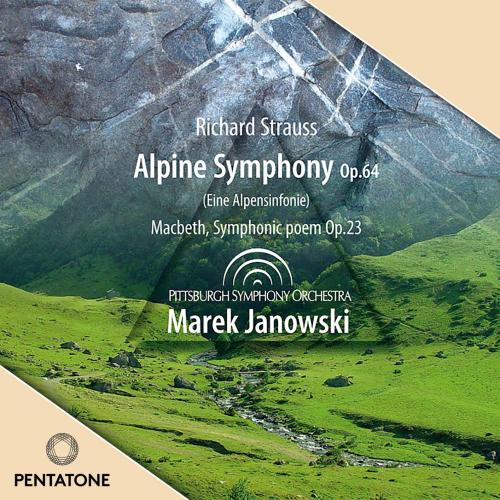
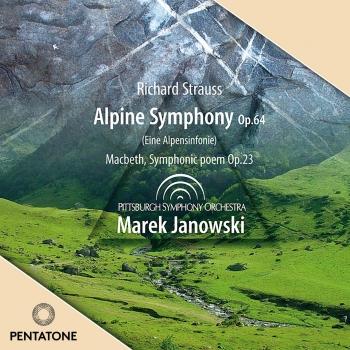
Strauss: Macbeth & Alpensinfonie Pittsburgh Symphony Orchestra & Marek Janowski
Album info
Album-Release:
2009
HRA-Release:
31.05.2024
Label: PentaTone
Genre: Classical
Subgenre: Orchestral
Artist: Pittsburgh Symphony Orchestra & Marek Janowski
Composer: Richard Strauss (1864-1949)
Album including Album cover
- Richard Strauss (1864 - 1949): Macbeth, Op.23:
- 1 Strauss: Macbeth, Op.23 19:17
- Alpine Symphony, Op. 64:
- 2 Strauss: Alpine Symphony, Op. 64: Nacht 03:29
- 3 Strauss: Alpine Symphony, Op. 64: Sonnenaufgang 01:30
- 4 Strauss: Alpine Symphony, Op. 64: Der Anstieg 02:26
- 5 Strauss: Alpine Symphony, Op. 64: Eintritt in den Wald 05:46
- 6 Strauss: Alpine Symphony, Op. 64: Am Wasserfall 00:15
- 7 Strauss: Alpine Symphony, Op. 64: Erscheinung 00:45
- 8 Strauss: Alpine Symphony, Op. 64: Auf blumige Wiesen 00:50
- 9 Strauss: Alpine Symphony, Op. 64: Auf der Alm 02:03
- 10 Strauss: Alpine Symphony, Op. 64: Durch Dickicht und Gestrüpp auf Irrwegen 01:21
- 11 Strauss: Alpine Symphony, Op. 64: Auf dem Gletscher 01:03
- 12 Strauss: Alpine Symphony, Op. 64: Gefahrvolle Augenblicke 01:21
- 13 Strauss: Alpine Symphony, Op. 64: Auf dem Gipfel 04:21
- 14 Strauss: Alpine Symphony, Op. 64: Vision 04:02
- 15 Strauss: Alpine Symphony, Op. 64: Nebel steigen auf 00:22
- 16 Strauss: Alpine Symphony, Op. 64: Die Sonne verdüstert sich allmählich 00:53
- 17 Strauss: Alpine Symphony, Op. 64: Elegie 02:23
- 18 Strauss: Alpine Symphony, Op. 64: Stille vor dem Sturm 02:48
- 19 Strauss: Alpine Symphony, Op. 64: Gewitter und Sturm, Abstieg 03:23
- 20 Strauss: Alpine Symphony, Op. 64: Sonnenuntergang 02:22
- 21 Strauss: Alpine Symphony, Op. 64: Ausklang 06:16
- 22 Strauss: Alpine Symphony, Op. 64: Nacht (II) 02:03
Info for Strauss: Macbeth & Alpensinfonie
Technically speaking, Eine Alpensinfonie (= An Alpine Symphony) is not a symphony. For after 1911, Richard Strauss rejected his original plan to write a four-movement symphony based on the theme of a Tragedy of an Artist, and instead sat down to write a one-movement symphonic poem. He concentrated on the part he had first designated as the opening movement of the symphony and in which he provided a programmatic description of “the Alps”. The first sketches were made in 1911; in 1913 the work existed in the form of a partichelo (= reduced score); and two years later, the full score was completed. Some scholars have interpreted the prolonged period of time spent by Strauss in the composition of the Alpine Symphony, with very little progress at times, as “an indication that he had exhausted his capacity to portray instrumental programme music” (Wagner). The work was lacking a “truly significant musical core thought”, which was apparent for instance from the enormously expanded length of the Alpensinfonie (not only is this Strauss’ last, but also his longest tone poem, with an average duration of about 60 minutes), as well as from its relinquishment of certain categories employed in other symphonic poems, such as humour, irony and persiflage.
Pittsburgh Symphony Orchestra
Marek Janowski, conductor

The Pittsburgh Symphony Orchestra
has enjoyed broader acclaim than the scale of its Pennsylvania home might imply, thanks to an illustrious roster of 20th-century maestros who guided the ensemble at pivotal stages. During the 2010s the group released an extensive sequence of recordings devoted to core symphonic literature.
Established in 1896 by the Pittsburgh Art Society, the orchestra engaged Irish-born operetta composer Victor Herbert as music director two years later. That appointment ran against the prevailing preference for German leaders yet quickly built a broad following. In 1904 the ensemble veered sharply by naming Germany’s Emil Paur conductor, resulting in programs dominated by Brahms and fellow symphonists. Tensions with local players, compounded by the financial fallout from the Panic of 1907, led to the orchestra’s dissolution in 1910. It was revived in 1927, deliberately defying a Pennsylvania statute that prohibited public music on the Sabbath and thereby securing widespread attention. The ensemble embraced radio early, beginning broadcasts in 1936 that reached much of the eastern United States. The following year Otto Klemperer took the podium, one in a succession of internationally prominent conductors who elevated the orchestra’s standards. Subsequent leaders included Fritz Reiner (1938-1948), Vladimir Bakaleinikov (1948-1952), William Steinberg (1952-1976), André Previn (1976-1984), Lorin Maazel (1984-1996, who had earlier resided in Pittsburgh and studied with Bakaleinikov), Mariss Jansons (1996-2004), a distinctive triumvirate of Marek Janowski, Andrew Davis, and Yan Pascal Tortelier (2004-2008), and, from 2008 onward, Manfred Honeck. A concurrent pops series was led by renowned ragtime pianist Marvin Hamlisch from 1995 until his death in 2014; in 2019 Kenny “Babyface” Edmonds appeared as guest artist. Early performances took place at Pittsburgh’s Carnegie Music Hall, Syria Mosque (a venue inspired by a shrine rather than an actual mosque), and Penn Theatre; in 1971 the orchestra acquired its dedicated Heinz Hall, later enlarged on several occasions. Steinberg and Previn oversaw the accumulation of an extensive recorded legacy. Honeck renewed this activity with a 2010s series of symphonic works issued on the Exton and Reference Recordings labels. In 2018 the orchestra released a performance of Beethoven’s Symphony No. 3 in E flat major, Op. 55, coupled with Richard Strauss’s Horn Concerto No. 1, Op. 11, Honeck’s approach shaped by the historically informed performance movement. Under Honeck the ensemble received a Grammy nomination for its 2019 album Bruckner: Symphony No. 9.
Marek Janowski
was Artistic Director and Chief Conductor of the Rundfunk-Sinfonieorchester Berlin (RSB) from 2002 to 2015. Previously – to some extent simultaneously – he served, inter alia, as the music director of the Orchestre de la Suisse Romande (2005–2012), the Orchestre Philharmonique de Monte-Carlo (2000–2005) and the Orchestre Philharmonique de Radio France (1984–2000), which he developed into France’s top orchestra. In addition, he headed up the Gürzenich Orchestra in Cologne (1986–1990) and the Dresdner Philharmonie (2001–2003) for a number of years.
Born in Warsaw in 1939, raised and educated in Germany, Marek Janowski’s creative path took him from Aachen, Cologne, Düsseldorf and Hamburg as general music director to Freiburg i. Br. and Dortmund. Since the late 1970s there is no opera house of international renown where he has not been a regular guest, from the Metropolitan Opera New York to the Bavarian State Opera in Munich, from San Francisco to Hamburg, Vienna and Paris.
On the concert circuit, on which he has concentrated since the late 1990s, he continues the great German conducting tradition. He ranks worldwide as an outstanding Beethoven, Schumann, Brahms, Bruckner and Strauss conductor, as well as an expert in the French repertoire. His leave-taking from opera was, however, only institutional in nature, not musical –thus, Marek Janowski is considered one of the most knowledgeable conductors for Richard Wagner’s music, now more than ever. With the Rundfunk-Sinfonieorchester Berlin, the Rundfunkchor Berlin and a phalanx of international soloists, he performed the ten operas and music dramas of the Bavarian canon in concert performances in Berlin’s Philharmonic Hall between 2010 and 2013. All the concerts were released by Pentatone on SACD in cooperation with Deutschlandradio.
More than 50 recordings, often winning internationally awards – including several complete opera recordings and complete symphonic cycles – have been contributing for over 35 years to making Marek Janowski’s particular capabilities as a conductor internationally known.
In 2016 and 2017 Marek Janowski returned once again to the opera house, conducting the “Ring” at the Bayreuth Festival. In addition, he was invited by the NHK Symphony (Japan’s most important orchestra) from 2014 to 2017 to conduct concert performances of Wagner’s “Ring” tetralogy in Tokyo. He will also perform Wagner’s “Tristan und Isolde” in the spring of 2020 and his “Parsifal” in 2021 with this orchestra.
This album contains no booklet.