





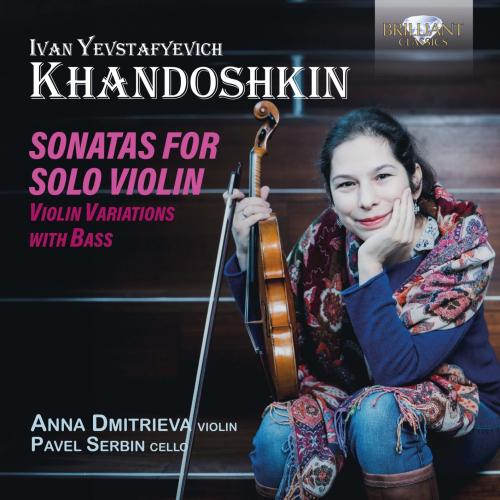
Khandoshkin: Sonatas for Solo Violin Anna Dmitrieva & Pavel Serbin
Album info
Album-Release:
2026
HRA-Release:
27.10.2026
Label: Brilliant Classics
Genre: Classical
Subgenre: Instrumental
Artist: Anna Dmitrieva & Pavel Serbin
Composer: Iwan Khandoschkin (1747-1804)
Album including Album cover Booklet (PDF)
- Ivan Yevstafyevich Khandoshkin (1747 - 1804): Violin Sonate No. 1 in G Minor, Op. 3:
- 1 Khandoshkin: Violin Sonate No. 1 in G Minor, Op. 3: I. Marcia Maestoso 04:53
- 2 Khandoshkin: Violin Sonate No. 1 in G Minor, Op. 3: II. Allegro Assai 04:59
- 3 Khandoshkin: Violin Sonate No. 1 in G Minor, Op. 3: III. Andante Con Variazzione 08:59
- Variation in D Major "Косари" - "The Mowers"("Ах, Послала Меня Мати"-"Ah, My Mother Sent Me"):
- 4 Khandoshkin: Variation in D Major "Косари" - "The Mowers"("Ах, Послала Меня Мати"-"Ah, My Mother Sent Me") 04:08
- Variation in D Minor "Ах, На Что Ж Было, К Чему Было.." - "Ah, What Was It For, Why Was It For...":
- 5 Khandoshkin: Variation in D Minor "Ах, На Что Ж Было, К Чему Было.." - "Ah, What Was It For, Why Was It For..." 03:39
- Violin Sonate No. 3 in D Major, Op. 3:
- 6 Khandoshkin: Violin Sonate No. 3 in D Major, Op. 3: I. Andante Maestoso 05:08
- 7 Khandoshkin: Violin Sonate No. 3 in D Major, Op. 3: II. Menuetto Grazioso.Trio 03:35
- 8 Khandoshkin: Violin Sonate No. 3 in D Major, Op. 3: III. Allegro Vivace 01:45
- Variation in E Major "Ах, Жил Я Молодец..." - "Ah, I Was Once a Gallant Youth...":
- 9 Khandoshkin: Variation in E Major "Ах, Жил Я Молодец..." - "Ah, I Was Once a Gallant Youth..." 07:52
- Variation in F Major "Ах, Талан Ли Мой Талан..." - "Ah, My Fate, My Fate...":
- 10 Khandoshkin: Variation in F Major "Ах, Талан Ли Мой Талан..." - "Ah, My Fate, My Fate..." 04:49
- Violin Sonata No. 2 in E-Flat Major:
- 11 Khandoshkin: Violin Sonata No. 2 in E-Flat Major: I. Andante 04:53
- 12 Khandoshkin: Violin Sonata No. 2 in E-Flat Major: II. Tempo Di Menuetto 03:21
- 13 Khandoshkin: Violin Sonata No. 2 in E-Flat Major: III. Rondo. Allegro 03:13
- Variation in F Major "Kozachok" - "Cossack Dance":
- 14 Khandoshkin: Variation in F Major "Kozachok" - "Cossack Dance" 04:46
Info for Khandoshkin: Sonatas for Solo Violin
Until thirty years ago, the Russian performing school largely overlooked the principles of playing historical instruments. However, with the fall of the "Iron Curtain" of traditional approaches, a newfound freedom emerged – not only in daily life but also in the interpretation of early music. Today, as we strive to preserve this cultural openness, we look back to the 18th century – an era when Russia made an extraordinary leap into the world of instrumental art in a remarkably short period of time. Ivan Khandoshkin, a brilliant violinist and composer, became the pivotal figure of this breakthrough.
Born in 1747, Khandoshkin was an elder contemporary of W.A. Mozart and a younger contemporary of J. Haydn. Young Ivan's extraordinary talent led him, at the age of thirteen, to join the court orchestra of Emperor Peter III, a passionate music lover and amateur violinist himself. Under the tutelage of the Italian court violinist Titto Porto, Khandoshkin’s progress was so remarkable that in 1762 he was appointed to the Court Orchestra. A significant milestone was the 1781 publication of two editions of his work in Amsterdam. After returning to St Petersburg in 1788, he remained a central figure in concert life, performing his own works and serving as a first violinist in various orchestras. In 1804, Khandoshkin died following a stroke and was buried at the Volkovo Cemetery in St Petersburg.
Khandoshkin's sonatas for solo violin were published posthumously as Op.3 around 1806 by the St Petersburg publisher Friedrich Dittmar, but stylistic features indicate that they were composed in the 1790s. The use of the solo violin served both a practical purpose—allowing performance in the absence of a continuo player—and an artistic one: it was an opportunity to demonstrate the highest level of virtuosity. Any composer undertaking such works entered into an "intellectual duel" with works of great masters of these genres, such as the sonatas and partitas of J.S. Bach, the fantasies of G.P. Telemann, the fugues of J. Stamitz and W. Pichl, the sonatas of J.F. Reichardt and F.W. Rust.
Khandoshkin holds a distinguished place in this lineage, his pieces pose exceptional technical demands while reflecting profound artistic intentions, embodying three distinct aesthetic currents: the fury of Sturm und Drang, the expressive nobility of the pathetish-galant style, and the refined hedonism of the Rococo.
Anna Dmitrieva (b. 1987) graduated from the Saint Petersburg Conservatory, where she studied under T. Liberova, P. Popov, and I. Dzektzer. She continued her studies in chamber music and Baroque violin at the Hochschule für Musik und Tanz Köln with A. Spiri, H. Schoneweg, R. Gwilt, and K. Junghänel. With her ensemble Ludus Instrumentalis, she completed postgraduate studies at the Mozarteum Salzburg under R. Goebel.
Highlights of recent seasons include her work as concertmaster of Concerto Köln in Romantic repertoire under Kent Nagano and Jacob Lehmann, as well as appearances as leader and soloist in a wide range of Baroque programmes. She has also served as leader for Akademie für Alte Musik Berlin, Ensemble Boulevard Baroque, and Ensemble 1700. Her performing and recording collaborations include Cordevento, La Chapelle Harmonique, Compagna di Punto, Altera Pars, Il Pomo d'Oro, B'Rock Orchestra, Musica Gloria, Collegium Musicum ’23, and the Orchestra of the Eighteenth Century, among others.
Anna Dmitrieva, violin
Pavel Serbin, cello
Anna Dmitrieva
is quickly developing her career as a HIP violinist and becoming a frequently asked guest in many ensembles across Europe.
Highlights of past seasons feature her work as a concertmaster of Concerto Köln in romantique repertoire under Kent Nagano, Jacob Lehmann as well as leader/soloist in various Baroque programs, leader of Akamus Berlin, Ensemble Boulevard Baroque and Ensemble 1700. Her experience also includes performances and recordings with such groups und orchestras as Cordevento, La Chapelle Harmonique, Compagna di Punto, Altera Pars, Il Pomo d'oro, B'rock, Musica Gloria, Collegium Musicum '23, Orchestra of the Eighteenth century and others. Next season Anna will appear as a leader in such prestigeous venues as the Elbphilharmonie Hamburg, Philharmonie Köln and Bachfest Leipzig as well perform her solo programs.
At the end of 2020 Anna co-founded a piano trio Alterna (on historical instruments) and in May 2021 they won 2nd prize and a Beethoven prize at the competition “Beethoven in his time” in Siegburg (Germany). In May 2023 the debut CD of the group is out and enjoys a nice critic.
With her ensemble Ludus Instrumentalis she was awarded 1st Prize at Berliner-Bach Wettbewerb as well as in the Förderpreis Alte Musik in Saarbrücken and Gebrüder Graun Wettbewerb in Bad Liebenwerda In 2016 she was Semifinalist at International baroque music competition Concours Corneille. She has recorded numerous CD’s under the prestigious labels of Pentatone, Outhere, Genuin and Alpha.
Anna Dmitrieva (1987) graduated from St.Petersburg Conservatory under the tutalige of T.Liberova, P.Popov, I.Dzektzer. She studied chamber music and baroque violin in Hochschule für Musik und Tanz Köln studying with A.Spiri, H.Schoneweg, R.Gwilt, and K.Junghänel. With her group Ludus Instrumentalis she did a post graduate course in Mozarteum Salzburg with R.Goebel.
Since 2023, Anna plays on Camillo Camilli violin from 1743, loaned by the Jumpstart Jr. Foundation. Her debut solo CD featuring the music of Ivan Khandoshkin will appear on Brilliant Classics in 2026.
Pavel Serbin
plays the cello and viola da gamba. He is also a teacher at the Moscow Conservatoire, a founder of the ensemble A la Russe and both soloist and artistic director of the orchestra Pratum Integrum. Born in Moscow in 1978, he graduated from the Gnessin Music School (studied with Honoured Culture Worker V.M. Birina) and the Moscow Conservatoire (among his teachers: professors Dmitry Miller – violoncello, Alexander Rudin – Chamber music, Alexander Galkovsky – Quartet). He has also attended classes at the Royal Academy of Music in The Hague taught by Jaap ter Linden (Baroque cello) and Wieland Kuijken (viola da gamba). Serbin has won prizes at the Bruges Early Music Competition (1999, as part of the Gassenhauer Trio) and the competitions Premio Bonporti and Van Wassenaar (2000, in a duet with Olga Martynova). His dissertation was on cello music composed in Russia from the late 18th to early 19th centuries.
In 2003 he was among the founders of the orchestra Pratum Integrum, which performs on period instruments. Pavel Serbin determines their repertoire policy and the orchestra now plays an important role in Russian culture. At his initiative Pratum Integrum has performed some two hundred compositions from the 17th to 19th centuries, many never heard before in Russia. As a soloist Serbin has presented to the Russian public for the first time chamber cello pieces by Jan Bohumir Prac, Johann Henrich Facius, Gottfried Rieger and Jacob Klein. Serbin has played with the Academy of Ancient Music (London) led by Christopher Hogwood and Paul Goodwin, the orchestra Moderntimes_1800, the Bergen Barokk ensemble, and others. Since 2008 he has taken the role of conductor. Under his direction Pratum Integrum has performed symphonies by Haydn, Rosetti and Vanhal, as well as Fomin’s melodrama Orpheus.
Booklet for Khandoshkin: Sonatas for Solo Violin