





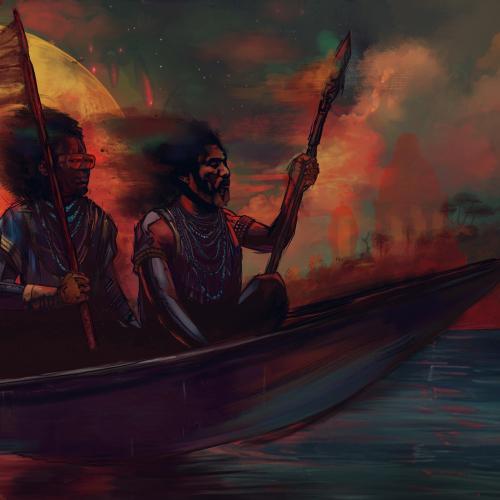
Rowing up River to Get Our Names Back Anthony Joseph
Album info
Album-Release:
2025
HRA-Release:
07.02.2025
Album including Album cover
- 1 Satellite 04:50
- 2 Black History 06:42
- 3 Tony 09:18
- 4 A Juba for Janet 08:13
- 5 Churches of Sound (The Benitez-Rojo) 08:38
- 6 An Afro Futurist Poem 04:40
- 7 Milwaukee & Ashland 08:42
Info for Rowing up River to Get Our Names Back
While often atmospheric in its thematic registers, ranging from spaces of the subterranean underground to the intergalactic, and equally so with its sonic registers, ranging from doubly articulated vocals to the reverb echo, there is indeed something like a core to Rowing Up River to Get Our Names Back. Taken as a suite, the three tracks that make up the middle, if not heart and soul, of the album—“Tony,” “A Juba for Janet,” and “Churches of Sound (The Benítez Rojo)”—put on display how the cultures and histories of the Black diaspora always constitute both the downbeat and backbeat for Anthony, not just his music but perhaps even his very consciousness. We can hear it in the deep pain when “Churches of Sound” moves into a poetic ode when Anthony notes that Lord Kitchener’s Calypso “croon reached Ghana / just in time for Independence,” and in “A Juba for Janet” with its dub soundscape, and yet again with the Afrobeat undertones of “Tony.” If “Churches of Sound” is closer to an ode, “Tony” might be a paean; significant no less because it contains the lyrics from which the album gets its name. It is here that Anthony uses the conceit of seeing Tony Oladipo Allen perform in France to proclaim his admiration of Allen’s virtuosity as a drummer (“He was duplicitous / a conjure man / with seven hands.”), arguably as significant as any of his counterparts including Art Blakey and Max Roach.
If Rowing Up River to Get Our Names Back has an anthem it might well be “An Afrofuturist Poem.” The penultimate track on album, and the shortest at 4:41, Anthony opens the song with the line “I am my mother’s son …,” seemingly in reference to Toni Morrison’s famous lines about sons in her novel Beloved, before announcing numerous other sources that constitute his personal and artistic genealogy including his father, I & I, and oil. But in the middle of the song, the bass subsides and for a full 30 seconds Anthony waxes “We must arrive new mythologies / and syntax / and modes of expression / which are fixed beyond comparison / to alien transmission.”
The resonances of Afrofuturism are everywhere on this album as both Anthony’s lyrics and Dave Okumu’s production try to “ride through space.” There are mentions of “anti-matter propulsion” and “Afronauts” elsewhere, but the song that emblematizes Afrofuturism as more than merely spatial temporality is the album’s lead track. “Satellite” is a reminder and encomium that, facing the conditions of modernity, Black folks across space and time have always been curious, if not compelled, by a yearning for the beyond, a beyond outside of the here and now, and sometimes back into the past to press into the future. In this sense, “Satellite” shares a sonic accord and political vision with the Soulquarians’ “Heaven Somewhere,” on a version that featured Omar. In an album where Anthony plays with order, sequence, and boundaries, such as when he inverts “alpha and omega” to “omega and alpha” or rearranges the postcolonial model of “core and periphery,” he concludes that there is, or at least can be, a center: “Moving through / the center / connected to everything (yeah, yeah) / spun out of galaxies / and diasporas / and still at the center / of all that is.”
Dan See, drums
Dave Okumu, bass, guitars, keyboards, synthesizers, programming, percussion, background vocals
Nick Ramm, Fender Rhodes, synthesizer
Aviram Barath, synthesizer, Moog
Colin Websters, saxophones
James Wade Sired, trombones
Byron Wallen, trumpet
Eska Mtungwazi, vocals, vocal arrangement
Anthony Joseph, vocals
Aviram Barath, synthesizer
Engineered by Nick Powell and Dave Okumu
Mixed by Dan Parry
Mastered by Shawn Joseph @ Optimum Mastering
Produced and Arranged by Dave Okumu
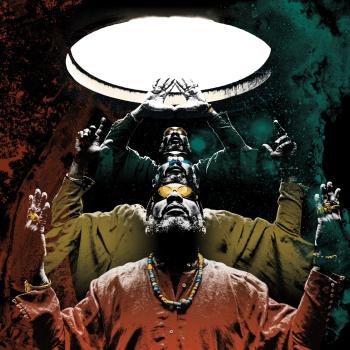
Anthony Joseph
is a poet, novelist, academic and musician who moved from Trinidad to the UK in 1989. A lecturer in creative writing at Birkbeck College, he is particularly interested in the point at which poetry becomes music.
As well as four poetry collections, a slew of albums, and three novels – most recently Kitch – Joseph has published critical work exploring the aesthetics of Caribbean Poetry among other subjects. He performs internationally as the lead vocalist for his band The Spasm Band. Sonnets for Albert is his first poetry collection since Rubber Orchestras. His most recent album is The Rich Are Only Defeated When Running for Their Lives.
The life of Caribbean people is not really documented. So this idea of Caribbean life being fragmented is something that I've had in my mind for a long time. So when I came to write this collection for my father, I realized that it was the same process and what I had were fragments, especially with him, because he wasn't around in a physical sense all the time. So all I had were little photographs, scattered memories, and remembrances. They're little parts of his life and parts of my experience with him... I never disliked my father. I always loved him and always was fascinated and captivated by him.
My relationship with improvisational music is something that I'm still trying to theorize and trying to understand exactly why it is that it works. So all I know is that, in approaching a poem, it's about form and content. It's about matching process to content. And for me, the act of writing poetry is kind of like a jazz soloist puts together a solo. It's related in that way because as a writer, as a poet, you are always looking for the new. You're looking for something, a new way of saying something. You're using language that everyone uses, but you're always trying to reuse it in an original way. Always trying to have a phrase or metaphor that is new.
This album contains no booklet.