


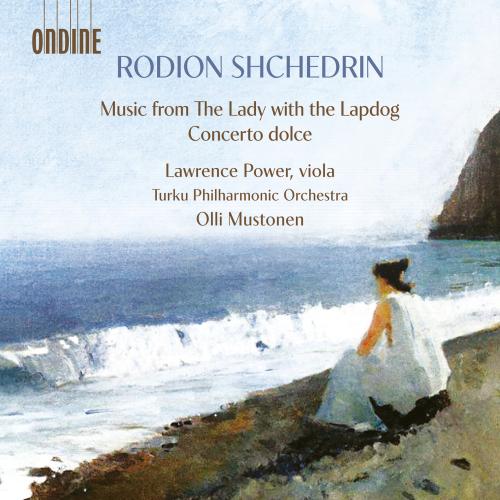
Rodion Shchedrin: Music from The Lady with the Lapdog, Concerto Dolce & other works Lawrence Power, Turku Philharmonic Orchestra & Olli Mustonen
Album info
Album-Release:
2026
HRA-Release:
06.03.2026
Label: Ondine
Genre: Classical
Subgenre: Concertos
Artist: Lawrence Power, Turku Philharmonic Orchestra & Olli Mustonen
Composer: Rodion Schtschedrin (1932-2025)
Album including Album cover Booklet (PDF)
Coming soon!
Thank you for your interest in this album. This album is currently not available for sale but you can already pre-listen.
Tip: Make use of our Short List function.
- Rodion Shchedrin (1932 - 2025): Music for Strings, Oboes, Horns and Celesta:
- 1 Shchedrin: Music for Strings, Oboes, Horns and Celesta: I. Andante moderato 04:27
- 2 Shchedrin: Music for Strings, Oboes, Horns and Celesta: II. Allegro 02:52
- 3 Shchedrin: Music for Strings, Oboes, Horns and Celesta: III. Con passione 05:33
- 4 Shchedrin: Music for Strings, Oboes, Horns and Celesta: IV. Allegro moderato 02:55
- 5 Shchedrin: Music for Strings, Oboes, Horns and Celesta: V. Allegro 01:48
- 6 Shchedrin: Music for Strings, Oboes, Horns and Celesta: VI. Con passione 08:02
- Shepherd’s Pipes of Vologda (Hommage à Bartók):
- 7 Shchedrin: Shepherd’s Pipes of Vologda (Hommage à Bartók) 06:26
- Concerto dolce:
- 8 Shchedrin: Concerto dolce 21:04
- The Frescoes of Dionysios:
- 9 Shchedrin: The Frescoes of Dionysios 11:48
Info for Rodion Shchedrin: Music from The Lady with the Lapdog, Concerto Dolce & other works
Composer Rodion Shchedrin (1932–2025) was one of the leading figures of post-war Soviet music. This album by the Turku Philharmonic Orchestra and conductor Olli Mustonen brings together four of his works, including music from his ballet The Lady with the Lapdog, as well as a viola concerto, Concerto dolce, performed by Lawrence Power, one of the greatest violists of our time. Rodion Shchedrin passed away while this album, which is a monument to the unique friendship and artistic collaboration that Olli Mustonen and Rodion Shchedrin cultivated over the course of three decades, was in preparation.
Shchedrin floated freely across styles and combined influences and materials from multiple sources. He described himself with the term ‘post-avant-garde’ and unlike many modernists was unwilling to anchor himself to strictly defined stylistic parameters. Shchedrin’s five ballets (1956–1985) occupy a special place in his output, establishing him as a fully-fledged heir to the Russian ballet tradition (following Tchaikovsky, Stravinsky, Prokofiev, among others) while also determinedly reforming that tradition. The last of Shchedrin’s ballets to be completed was The Lady with the Lapdog (1985), written for the 60th birthday of his wife, Maya Plisetskaya. Shortly after, he adapted this 50-minute ballet into a more concise concert piece, titled Music for strings, two oboes, two horns and celesta (1986) – a profoundly intense and emotional piece. It is a summary of the ballet, so to speak, and very closely related to the original ballet in that even the instrumentation is the same.
Shepherd’s Pipes of Vologda (1995) was commissioned by the Hungarian Broadcasting Company and is a homage to the Hungarian master composer Béla Bartók. During the early 1950s, as a member of an ethnomusicological research team, Shchedrin travelled to Belarus and Vologda to study and record authentic folk music. Echoes of his encounter with genuine folk tradition can be heard in this work which was completed over 40 years later.
Concertos were an important vehicle for Shchedrin’s musical idiom, as is apparent in his catalogue. Although the solo parts in his concertos are always challenging, these are not virtuoso showcases. The concertante aspect is explored through the dynamics of the relationship between soloist and orchestra, between the individual and the collective. Concerto dolce is dominated by soaring viola melodies that often comply with the dolce of the title but also contain intense, painful and edgy tones. The mood of the piece is a tranquil narrative, often intensely meditative or reminiscent, with only occasional departures.
Shchedrin’s chamber work The Frescoes of Dionysios (1981) focuses on the sacred: the Orthodox tradition in the Vologda region, above all one of the greatest figures in the Moscow School of icon painting, Dionysios (c.1440–1502). His most significant and best-preserved set of works is at the Ferapontov Monastery which was designated a UNESCO World Heritage Site in 2000. In this piece, Shchedrin sought to capture the austere, reductive, stylised yet captivating mood of the frescoes.
Lawrence Power, viola
Turku Philharmonic Orchestra
Olli Mustonen, conductor
Lawrence Power
Internationally-acclaimed viola player Lawrence Power is widely praised for his richness of sound, technical mastery and his passionate advocacy for new music. Heralded by the New York Times as ‘a musician on a mission to make us pay attention to the viola’, Lawrence has advanced the cause of the viola both through the excellence of his performances, whether in recitals, chamber music or concertos and the creation of the Viola Commissioning Circle (VCC), which has led to a substantial body of fresh repertoire for the instrument by today’s finest composers. Over the past decade, Lawrence has become a regular guest performer with orchestras of the highest calibre, from Chicago Symphony, Boston Symphony, Royal Concertgebouw, Bayerischer Rundfunk, Stockholm, Bergen and Warsaw Philharmonic orchestras to the Chamber Orchestra of Europe, BBC Symphony, Philharmonia, BBC Scottish Symphony and Royal Liverpool Philharmonic orchestras, with conductors such as such as Osmo Vänskä, Lahav Shani, Parvo Järvi, Vladimir Jurowski, Andrew Manze, Edward Gardner, Nicholas Collon, Ilan Volkov and Esa-Pekka Salonen. As a chamber musician he is in much demand and regularly performs at Verbier, Salzburg, Aspen, Oslo and other festivals with artists such as Steven Isserlis, Nicholas Alstaedt, Simon Crawford-Phillips, Vilde Frang, Maxim Vengerov and Joshua Bell.
Turku Philharmonic Orchestra
The Turku Musical Society, which later formed the Turku Philharmonic Orchestra, was founded in 1790. As the oldest orchestra in Finland – and one of the oldest in the world – the ensemble continues to develop and flourish at the baton of renowned conductors. During its history it has premiered pieces by Jean Sibelius under the leadership of the composer himself and worked with legendary conductors such as Paavo Berglund and chief conductors such as Tauno Hannikainen, Jorma Panula, Jacques Mercier, Hannu Lintu and Leif Segerstam. During 2021–2023 the orchestra’s 74 musicians enjoyed the artistic leadership of Olli Mustonen.
Olli Mustonen
has a unique place on today’s music scene. Following the tradition of great masters such as Rachmaninov, Busoni and Enescu, Mustonen combines the roles of his musicianship as composer, pianist and conductor in an equal balance that is quite exceptional, often bringing them together in one fascinating triple role performance. Mustonen took up the position of Principal Guest Conductor of the Lapland Chamber Orchestra at the beginning of 2023 where he continued his tenure until the end of 2025 combining orchestral concerts with chamber music and recitals. During an illustrious career, Mustonen has brought his extraordinary musical insight to many of world’s most significant orchestras, including the Berlin, New York and Los Angeles Philharmonic orchestras, Chicago Symphony, Cleveland Orchestra, Royal Concertgebouw Orkest, Mariinsky Theatre Orchestra, Orchestre de Paris, Tonhalle Orhester Zürich, and all the London orchestras. Recipient of the 2019 Hindemith Prize of the City of Hanau, Mustonen’s life as a composer is at the heart of his piano playing and conducting. In 2021, Mustonen officially commenced his directorship as Artistic Director and Principal Conductor of the Turku Philharmonic Orchestra where he held his tenure until 2023 and was fortunate to be able to conduct regularly forming a strong connection with the musicians and explore a range of repertoire from Beethoven to Bartók to Rautavaara. Spending a substantial amount of time in Finland, he also joined the Finnish Radio Symphony, Helsinki Philharmonic and Jyväskylä Symphony Orchestras amongst others.
Booklet for Rodion Shchedrin: Music from The Lady with the Lapdog, Concerto Dolce & other works