




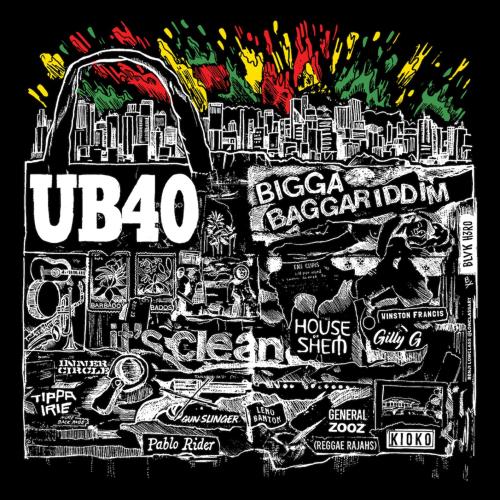
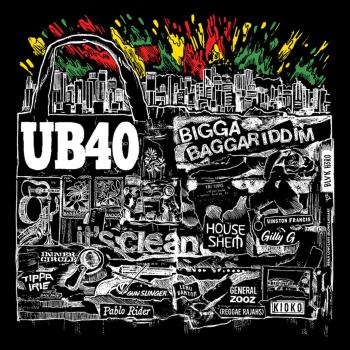
Bigga Baggariddim UB40
Album info
Album-Release:
2021
HRA-Release:
16.07.2026
Album including Album cover
- 1 Good Vibes Tonight 03:25
- 2 On The Road 03:24
- 3 Gravy Train Is Coming 04:41
- 4 Rebel Love 03:56
- 5 Did You See That? 04:37
- 6 You Don't Call Anymore 03:43
- 7 Me Nah Leave Yet 03:52
- 8 Love You Now 03:28
- 9 Mi Life Action 03:03
- 10 My Best Friend's Girlfriend 03:03
- 11 Message Of Love 03:08
- 12 I'm Alright 04:05
- 13 Show And Prove 03:17
- 14 Whatever Happened To The Have Nots? 03:27
- 15 Roots Rock Reggae 04:18
Info for Bigga Baggariddim
When a band gets to the level of entrenchment that England’s UB40 has achieved, it can make the album it wants. Referenced by jam-champions Phish and still a serviceable dad-joke punchline, UB40 has now logged more than 40 years as a band. Helped along by big hits in the 1980s and ’90s, it keeps the reggae fires burnin’ with Bigga Baggariddim, its 21st album.
The album’s title references the band’s 1985 record on which it reworked its earlier songs with the aid of high-profile guest musicians. Bigga Baggariddim follows this format in that each song features rappers, MCs or full reggae bands in collaboration with UB40. Songs appear in multiple versions so that the 11 featured artists can provide their own spin.
Now, you may be asking: “Which version of UB40 are we talking about?” To clarify, this UB40 is the legally ordained entity that has retained the right to use the name. In 2008, long-time band members Ali Campbell and Micky Virtue left the band, followed by vocalist Astro in 2013. The three joined forces for their own UB40 act, soon changing their name to UB40 Reunited.
“Bigga Baggariddim” quickly establishes itself as a roots-oriented album. The first three tracks comprise an 11-minute suite around a familiar reggae chord progression. The band promises reggae touchstones like “good vibes” and a “gravy train” are en route. The three songs essentially represent three interpretations by way of three different collaborations. The subtle tweaks from song to song support a relaxed, sustained groove.
“Did You See That” gets a little skankier, thanks to Pablo Rider’s rasp and a hypnotic dub sway. About as dirty as the well-behaved UB40 gets, the song benefits greatly from Rider’s authentic, grimy flow. The lean arrangement also scores, transporting listeners to the smoky dub dens of the likes of Linval Thompson.
Heavily vocal-oriented, UB40 at times approaches boy-band embellishment. “Rebel Love” and the trio of songs beginning with “You Don’t Call Anymore” get a little carried away with feeling and sweetness. The latter benefits from a strong skeletal rhythm section, however, with bass and horns holding down the jam. The rag-and-bone shuffle is continued on “Me Nah Leave Yet” and “Love You Now,” for the respective benefit of guest MC Gilly G and New Zealand reggae band House Of Shem. Nevertheless, the three versions mostly tread over the same territory.
Apparent simplicity belies subtle and specific musical choices. There are essentially only eight movements, four of which appear in multiple versions. Though this provides a platform for the guests to explore different directions, hearing the same song three times in a row does become tiresome. And at 55 minutes, Bigga Baggariddim asks a significant time investment to pull out what amounts to negligible variations.
UB40

UB40
The story of UB40, and how this group of young friends from Birmingham transcended their working-class origins to become the world’s most successful reggae band is not the stuff of fairytales as might be imagined. The group’s led a charmed life in many respects it’s true, but it’s been a long haul since the days they’d meet up in the bars and clubs around Moseley, and some of them had to scrape by on less than £8 a week unemployment benefit. The choice was simple if you’d left school early. You could either work in one of the local factories, like Robin Campbell did, or scuffle along aimlessly whilst waiting for something else to happen.
By the summer of 1978, something else did happen, and the nucleus of UB40 began rehearsing in a local basement. Robin’s younger brother Ali, Earl Falconer, Brian Travers and James Brown all knew each other from Moseley School of Art, whilst Norman Hassan had been a friend of Ali’s since school. Initially, they thought of themselves as a "jazz-dub-reggae" band, but by the time Robin was persuaded to join and they’d recruited Michael Virtue and Astro – who’d learnt his craft with Birmingham sound-system Duke Alloy – the group had already aligned themselves to left-wing political ideals and forged their own identity, separate from the many punk and Two Tone outfits around at that time. The group had nailed their colours to the mast by naming themselves after an unemployment benefit form. Their political convictions hadn’t been gleaned second hand either, but cemented in place whilst attending marches protesting against the National Front, or rallies organised by Rock Against Racism.
By the time Chrissie Hynde invited them to tour with the Pretenders during the summer of 1980 and their debut single "King b/w Food For Thought" had sailed into the UK Top 5, all the essential elements of UB40 were already in place. Their line-up will remain unchanged for almost thirty years, and they will continue playing a mix of original material and inspired choice of reggae covers in a style that’s instantly accessible with its bright melodies and sweeping horn arrangements – one that’s allied to a formidable rhythm section, capable of holding its own with anything from Jamaica.
UB40’s first album was released the following September, on Graduate Records. Their deal allowed them more creative freedom than if they had signed with a major label. The cover artwork memorably duplicated an unemployment benefit card, with the title "Signing Off" rubber-stamped in red, but it was the music that quickly worked its way into the affections of a young, mainly student crowd with its knowing lyrics, solid reggae rhythms and dubby, instrumental passages, offset by warm horn solos and Jamaican style scatting. There was nothing else like it at the time. As a multi-cultural band from Birmingham, UB40 weren’t drawn into trying to sound "authentic," and there was considerably more depth to their music than that of many punk and 2Tone bands. "I’m a British subject, not proud of it, whilst I carry the burden of shame," they sang on one of the tracks. Accepting the truth of their own situation amidst a sea of other reggae songs proclaiming black heritage gave us a valuable insight into where UB40 were coming from. They were unafraid to stand up and be counted, and British audiences instinctively loved them for it. "Signing Off" duly went to No. 2 in the UK and stayed on the nation’s album charts for 72 weeks.
At the end of 1980, the contract with Graduate expired and UB40 formed their own record company, DEP International, with all eight members owning an equal share. They also signed a licensing deal with CBS, which ensured them far better distribution. "Signing Off" was still in the charts when they released their second album "Present Arms" in the summer of 1981. The sound was immediately brighter, harder and more professional, yet the spirit and commitment underpinning the band’s songs remained resolutely unchanged, as heard on "One In Ten," written about the UK’s record number of unemployed. With lyrics like "Nobody knows me, but I’m always there. A statistical reminder of a world that doesn’t care," "One In Ten" became an anthem of the British protest movement, and a genuine counterpart to the equally motivated songs being written by the likes of Bob Marley and Peter Tosh in the Caribbean. "One In Ten" will earn the rare distinction of being "versioned" by Jamaican reggae acts in future. Back in 1981, it formed part of the soundtrack accompanying the race riots erupting in places like Brixton, Handsworth and St. Paul’s in Bristol – hard pressed, inner city areas with large immigrant communities that had found themselves on the frontline in resisting the right wing policies of Margaret Thatcher’s government. More information, please visit: www.ub40.co.uk
This album contains no booklet.