




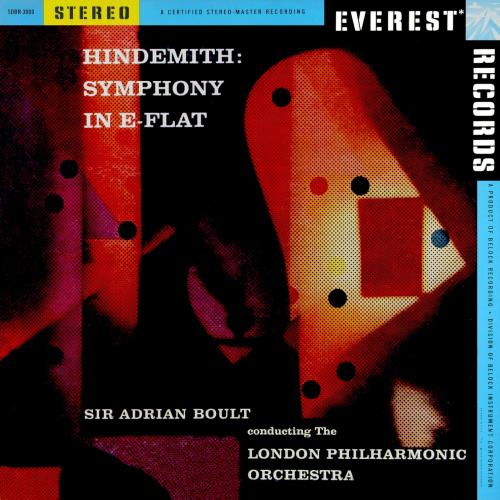
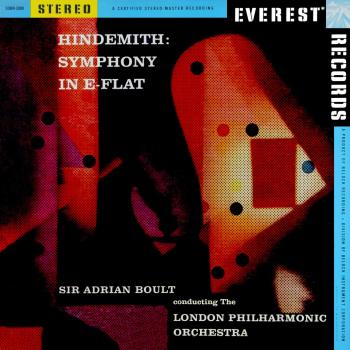
Hindemith: Symphony in E-Flat (Transferred From The Original Everest Records Master Tapes) London Philharmonic Orchestra & Sir Adrian Boult
Album info
Album-Release:
2013
HRA-Release:
14.01.2026
Label: Everest
Genre: Classical
Subgenre: Orchestral
Artist: London Philharmonic Orchestra & Sir Adrian Boult
Composer: Paul Hindemith (1895-1963)
Album including Album cover Booklet (PDF)
I`m sorry!
Dear HIGHRESAUDIO Visitor,
due to territorial constraints and also different releases dates in each country you currently can`t purchase this album. We are updating our release dates twice a week. So, please feel free to check from time-to-time, if the album is available for your country.
We suggest, that you bookmark the album and use our Short List function.
Thank you for your understanding and patience.
Yours sincerely, HIGHRESAUDIO
- Paul Hindemith (1895 - 1963): Symphony in E-Flat:
- 1 Hindemith: Symphony in E-Flat: I. Sehr lebhaft (Remastered 2013) 05:07
- 2 Hindemith: Symphony in E-Flat: II. Sehr langsam (Remastered 2013) 09:21
- 3 Hindemith: Symphony in E-Flat: III. Scherzo. Lebhaft (Remastered 2013) 06:15
- 4 Hindemith: Symphony in E-Flat: IV. Mäßig schnelle Halbe (Remastered 2013) 08:59
Info for Hindemith: Symphony in E-Flat (Transferred From The Original Everest Records Master Tapes)
Hindemith's Symphony in E-flat was composed between September and December 1940, shortly after the composer's arrival to the United States, fleeing the cultural repression of the Nazi regime. It was premiered in Minneapolis on November 21 of 1941, performed by the Minneapolis Symphony Orchestra conducted by Dimitri Mitropoulos. After the premiere, Mitropoulos wrote to the composer, "The performance of your symphony was for me one of the highest artistic moments of my career. God bless you, dear artist, and give us more of your creations."
During Hindemith's first year in the U.S. he took on a number of lecturing appointments. It was while at Tanglewood that he began work on the symphony, suggesting that the immediate stimulus for such an undertaking had come from the lavish sounds of Koussevitsky's Boston Symphony Orchestra he had regularly heard there. In the works which followed "Mathis der Maler" and "Nobilissima Visione" two trends can be identified in Hindemith's music. One is a growing interest in the genres of old; sonata, symphony and concerto, and the other is a greater reliance on tonal harmony, very much in line with his written treatises. This symphony in particular is cyclical in nature.
The work hardly discloses a significant change in the composer's style or manner from the music he was composing when he departed Germany. In its combination of baroque contrapuntal textures, rhythmic drive and fortspinnung (from which the nature of many of the accompanimental and thematic figures derive), of classical formal and developmental procedures, of the romantic large-scale "gesture", and his own XX-century mildly dissonant harmonic language, the Symphony in E flat is a fine early example of that aspiration towards integration of the entire Germanic musical heritage which seemed to become Hindemith's objective in the works of this period.
The first movement is monothematic in form. It begins with a vigorous, fanfare-like main theme introduced by the brass in a heroic way. We don't find contrasting material, but instead we are quickly launched to a development of the main theme, growing more forceful and imperious. A brief but softer transition leads to the recapitulation of the theme, a powerful coda ends the movement in a triumphal way.
The second movement is very free form, based on two alternating themes. It opens with a sombre main theme in form of a march, introduced by the brass and woods in an almost funereal in tone. It is based on the opening theme of the symphony. After it is taken by strings, clarinets present a second theme of pastoral nature, offering great contrast. An expressive and agitated climax is reached as the main theme returns in counterpoint with a variation of the main theme from the first movement. The second theme briefly returns before the main one reappears on strings, before a contrapuntal crescendo leads to a powerful second climax. The movement then ends with a final and climactic return of the main theme.
The third movement is written in ternary form, being a scherzo in all but name. It begins with an animated and strongly rhythmic main theme, exposed by full orchestra and unfolded in a playful way. It is derived from the opening theme of the work. After an energetic climax, the central section (the trio in the usual scherzo) features a calm and lyrical second theme on clarinets, passing to other woodwind instruments while supported by strings. The main theme then returns in full force, concluding the movement with a short fugato. After a short caesura, the lively "scherzo" goes over directly into the last part.
The fourth movement is also monothematic in structure. It opens with a rhythmic main theme on strings, which is a variation of the opening theme. As in the first movement, we don't really find contrasting material, but a near-continuous development of the theme while exploring different moods. Extensive use of counterpoint is also employed by Hindemith, particularly in the middle part as it drives towards a powerful climax. After a lamenting passage for strings, a long crescendo takes place in which the music grows more decided and resolute. A triumphal coda then ends the entire symphony.
London Philharmonic Orchestra
Sir Adrian Boult, conductor
Digitally remastered
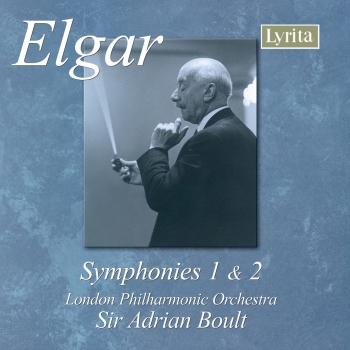
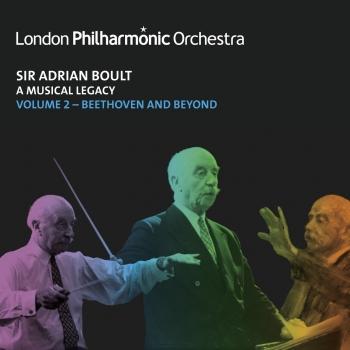
Sir Adrian Boult
(1889-1983) spoke these words in a broadcast talk in February 1947. As a performer he exemplified the supreme professional. With a baton technique second to none, Boult's greatest achievement was the formation of the BBC Symphony Orchestra in 1930 and its subsequent development into a world-class ensemble by the end of that decade. The sheer range of music played during his time with the BBC remains extraordinary, including many world and British premieres. Unceremoniously dumped by the BBC at the mandatory retiring age of 60, Sir Adrian then worked with the London Philharmonic Orchestra in the 1950s. For the last 30 years of his life he served as a guest conductor, except for a single year in Birmingham. Boult was knighted in 1937 and made a Companion of Honour in 1969. He retired in 1979.
In musical and general education the conductor must be unusually well equipped. He must have a great deal of musical knowledge; and I don't just mean of orchestral scores. He must also have a working knowledge of all instruments with which he is to come in contact, including the human voice. (Sir Adrian Boult)
Booklet for Hindemith: Symphony in E-Flat (Transferred From The Original Everest Records Master Tapes)