






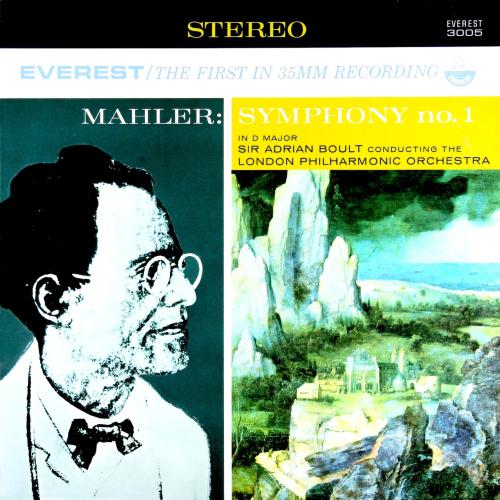
Mahler: Symphony No. 1 in D Major "Titan" (Transferred from the Original Everest Records Master Tapes) London Philharmonic Orchestra & Sir Adrian Boult
Album info
Album-Release:
2013
HRA-Release:
14.01.2026
Label: Everest
Genre: Classical
Subgenre: Orchestral
Artist: London Philharmonic Orchestra & Sir Adrian Boult
Composer: Gustav Mahler (1860-1911)
Album including Album cover Booklet (PDF)
I`m sorry!
Dear HIGHRESAUDIO Visitor,
due to territorial constraints and also different releases dates in each country you currently can`t purchase this album. We are updating our release dates twice a week. So, please feel free to check from time-to-time, if the album is available for your country.
We suggest, that you bookmark the album and use our Short List function.
Thank you for your understanding and patience.
Yours sincerely, HIGHRESAUDIO
- Gustav Mahler (1860 - 1911): Symphony No. 1 in D Major "Titan":
- 1 Mahler: Symphony No. 1 in D Major "Titan": I. Langsam, schleppend wie ein Naturlaut (Remastered 2013) 14:31
- 2 Mahler: Symphony No. 1 in D Major "Titan": II. Kräftig bewegt, doch nicht zu schnell (Remastered 2013) 05:54
- 3 Mahler: Symphony No. 1 in D Major "Titan": III. Feierlich und gemessen, ohne zu schleppen (Remastered 2013) 09:05
- 4 Mahler: Symphony No. 1 in D Major "Titan": IV. Stürmisch bewegt (Remastered 2013) 16:55
Info for Mahler: Symphony No. 1 in D Major "Titan" (Transferred from the Original Everest Records Master Tapes)
Symphony No. 1 in D major by Gustav Mahler was mainly composed between late 1887 and March 1888, though it incorporates music Mahler had composed for previous works. It was composed while Mahler was second conductor at the Leipzig Opera, Germany. Although in his letters Mahler almost always referred to the work as a symphony, the first two performances described it as a symphonic poem and as a tone poem in symphonic form respectively. The work was premièred at the Vigadó Concert Hall, Budapest, in 1889, but was not well received. Mahler made some major revisions for the second performance, given at Hamburg in October 1893; further alterations were made in the years prior to the first publication, in late 1898. Some modern performances and recordings give the work the title Titan, despite the fact that Mahler only used this label for the second and third performances, and never after the work had reached its definitive four-movement form in 1896.
London Symphony Orchestra
Sir Eugene Goossens, conductor
Digitally remastered





Sir Adrian Boult
(1889-1983) spoke these words in a broadcast talk in February 1947. As a performer he exemplified the supreme professional. With a baton technique second to none, Boult's greatest achievement was the formation of the BBC Symphony Orchestra in 1930 and its subsequent development into a world-class ensemble by the end of that decade. The sheer range of music played during his time with the BBC remains extraordinary, including many world and British premieres. Unceremoniously dumped by the BBC at the mandatory retiring age of 60, Sir Adrian then worked with the London Philharmonic Orchestra in the 1950s. For the last 30 years of his life he served as a guest conductor, except for a single year in Birmingham. Boult was knighted in 1937 and made a Companion of Honour in 1969. He retired in 1979.
In musical and general education the conductor must be unusually well equipped. He must have a great deal of musical knowledge; and I don't just mean of orchestral scores. He must also have a working knowledge of all instruments with which he is to come in contact, including the human voice. (Sir Adrian Boult)
Booklet for Mahler: Symphony No. 1 in D Major "Titan" (Transferred from the Original Everest Records Master Tapes)