

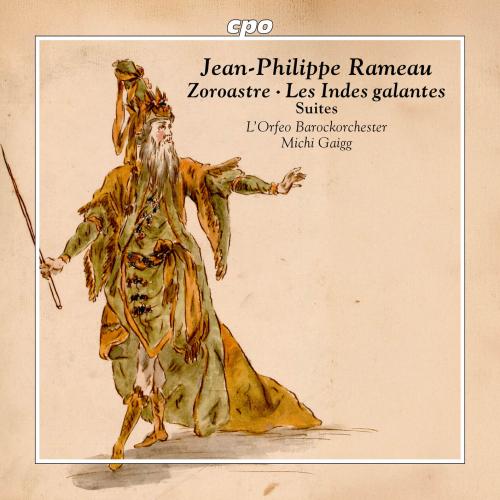
Rameau: Suites from "Zoroastre" & "Les indes galantes" L'Orfeo Barockorchester & Michi Gaigg
Album info
Album-Release:
2026
HRA-Release:
06.03.2026
Label: CPO
Genre: Classical
Subgenre: Orchestral
Artist: L'Orfeo Barockorchester & Michi Gaigg
Composer: Jean Philippe Rameau (1683-1764)
Album including Album cover Booklet (PDF)
Coming soon!
Thank you for your interest in this album. This album is currently not available for sale but you can already pre-listen.
Tip: Make use of our Short List function.
- Jean-Philippe Rameau (1683 - 1764): Suite from "Zoroastre, RCT 62" (1749 Version):
- 1 Rameau: Suite from "Zoroastre, RCT 62" (1749 Version): I. Ouverture 03:57
- 2 Rameau: Suite from "Zoroastre, RCT 62" (1749 Version): II. Gavotte (Pour la suite d’Amélite) 01:23
- 3 Rameau: Suite from "Zoroastre, RCT 62" (1749 Version): III. Ballet figuré: Gigue (Pour les sauvages indiens et indiennes) 01:26
- 4 Rameau: Suite from "Zoroastre, RCT 62" (1749 Version): IV. Rigaudon (Pour les sauvages indiens et indiennes) 00:59
- 5 Rameau: Suite from "Zoroastre, RCT 62" (1749 Version): V. Menuets I-II (Pour les sauvages indiens et indiennes) 02:31
- 6 Rameau: Suite from "Zoroastre, RCT 62" (1749 Version): VI. Contredanse (Pour les mages, les sauvages indiens et indiennes) 00:50
- 7 Rameau: Suite from "Zoroastre, RCT 62" (1749 Version): VII. Ouverture (Reprise) 03:56
- 8 Rameau: Suite from "Zoroastre, RCT 62" (1749 Version): VIII. Entracte: Air (Entrée des mages) 02:17
- 9 Rameau: Suite from "Zoroastre, RCT 62" (1749 Version): IX. Ballet figuré: Sarabande (Pour les esprits élémentaires) 01:53
- 10 Rameau: Suite from "Zoroastre, RCT 62" (1749 Version): X. Gavotte en rondeau (Pour les esprits élémentaires) 01:33
- 11 Rameau: Suite from "Zoroastre, RCT 62" (1749 Version): XI. Loure (Pour les esprits élémentaires) 02:26
- 12 Rameau: Suite from "Zoroastre, RCT 62" (1749 Version): XII. Passepieds I-II (Pour les esprits élémentaires) 02:16
- 13 Rameau: Suite from "Zoroastre, RCT 62" (1749 Version): XIII. Ballet figuré: Air (Pour la Haine et le Désespoir) 02:18
- 14 Rameau: Suite from "Zoroastre, RCT 62" (1749 Version): XIV. Air (Pour les démons) 01:46
- 15 Rameau: Suite from "Zoroastre, RCT 62" (1749 Version): XV. Air I (Pour les esprits élémentaires) 02:48
- 16 Rameau: Suite from "Zoroastre, RCT 62" (1749 Version): XVI. Air II en rondeau (Pour les esprits élémentaires) 01:46
- 17 Rameau: Suite from "Zoroastre, RCT 62" (1749 Version): XVII. Ballet figuré: Entrée des bergers et bergères, des castres et pastourelles 03:07
- 18 Rameau: Suite from "Zoroastre, RCT 62" (1749 Version): XVIII. Air en rondeau (Pour les esprits élémentaires, les bergers et bergères, les castres et pastourelles) 00:46
- 19 Rameau: Suite from "Zoroastre, RCT 62" (1749 Version): XIX. Gavottes I-II (Pour les bergers et bergères, les castres et pastourelles) 02:09
- 20 Rameau: Suite from "Zoroastre, RCT 62" (1749 Version): XX. Contredanse (Reprise) 00:55
- Suite from "Les indes galantes, RCT 44" (1736 Version):
- 21 Rameau: Suite from "Les indes galantes, RCT 44" (1736 Version): I. Ouverture 04:32
- 22 Rameau: Suite from "Les indes galantes, RCT 44" (1736 Version): II. Tambourins I-II 02:44
- 23 Rameau: Suite from "Les indes galantes, RCT 44" (1736 Version): III. Air pour les esclaves africains 01:23
- 24 Rameau: Suite from "Les indes galantes, RCT 44" (1736 Version): IV. Air pour les esclaves africains 02:17
- 25 Rameau: Suite from "Les indes galantes, RCT 44" (1736 Version): V. Musette en rondeau 02:44
- 26 Rameau: Suite from "Les indes galantes, RCT 44" (1736 Version): VI. Rigaudons I-II (Pour les matelots provençaux etmMatelotes provençales) 01:22
- 27 Rameau: Suite from "Les indes galantes, RCT 44" (1736 Version): VII. Danse du grand calumet de la paix en rondeau pour les sauvages 02:01
- 28 Rameau: Suite from "Les indes galantes, RCT 44" (1736 Version): VIII. Tambourins I-II (Reprise) 01:23
Info for Rameau: Suites from "Zoroastre" & "Les indes galantes"
Jean-Philippe Rameau was one of the most important luminaries of the 18th century as a composer and theorist, although he kept his compositional and scholarly activities so carefully separate that his pieces show no trace of the considerations of this "sonic scholar". The subject matter of his stage works is something else entirely. Les Indes galantes, for example, draws on the latest ethnological explorations of Asia and America, while the grand opera Zoroastre is based on research into the Persian religious founder Zarathustra, who after considerable trials wins the hand of his beloved and the throne of Bactria. One of the most surprising aspects of this fantastic production is how effectively yet discreetly these exotic subjects were incorporated into the established dance forms of the Baroque period, and that Rameau was even able to stage a Native American rain dance.
L'Orfeo Barockorchester
Michi Gaigg, conductor
L’Orfeo Barockorchester
For 30 years now the L’Orfeo Barockorchester ranges among the most prominent players on the Early Music stage. According to the Neue Zürcher Zeitung the international ensemble, directed by its founder Michi Gaigg, boasts uniqueness that sets it apart from any globalized uniformity. This quality is based on widely diverse musical synergies. A spirited approach, a sense of continuity, healthy dynamics in the ensemble and an inquisitive nature are the ingredients for Michi Gaigg’s recipe. Against this background she creates her own colourful, sensual, temperamental and unmistakable handwriting.
L’Orfeo now boasts an extensive discography (counting more than 40 CD’s up to date) of some world premieres and opera productions which received international awards by BBC Music Magazine, Diapason, Gramophone, Forbes, Pizzicato (“Supersonic Award”), Le Monde de la Musique, Fono Forum, Radio Österreich 1 (“Pasticcio Prize”) as well as the German Music Award “Echo Klassik” and “Opus Klassik”.
In 2021, celebrating the 25th anniversary, the production of the complete symphonies and symphonic fragments by Schubert was released. This is the current showpiece in L’Orfeo’s many-faceted repertoire reaching from the French, German and Austrian Baroque to the Sinfonia of the Mannheim School, First Viennese School and the early Romantics.
L’Orfeo also leaves its mark as an opera orchestra, recently with Joseph Haydn’s “Turkish” opera L’incontro improvviso and the Mozart disc “From Zero to Hero” with tenor Daniel Behle. Further rarities and master works include operas by George Frideric Handel, Georg Philipp Telemann, Jean-Philippe Rameau, Georg Anton Benda, Christoph Willibald Gluck as well as a trilogy of early works by Gioachino Rossini.
The most significant festivals and venues in recent times have been Salzburg Festival, Lucerne Festival, Beethovenfest Bonn, Innsbrucker Festwochen der Alten Musik, Schwetzinger SWR Festspiele, MDR Summer Festival, Handel Festival Halle, Early Music Festival Regensburg, International Baroque Festival Melk, Herbstgold Festival Eisenstadt, Schubertiade Schwarzenberg & Hohenems, EXPO 2015 Milano, Festival Bach de Lausanne, Mozart Festival Würzburg, Gluck Opera Festival Nürnberg, Cologne Early Music Festival, Palau de la Música Catalana Barcelona, Gala Concert in the Vatican City (Sixtine Chapel), Musikverein Wien, Wiener Konzerthaus, Theater an der Wien, Brucknerhaus Linz, etc., tours of France, Spain, South Africa and Namibia.
The L’Orfeo Barockorchester conducted by Michi Gaigg performed its very successful debut at the renowned Elbphilharmonie Hamburg in 2019 (re-invitation 2022).
Education: Euridice Barockorchester of the Anton Bruckner Private University Linz. An incentive of L’Orfeo: members of L’Orfeo coach the students during sectional rehearsals and perform with the students.
Michi Gaigg
was born in Schörfling at the Attersee, Austria (Salzkammergut). She was strongly influenced by Nikolaus Harnoncourt during her violin studies at the Salzburg Mozarteum and subsequently continued studies of the Baroque violin with Ingrid Seifert and Sigiswald Kuijken. Before founding her own Baroque orchestra L’Arpa Festante Munich in 1983 (direction until 1995) Michi Gaigg was a member of internationally acclaimed ensembles and worked together with Frans Brüggen, Alan Curtis, Christopher Hogwood, René Jacobs, Ton Koopman and Hermann Max.
In 1996 she founded the L’Orfeo Barockorchester together with the recorder and oboe player Carin van Heerden. Under Michi Gaigg’s direction the orchestra has established itself as one of the leading ensembles in historically informed performance practice and has repeatedly been awarded various prizes for its CD recordings (almost 50 productions so far) by BBC Music Magazine, Diapason, Gramophone, Pizzicato (“Supersonic Award”), Le Monde de la Musique, Fono Forum, Radio Österreich 1 (“Pasticcio Prize”) as well as the German Music Awards “Echo Klassik” and “Opus Klassik”.
In 2021 an acclaimed production of the complete symphonies and symphonic fragments by Schubert was released.
Michi Gaigg has a strong affinity for French Baroque music. The innovative and visionary strength of the music, especially the works by Jean-Philippe Rameau, is fertile soil for her interpretation of operas and orchestral repertoire from the pre-Classical era and the First Viennese School. This is the repertoire with which Michi Gaigg and the L’Orfeo Barockorchester create press and audience furore time and again. Her approach to the early Romantics Franz Schubert and Felix Mendelssohn Bartoldy also invites new listening experiences.
In addition to her extensive concert activities as violinist and conductor Michi Gaigg first taught at the Conservatoire National de Strasbourg and from 1994-2017 at the Institute for Early Music at the Anton Bruckner Private University in Linz. She was the artistic director for 22 years (up to 2024) of the donauFESTWOCHEN im Strudengau, a festival for Early and Contemporary music, for which she was awarded the Artists’ Award for Stage Performance and the Medal for Cultural Achievements of the province of Upper Austria. Michi Gaigg was additionally awarded the Heinrich-Gleissner-Prize (2016) and the Honorary Art Prize (2020).
Booklet for Rameau: Suites from "Zoroastre" & "Les indes galantes"