




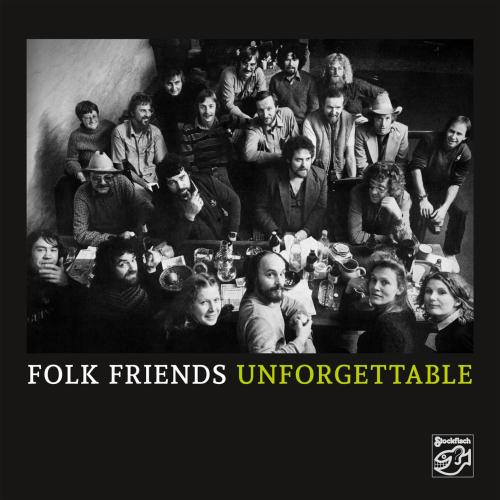
Unforgettable (Remastered) Folk Friends
Album info
Album-Release:
2026
HRA-Release:
13.07.2026
Album including Album cover Booklet (PDF)
- 1 Die Gedanken sind frei 02:31
- 2 Kaffee schwarz, Zigarette 02:32
- 3 Columbus Georgia 04:29
- 4 Raindrop 02:17
- 5 Song for the Fox 03:29
- 6 The John McLean March 04:10
- 7 Come ye oèr frae France 01:32
- 8 Willie Moore 03:56
- 9 Sugar for Sugar 02:43
- 10 Voices from the Mountains 01:47
- 11 King Fareweel 04:18
- 12 The Band Played Waltzing Matilda 07:07
- 13 Little Old Lady 02:16
- 14 Yesterday`s People 02:36
- 15 Garden Song 03:23
- 16 Take the Children and Run 03:21
Info for Unforgettable (Remastered)
More than 45 years ago, Carsten Linde had the brilliant idea of inviting folk musicians from various countries to a joint session at the Stockfisch Studio in Northeim. How Carsten managed to make this gathering a reality in 1979 borders on a miracle. In October 1980, a second gathering of the Folk Friends took place. The recordings from this session exceeded the total playing time of the double-LP format available at the time, which is why many tracks remained unreleased.
45 years later, we rediscovered the analog recordings in excellent quality in the Stockfisch archive. They are thus a document from days gone by and a memento of beloved musicians who have left us. (Günter Pauler, January 2026)
Preparations for the 1980 Folk Friends Sessions dragged on for nearly two years. There was a lot to do: the artists’ tour schedules and long-term commitments had to be coordinated, train and plane tickets booked, accommodations arranged for 15 musicians and 7 guests, and a one-week time slot reserved for making music together at Günter Pauler’s recording studio. Finally, the time had come: the first musicians had already arrived, while others still needed to be picked up.
There were warm greetings and hugs; laughter and lively conversation filled the room. Some hadn’t seen each other in years, while others were meeting for the first time. After initial discussions and brainstorming about song selection, possible arrangements, and collaborative roles, everyone quickly picked up their instruments, and Günter Pauler began recording.
All the Folk Friends listened intently, impressed by his technical skill and his gift for conjuring up tracks with outstanding sound quality at the mixing console. The session further fueled the relaxed and friendly atmosphere, and even today—more than 45 years later—we remember those feelings that sustained us all and bound us together forever. We talked and rehearsed together late into the night; everyone was bursting with ideas and gave it their all. The presence of so many musician friends was a huge source of inspiration, and collaborations that had previously seemed almost impossible emerged spontaneously during those days.
Friendship, musical harmony, and technical quality came together that week in a creative process—one thing led to another. In the end, we listened to the recordings together and decided where they would fit on the double album “Folk Friends 2.” Afterward, the Folk Friends scattered to the four winds once more. We met up occasionally at these musicians’ concerts, but we never came together again as a large group. What remained was the bond of friendship, forged in 1980 and strengthened over the years. All the songs from the 1980 session deserved to appear on the album, but space was limited. The outtakes were archived, where they were recently rediscovered by Günter Pauler.
“As with the recordings released on ‘Folk Friends 2’ in 1980, these are handcrafted acoustic songs full of emotional depth. We are releasing them after 45 years as documents and reflections of the music that carried the Folk Friends across Europe. The songs preserve their dreams of friendship, of togetherness, and of a just world without wars. Like them, we believe in the power of poetry and music to bring people together."
"We dedicate these recordings to the late Folk Friends: Derroll Adams, legendary banjo player; Alex Campbell, Scottish troubadour; Guy Carawan, singer of the American civil rights movement; Werner Lämmerhirt, magician on the guitar; Wizz Jones, highly esteemed ‘folksinger’s folksinger’; Dolores Keane, Queen of Irish Female Singers; and Danny Thompson. The Folk Friends and their songs: Too Good To Be Forgotten." (Carsten Linde)
Alex Campbell, vocals
Andy Irvine, bouzouki, mouth organ, guitar, vocals
Candie Carawan, vocals
Danny Thompson, bass, double bass
Davey Arthur, mandolin, guitar
Derroll Adams, 5-string banjo, vocals
Dick Gaughan, guitar, vocals
Dolores Keane, concert flute, vocals
Finbar Furey, guitar, Uillean pipes, flute, tin whistle, vocals
Guy Carawan, guitar, vocals
Hannes Wader, guitar, vocals
Jörg Suckow, cello
John Faulkner, hurdy-gurdy, fiddle, bouzouki, vocals
Lydie Slopianka-Auvray, accordion
Ramblin' Jack Elliot, guitar, vocals
Werner Lämmerhirt, guitar, vocals
Wizz Jones, guitar, vocals
Digitally remastered
Folk Friends
Hannes, Guy, Derroll, Alex, Wizz, Finbar, Davey and Werner had met rather by chance in recent years when their paths crossed on tours or at festivals. Sometimes, on the sidelines or backstage, they would unpack their instruments and play songs and tunes they liked. From time to time they also played together in sessions and noticed that they got along well not only musically but also personally.
Because they had become friends, they had now — regardless of their "market value" or exclusive ties to agencies and record companies — met at the mill and started making music together. Much of that friendly, laid-back vibe echoes in the music and songs on this album. The enthusiasm to sing and play together in different groups and to be able to try out new musical possibilities can be heard atmospherically and as a feeling in every track on this album. All songs and instrumentals are disc premieres in the changing combinations of the "Folkfriends".
The musicians and singers involved chose the titles they wanted to record themselves in consultation with one another. They arranged their music and songs together. Without any pressure to record their music as a usable product in a certain time, they held their sessions in the garden and in the large room of the mill right in front of the microphones.
A living room — even if it's surrounded by the 'solitude' of rural life — is not a soundproof recording studio with noise-absorbing flooring and the threatening red light of 'Recording!' The farmers' tractors drove past Hannes Mühle, and the neighborhood dogs fought in front of her. Occasionally these noises penetrated through the closed doors and windows and could then be heard on the tape. We deliberately understood this atmospheric noise as secondary if a recording seemed unrepeatable and unique in its feel (e.g. with Derroll's "Pay Day At Coal Creek").
It was not intended to make recordings as they are possible 'clean' in expensive recording studios — albeit in a sterile environment, mostly in forced isolation of the musicians and only with the help of playback methods. These recordings are true "live" recordings.
They were created in the joint work of all those involved, with the exception of a few recordings without playback. Because musicians are people whose feet tap along to the rhythm of their music, whose fingers sweat and then produce overtones when running fast on the guitar strings and because their breath can be heard blowing flutes and flutes, we deliberately recorded these noises. We have not attempted to suppress them through technical means, as is usually done.
Musicians are not machines whose products can be seen in a predetermined, perfectly controllable end result, but sensitive people who express their sensations and feelings as essential creative moments in their songs and melodies. Seen in this way, the recordings of the "Folkfriends" reflect a relaxed, human atmosphere with the exclusion of technical refinements. Seen in this way, folk music is direct and simple and, by doing without too much technology, is understandable for everyone and can be done by everyone. (Carsten Linde)
Booklet for Unforgettable (Remastered)