




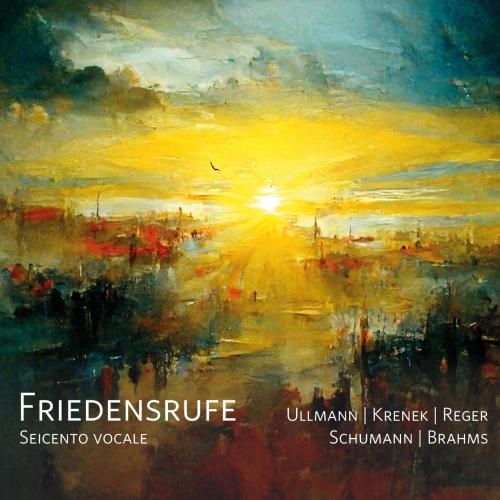
Friedensrufe Seicento vocale & Jan Croonenbroeck
Album info
Album-Release:
2024
HRA-Release:
06.10.2026
Label: Resonando
Genre: Classical
Subgenre: Choral
Artist: Seicento vocale & Jan Croonenbroeck
Composer: Viktor Ullmann (1898-1944), Ernst Krenek (1900-1991), Max Reger (1873-1916), Robert Schumann (1810-1856), Johannes Brahms (1833-1897)
Album including Album cover
- Robert Schumann (1810 - 1856): Op. 75/1:
- 1 Schumann: Op. 75/1: Schnitter Tod 03:53
- Johannes Brahms (1833 - 1897): WoO 35/12:
- 2 Brahms: WoO 35/12: Altdeutsches Kampflied 02:26
- Viktor Ullmann (1898 -1944): Die Weise von Liebe und Tod des Cornets Christoph Rilke:
- 3 Ullmann: Die Weise von Liebe und Tod des Cornets Christoph Rilke: Weise I 2 03:01
- 4 Ullmann: Die Weise von Liebe und Tod des Cornets Christoph Rilke: Weise I 5 03:33
- Robert Schumann: Wenn mein Stündlein vorhanden ist (Endenicher Sterbechoral):
- 5 Schumann: Wenn mein Stündlein vorhanden ist (Endenicher Sterbechoral) 01:43
- Viktor Ullmann: Die Weise von Liebe und Tod des Cornets Christoph Rilke:
- 6 Ullmann: Die Weise von Liebe und Tod des Cornets Christoph Rilke: Weise II 2 01:29
- Johannes Brahms: WoO 34/13:
- 7 Brahms: WoO 34/13: Schnitter Tod 02:11
- Viktor Ullmann: Die Weise von Liebe und Tod des Cornets Christoph Rilke:
- 8 Ullmann: Die Weise von Liebe und Tod des Cornets Christoph Rilke: Weise II 5 01:25
- 9 Ullmann: Die Weise von Liebe und Tod des Cornets Christoph Rilke: Weise II 6 01:02
- 10 Ullmann: Die Weise von Liebe und Tod des Cornets Christoph Rilke: Weise II 7 01:43
- 11 Ullmann: Die Weise von Liebe und Tod des Cornets Christoph Rilke: Weise II 8 02:03
- Johannes Brahms: WoO 34/8:
- 12 Brahms: WoO 34/8: In stiller Nacht 02:22
- Ernst Krenek (1900 - 1991): Op. 72:
- 13 Krenek: Op. 72: Kantate von der Vergänglichkeit des Irdischen 19:27
- Max Reger (1873 - 1916): Op. 144B:
- 14 Reger: Op. 144B: Seele, vergiß sie nicht 14:22
- Johannes Brahms: WoO 20:
- 15 Brahms: WoO 20: Dem dunkeln Schoß der heilgen Erde 03:09
Info for Friedensrufe
Seicento vocale’s debut album traces a musical and thematic line from the Thirty Years’ War to the world wars of the 20th century – a concept album that depicts aspects of war with tonal and verbal eloquence: from the dubious glorification of a hero’s death to the obvious senselessness of dying young.
In the center is Rainer Maria Rilke’s tale of a young cornet, as the melodrama Die Weise von Liebe und Tod des Cornets Christoph Rilke (The Tale of the Love and Death of Cornet Christoph Rilke) sensitively and captivatingly set to music by Victor Ullmann in the Theresienstadt concentration camp in 1944. Seicento vocale has divided Ullmann’s composition for piano and speaker into separate scenes, which are arranged for choir and juxtaposed with a capella works by Johannes Brahms and Robert Schumann. Thus, out of Rilke’s bleak journey into a distant war zone, from longed-for rest and a Baroque danse macabre, the catastrophe unfolds: on the morning of the battle, the Cornet oversleeps; so as not to abandon his unit completely, he lunges unprotected into enemy lines. For the bereaved, choir and listeners, only the empathy of grieving nature in Brahms’ In stiller Nacht (In Silent Night) remains.
Ernst Krenek also assumes a baroque tone with the selection of poems for his Kantate von der Vergänglichkeit des Irdischen (Cantata on the Transience of the Earthly). It combines the timeless expressive content of poetry by Gryphius, Fleming or Opitz with a modern musical language. Written in 1932, the cantata explores themes of suffering and the physical and psychological effects of war as a way of coming to terms with the past, yet it is also prophetic.
Max Regers Requiem „Seele, vergiß sie nicht“ (Soul, Forget Them Not) on a text by Friedrich Hebbel can be read as a commitment to a vibrant culture of mourning and remembrance, which Brahms intensifies even more in his setting of Schiller’s Dem dunklen Schoß der heilgen Erde (To Holy Earth’s E’er-Darkening Womb): comfort is found in the hope that the honest work of mourning may sow the seed for a better, more blossoming future.
The young ensemble and soloists shape their music freely and colourfully and possess a high quality of sound and interpretative depth. With their debut album, Seicento vocale aim to contribute to a responsible and historically conscious coexistence. The works serve not only for musical enjoyment, but also to commemorate and process the horrors of past wars, together with the desire for a collective “Never again”.
Cornelia Samuelis, soprano
Henriette Gödde, alto
Cornelia Glassl, piano
Seicento Vocale
Jan Croonenbroeck, musical director

Jan Croonenbroeck
In addition, he is the musical director of Ensemble Seicento Vocale, founded in 2016. The ensemble’s debut album Friedensrufe was nominated for the Quarterly Critics’ Award of the German Record Critics’ Association as well as for the ICMA Award. In the 2017/18 season, Jan Croonenbroeck was engaged as a principal répétiteur with conducting duties at the Staatstheater Nürnberg. From the 2018/19 season onwards, he worked as Head of Music Studies and Kapellmeister at the Staatstheater Darmstadt, where he conducted a wide-ranging operatic and concert repertoire.
Since 2018, Jan Croonenbroeck has collaborated as Musical Assistant at the Bayreuth Festival on productions of Lohengrin, Tannhäuser, Parsifal, and Der Ring des Nibelungen, working with Christian Thielemann, Pietari Inkinen, Cornelius Meister, Nathalie Stutzmann, and Pablo Heras-Casado. Guest engagements have taken him to the SWR Vokalensemble, the Rundfunkchor Berlin, the Berlin State Opera, the Opéra National de Paris, Hawaii Opera Theatre, and the Dresden Philharmonic, as well as appearing as a concert conductor with the Deutsche Philharmonie Merck and the Jena Philharmonic, and conducting two opera premieres at the Stadttheater Gießen. Since the 2023/24 season, he has been First Kapellmeister at the Staatstheater Nürnberg.
This album contains no booklet.