



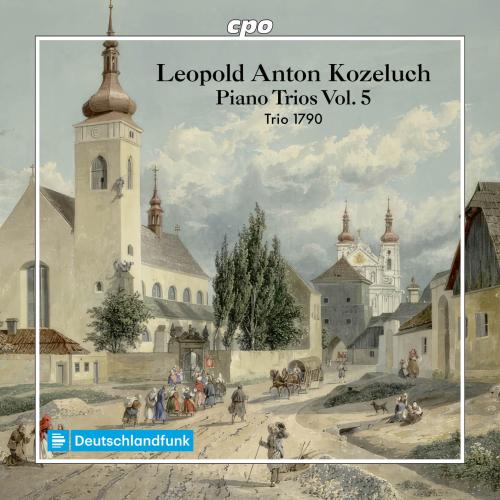
Kozeluch: Piano Trios Vol. 5 Trio 1790
Album info
Album-Release:
2026
HRA-Release:
08.10.2026
Label: CPO
Genre: Classical
Subgenre: Chamber Music
Artist: Trio 1790
Composer: Leopold Kozeluch (1747-1818)
Album including Album cover Booklet (PDF)
- Leopold Anton Koželuch (1747 - 1818): Sonata P.IX:40 in G major:
- 1 Koželuch: Sonata P.IX:40 in G major: Allegro 10:08
- 2 Koželuch: Sonata P.IX:40 in G major: Larghetto. Air Ecossois 05:00
- 3 Koželuch: Sonata P.IX:40 in G major: Rondeau. Allegretto Ecossois 06:40
- Sonata P.IX:42 in C major:
- 4 Koželuch: Sonata P.IX:42 in C major: Allegro 10:31
- 5 Koželuch: Sonata P.IX:42 in C major: Poco adagio. Air Ecossois 05:35
- 6 Koželuch: Sonata P.IX:42 in C major: Allegretto 06:05
- Sonata P.IX:10 in G major:
- 7 Koželuch: Sonata P.IX:10 in G major: Allegro 08:22
- 8 Koželuch: Sonata P.IX:10 in G major: Cantabile 04:26
- 9 Koželuch: Sonata P.IX:10 in G major: Rondeau. Allegro 05:40
Info for Kozeluch: Piano Trios Vol. 5
Leopold Anton Kozeluch (1747–1818) belonged to that generation of Bohemians who sought their fortune in Vienna during the 18th century. By 1781, Kozeluch had already established such a fine reputation that he received an offer from the Archbishop of Salzburg to succeed Mozart as court organist. His piano trios must have been very popular, for over 60 of them were published between 1781 and 1810. In his trios, Kozeluch sets new standards that did not fail to influence Beethoven and Schubert. The Trio 1790, performing on period instruments, treats us to precious gems which, far from losing any of their substance due to the delicate, filigree tone of the historically accurate instruments, but, on the contrary, gain a wealth of the subtlest nuances and a depth one would not expect in the music of this equally diligent, inventive and versatile Bohemian, which at first seems rather playful: Time and again, dramatic clusters emerge amidst the light-footed, distinctive sounds and lines, reminding the attentive listener of the ‘music of the future’ composed by the man who travelled from Bonn on the Rhine to Vienna on the Danube to shake the musical world to its core – Ludwig van Beethoven.
“The Trio 1790’s long familiarity with Kozeluch’s idiom and that of his era leads not only to insightful but thoroughly convincing interpretations of the three works.” (klassik.com, on Piano Trios P. IX: Nos. 8, 11, 1)
“The Trio 1790 brings out every detail of this entertaining, yet never superficial, music with precision and enthusiasm.” (FonoForum on Piano Trios P. IX: Nos. 9, 17, 43)
“Böhme was certainly a formidable rival to Mozart, as his piano trios demonstrate. The musicians tackle the trios with great verve and lively virtuosity, thereby highlighting the originality of the scores. A clean sound." (FonoForum on Piano Trios P.IX: Nos. 14, 15, 18)
Trio 1790
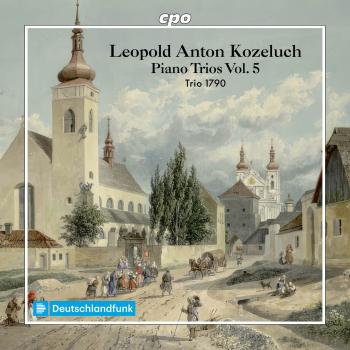
TRIO 1790
Since its inception, the ensemble has established itself as one of Germany’s leading piano trios dedicated to performing music on period instruments. The year 1790 marks the approximate midpoint of the ensemble's repertoire, which focuses on the era spanning from the first piano trios of the 1760s to the close of the Viennese Classical period around 1820.
Imola Gombos
Cellist and viola da gamba player Imola Gombos was born in Budapest. She was a prize-winner at the Hungarian national cello competition in 1990 and 1993. She initially earned diplomas in chamber music and pedagogy from the Franz Liszt Academy of Music in Budapest, subsequently studying baroque cello and viola da gamba in Vienna (with José Vázquez) and—as a DAAD scholarship recipient—in Frankfurt am Main (with Rainer Zipperling) and Bremen (with Hille Perl). As a soloist and chamber musician, she collaborates with renowned artists such as Monica Huggett, John Holloway, Barthold Kuijken, and Gabriel Garrido, as well as ensembles including "Weser Renaissance," "Das Kleine Konzert," and "Concerto Köln." Her professional activities include concerts, tours, and radio and CD recordings across Germany and the rest of Europe.
Annette Wehnert
studied in Cologne, Düsseldorf, and Bloomington. From 1991 to 1995, she was a member of the Deutsche Oper am Rhein. She has performed with numerous baroque ensembles, such as "Concerto Köln," "Musica Antiqua Köln," "La Stagione Frankfurt," and the "Freiburg Baroque Orchestra." She served as concertmaster of the "Kölner Akademie" from 1998 to 2008. She is frequently sought after as a chamber music partner by ensembles such as "Camerata Köln" and "Epoca barocca." Annette Wehnert has been teaching at the Cologne Conservatory since 1989. Her teaching activities have been complemented by numerous engagements leading courses on historical performance practice, including at the Enescu Conservatory in Bucharest and Potchefstroom University in South Africa.
Harald Hoeren
began his musical career with "Camerata Köln." As a harpsichordist and fortepianist, he has distinguished himself through more than 100 CD recordings featuring music ranging from the early Baroque to the Viennese Classical period. Concert tours have taken him across nearly all Central and Western European countries, as well as to Asia, North America, and South America. He served as a guest professor at the University of the Philippines in Manila in 1983 and 1990, and since 1984, he has led a class for historical keyboard instruments at the University of Music and Performing Arts in Frankfurt am Main, where he was appointed professor in 1999.
Booklet for Kozeluch: Piano Trios Vol. 5