


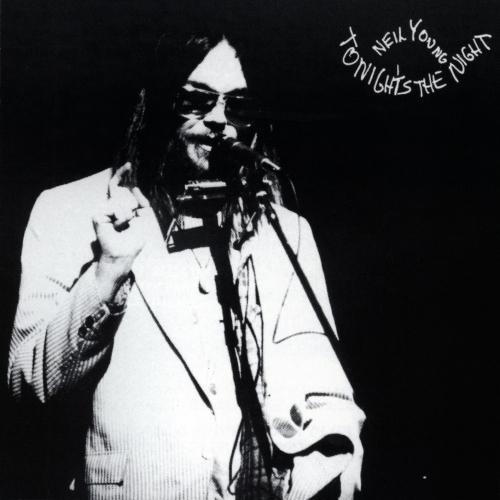
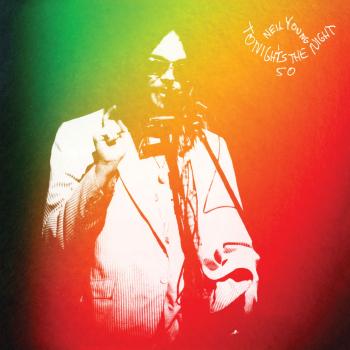
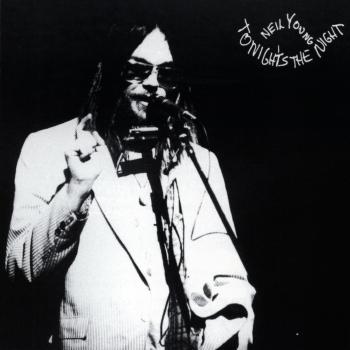
Tonight's the Night (2025 Remaster) Neil Young
Album info
Album-Release:
1975
HRA-Release:
04.09.2026
Album including Album cover
I`m sorry!
Dear HIGHRESAUDIO Visitor,
due to territorial constraints and also different releases dates in each country you currently can`t purchase this album. We are updating our release dates twice a week. So, please feel free to check from time-to-time, if the album is available for your country.
We suggest, that you bookmark the album and use our Short List function.
Thank you for your understanding and patience.
Yours sincerely, HIGHRESAUDIO
- 1 Tonight's the Night (2025 Remaster) 04:41
- 2 Speakin' Out (2025 Remaster) 04:57
- 3 World on a String (2025 Remaster) 02:25
- 4 Borrowed Tune (2025 Remaster) 03:25
- 5 Come on Baby Let's Go Downtown (2025 Remaster) 03:35
- 6 Mellow My Mind (2025 Remaster) 03:11
- 7 Roll Another Number (For the Road) [2025 Remaster] 03:04
- 8 Albuquerque (2025 Remaster) 04:01
- 9 New Mama (2025 Remaster) 02:11
- 10 Lookout Joe (Original Recording) 04:24
- 11 Tired Eyes (2025 Remaster) 04:36
- 12 Tonight's the Night, Pt. II (2025 Remaster) 04:55
Info for Tonight's the Night (2025 Remaster)
Let's get a popular misconception out of the way. The rap about this being one of Young's darkest, most harrowing albums is utter nonsense, perpetuated by critics who spend more time reading each other than listening to the music. TONIGHT'S THE NIGHT is dedicated to Young's guitarist Danny Whitten and roadie Bruce Berry, who died shortly before this recording was made, and the title cut details that very subject, but the darker moments here are leavened by a generous share of self-parodic humor and general Neil Young loopiness.
Sad, tender ballads like 'Borrowed Tune,' (itself not without humor) rub shoulders with hearty rockers like 'Come On Baby Let's Go Downtown.' Several tunes find Young and Crazy Horse exploring hard-edged country-rock with their collective tongue stuck firmly in the cheek, as on 'Roll Another Number.' Young's voice reels sadistically and purposefully out of tune, cutting through the arrangements like strategically placed barbed-wire (and providing a template for the work of Will Oldham/Palace two decades later). Sardonic, taunting, mercilessly self-deprecating, often downright funny, TONIGHT'S THE NIGHT is no gloomfest, but a multi-faceted, full-bodied classic.
'...One of the most bleakly beautiful rock albums ever made...' (Mojo)
„Written and recorded in 1973 shortly after the death of roadie Bruce Berry, Neil Young's second close associate to die of a heroin overdose in six months (the first was Crazy Horse guitarist Danny Whitten), Tonight's the Night was Young's musical expression of grief, combined with his rejection of the stardom he had achieved in the late '60s and early '70s. The title track, performed twice, was a direct narrative about Berry: 'Bruce Berry was a working man/He used to load that Econoline van.' Whitten was heard singing 'Come On Baby Let's Go Downtown,' a live track recorded years earlier. Elsewhere, Young frequently referred to drug use and used phrases that might have described his friends, such as the chorus of 'Tired Eyes,' 'He tried to do his best, but he could not.' Performing with the remains of Crazy Horse, bassist Billy Talbot and drummer Ralph Molina, along with Nils Lofgren (guitar and piano) and Ben Keith (steel guitar), Young performed in the ragged manner familiar from Time Fades Away -- his voice was often hoarse and he strained to reach high notes, while the playing was loose, with mistakes and shifting tempos. But the style worked perfectly for the material, emphasizing the emotional tone of Young's mourning and contrasting with the polished sound of CSNY and Harvest that Young also disparaged. He remained unimpressed with his commercial success, noting in 'World on a String,' 'The world on a string/Doesn't mean anything.' In 'Roll Another Number,' he said he was 'a million miles away/From that helicopter day' when he and CSN had played Woodstock. And in 'Albuquerque,' he said he had been 'starvin' to be alone/Independent from the scene that I've known' and spoke of his desire to 'find somewhere where they don't care who I am.' Songs like 'Speakin' Out' and 'New Mama' seemed to find some hope in family life, but Tonight's the Night did not offer solutions to the personal and professional problems it posed. It was the work of a man trying to turn his torment into art and doing so unflinchingly. Depending on which story you believe, Reprise Records rejected it or Young withdrew it from its scheduled release at the start of 1974 after touring with the material in the U.S. and Europe. In 1975, after a massive CSNY tour, Young at the last minute dumped a newly recorded album and finally put Tonight's the Night out instead. Though it did not become one of his bigger commercial successes, the album immediately was recognized as a unique masterpiece by critics, and it has continued to be ranked as one of the greatest rock & roll albums ever made.“ (William Ruhlmann, AMG)
Neil Young, vocals, guitar, harmonica, piano, vibraphone
Ben Keith, vocals, guitar, slide guitar, steel guitar
Nils Lofgren, vocals, guitar, piano
Danny Whitten, vocals, guitar
Ralph Molina, vocals, drums
Jack Nitzsche, guitar, piano, keyboards
Billy Talbot, bass
Kenny Buttrey, drums
Tim Drummond, drums
George Whitsell, vocals
Recorded August–September 1973 at Studio Instrument Rentals, Hollywood, CA (except 'Come On Baby': Fillmore East, NYC, March 1970; 'Lookout Joe': Broken Arrow Ranch, December 1972 and 'Borrowed Tune': Broken Arrow Ranch, December 1973)
Produced by David Briggs, Neil Young
Digitally remastered
Neil Young
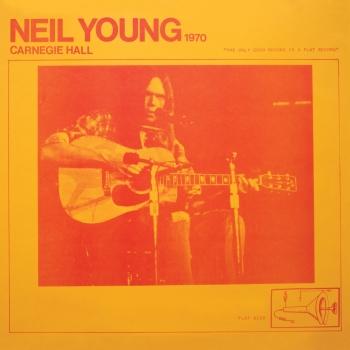
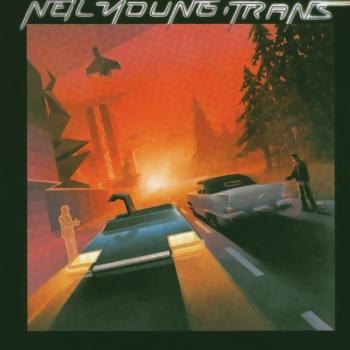
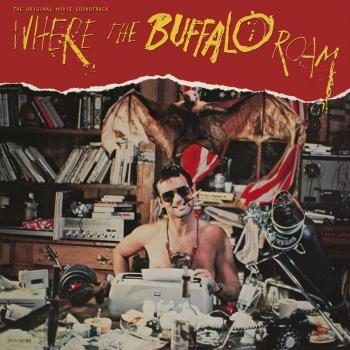
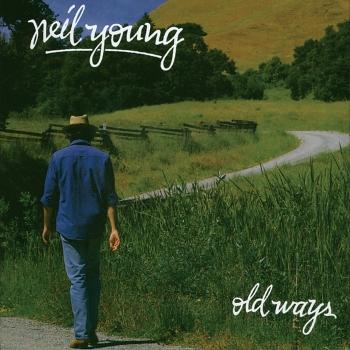
Born on November 12, 1945, in Toronto, Neil Young is a musician, singer-songwriter, and filmmaker, and is considered one of the most influential figures in rock music. He began his career in the 1960s with the band Buffalo Springfield and later performed with Crazy Horse, as well as solo and with other artists. His distinctive style blends folk, rock, country, and grunge. Albums such as *After the Gold Rush* (1970) and *Harvest* (1972)—featuring the classic "Heart of Gold"—rank among the milestones of his discography. In addition to his music, Young is known for his social activism. He has held U.S. citizenship since 2020 but continues to live partly in Canada.
This album contains no booklet.