



Genius Loves Company Ray Charles
Album info
Album-Release:
2004
HRA-Release:
31.03.2026
Album including Album cover
- 1 Here We Go Again 03:59
- 2 Sweet Potato Pie 03:48
- 3 You Don't Know Me 03:55
- 4 Sorry Seems To Be The Hardest Word 03:59
- 5 Fever 03:31
- 6 Do I Ever Cross Your Mind 04:35
- 7 It Was A Very Good Year 05:00
- 8 Hey Girl 05:16
- 9 Sinner's Prayer 04:25
- 10 Heaven Help Us All 04:33
- 11 Over The Rainbow 04:55
- 12 Crazy Love (Live) 03:43
Info for Genius Loves Company
“I’ve recorded with so many amazing artists in my career but never on a duets album all my own. I thought it was time to have some of the friends that I love and the artists that I admire come into my studio and sing with me live,” explains Ray Charles on the genesis of Genius Loves Company.” All the guests brought their own magic to each song. That’s what we wanted and that’s exactly what we got.” Ray’s confidence is understandable. Genius Loves Company stands as a remarkable hallmark in a remarkable career. In his brilliant debut for Concord Records, Ray sings a dozen duets with a dazzling array of guest artists from virtually every genre, who have won a combined 79 GRAMMY® Awards. “We cover it all,” Ray adds, “from country to R&B, pop, rock and blues. I’ve never let them put me in a little box, and this CD expresses that open feeling. A beautiful song is a beautiful song—and to sing with so many beautiful singers is a blessing from God.”
Featuring guest artists Natalie Cole, Elton John, Norah Jones, B.B. King, Gladys Knight, Diana Krall, Michael McDonald, Johnny Mathis, Van Morrison, Willie Nelson, Bonnie Raitt, and James Taylor.
In celebration of the 10th Anniversary of its release, Concord Music Group in conjunction with The Ray Charles Foundation and Hear Music will re-introduce this treasured album in a special 10th Anniversary Deluxe Edition. Genius Loves Company, originally released in 2004, is one of music’s most inspirational and historically significant albums of all time. With over 5.5 million copies sold, Ray Charles final studio album is certified multi-Platinum, Gold or Silver in numerous territories around the world. It is the Winner of eight GRAMMY Awards, including Album of the Year and Record of the Year in 2005 (tied with number of GRAMMYs won for Norah Jones’ Come Away With Me and Michael Jackson’s Thriller).
"Genius Loves Company is the last studio album Ray Charles completed before his death in June 2004. Prior to this, the last studio album he released was Strong Love Affair in 1996, which was a stab at modern pop, filled with new songs and given an adult contemporary sheen. It was not one of his most distinctive efforts, even when judged against his latter-day albums, and it disappeared not long after its release. Charles left Warner and, years later, signed with Concord, who released Genius Loves Company, which had a decidedly different approach than the all-modern Strong Love Affair. As the title acknowledges with a wink, this is a duets album, which may be a little commonplace as far as latter-day superstar albums go but is still a step up from his previous studio album since it puts Ray Charles in a comfortable, relaxed situation that plays to his strengths. Instead of trying to put Charles in a modern setting, producers John Burk and Phil Ramone (Burk helmed seven of the album's tracks, Ramone is responsible for the other five, and their work fits together seamlessly) go for a clean retro setting with a few guitars, synths, and a rhythm section, occasionally dressing it with an orchestra or some strings. In other words, apart from the glistening production, it's not far removed from any of Charles' crossover records from the '60s, and he's also given a strong set of songs, largely familiar pop classics, from "Fever" and "Somewhere Over the Rainbow" to "Sorry Seems to Be the Hardest Word" and "Crazy Love." His duet partners are fairly predictable -- classy newcomers like Norah Jones and Diana Krall, but also old stalwarts like Elton John, B.B. King, Johnny Mathis, James Taylor, Bonnie Raitt, and the ubiquitous Willie Nelson (who has never sounded older than he does here on "It Was a Very Good Year") -- but they're also reliable, never overshadowing Ray yet never shrinking in his shadow either; in short, it sounds more like a real duets album than most superstar duet records. The end result is modest, friendly, laid-back, and pleasing, one that remains faithful to Charles' music while sounding relatively fresh. It may not be weighty enough to be a career-capping masterpiece, but it's sweet enough to be an appropriate final album -- which is far more than can be said of Strong Love Affair, or any of the other albums he cut in the '80s or '90s for that matter." (Stephen Thomas Erlewine, AMG)
Ray Charles
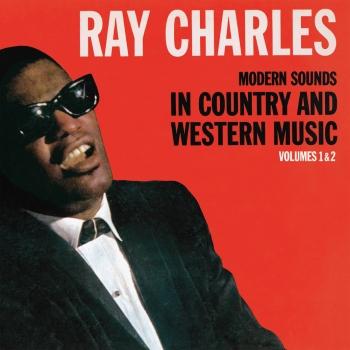
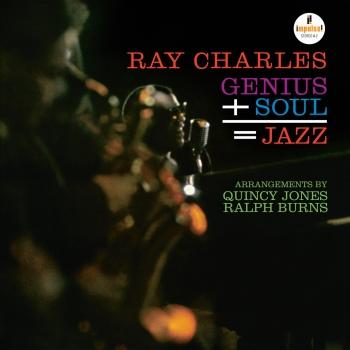
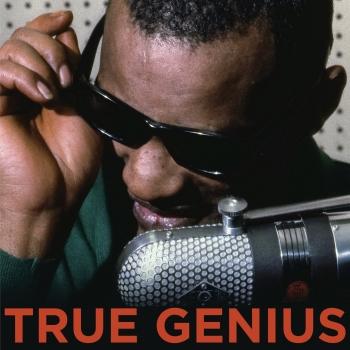
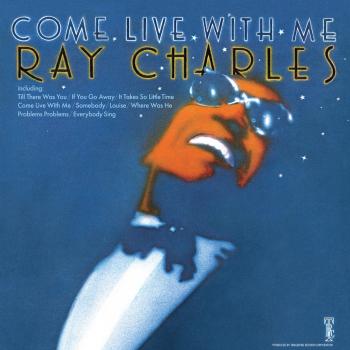
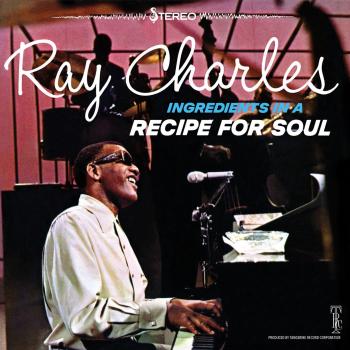
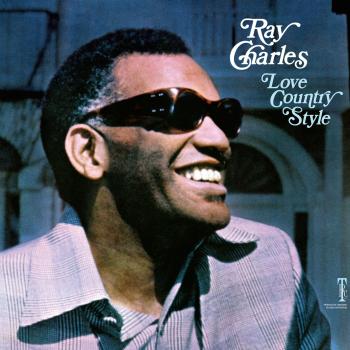
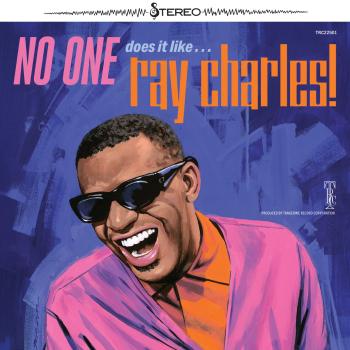


Ray Charles
The name Ray Charles is on a Star on Hollywood Boulevard’s Walk of Fame. The name Ray Charles designates a superstar worldwide. His bronze bust is enshrined in the Playboy Jazz Hall of Fame. There is the bronze medallion that was cast and presented to him by the French Republic on behalf of the French people. In just about every Hall of Fame that has anything to do with music, be it Rhythm & Blues, Jazz, Rock & Roll, Gospel or Country & Western, Ray’s name is very prominently displayed. There are many awards given to him in the foregoing categories as proof.
Probably the strongest element in Ray Charles’ life, and the most concentrated driving force, was music. Ray often said, “I was born with music inside me. That’s the only explanation I know.”
Ray Charles was not born blind. In fact, it took almost seven years for him to lose his sight in its entirety, which means he had seven years to see the joy and sadness of this big wonderful world – a world he would never see again. As a seven year old child, in searching for light, he stared at the sun continuously, thereby eliminating all chances of the modern-day miracle, cornea transplants – a surgery unheard of in 1937.
Perhaps the reason that Ray Charles made music his mistress and fell madly in love with the lady is that music was a natural to him. Ray sat at a piano and the music began; he opened his mouth and the lyrics began. He was in absolute control.
But the rest of his life was not quite so simple. Ray was born at the very beginning of the Great Depression – a depression that affected every civilized country in the world. Ray was born in 1930 in Albany, Georgia, the same year that another Georgia native by the name of Hoagy Carmichael, was already making his mark on the world. In 1930, the year of Ray’s birth, Hoagy recorded a song that became an all-time classic and remains so to this day; a song titled “Stardust.” It’s ironic that these two Georgia natives would someday cross paths again, as they did 30 years later when Ray Charles was asked by the State of Georgia to perform, in the Georgia Legislative Chambers, the song they had selected as their state song. That song was Ray’s version of “Georgia,” written by Hoagy Carmichael. Hoagy, who unfortunately was too ill to attend the event, was listening via telephone/satellite tie-up.
Ray’s mother and father, Aretha and Bailey, were “no-nonsense” parents. Even after Ray lost his sight, his mother continued to give him chores at home, in the rural area in which they lived, such as chopping wood for the wood burning stove in the kitchen in order for them to prepare their meals. Chores such as this often brought complaints from the neighbors, which were met with stern words from Mrs. Robinson. She told them her son was blind, not stupid, and he must continue to learn to do things, not only for himself, but for others as well. Unfortunately, Ray lost the guidance of his mother and the counseling of his father at a very young age. At 15 years old, Ray Charles was an orphan, but he still managed to make his way in this world under very trying conditions; living in the South and being of African-American heritage, plus being blind and an orphan.
Ray refused to roll over and play dead. Instead he continued his education in St. Augustine, at Florida’s State School for the Deaf and Blind. A few years later, Ray decided to move. His choice was Seattle, Washington. It was in Seattle that Ray recorded his first record. It was also in Seattle that the seed was planted for a lifelong friendship with Quincy Jones. More information please visit the Ray Charles homepage.
This album contains no booklet.