




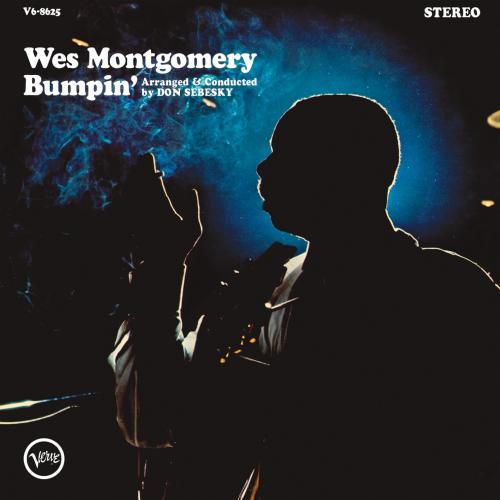
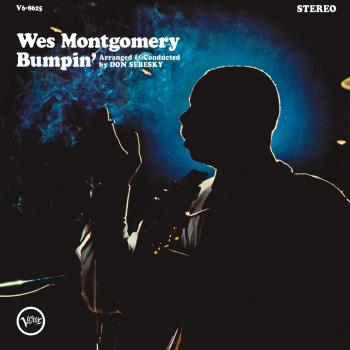
Bumpin’ (2025 Remaster) Wes Montgomery
Album Info
Album Veröffentlichung:
2026
HRA-Veröffentlichung:
30.01.2026
Das Album enthält Albumcover
Entschuldigen Sie bitte!
Sehr geehrter HIGHRESAUDIO Besucher,
leider kann das Album zurzeit aufgrund von Länder- und Lizenzbeschränkungen nicht gekauft werden oder uns liegt der offizielle Veröffentlichungstermin für Ihr Land noch nicht vor. Wir aktualisieren unsere Veröffentlichungstermine ein- bis zweimal die Woche. Bitte schauen Sie ab und zu mal wieder rein.
Wir empfehlen Ihnen das Album auf Ihre Merkliste zu setzen.
Wir bedanken uns für Ihr Verständnis und Ihre Geduld.
Ihr, HIGHRESAUDIO
- 1 Bumpin' 06:50
- 2 Tear It Down 03:13
- 3 A Quiet Thing 03:27
- 4 Con Alma 03:25
- 5 The Shadow Of Your Smile 02:17
- 6 Mi Cosa 03:15
- 7 Here's That Rainy Day 04:52
- 8 Musty 04:12
Info zu Bumpin’ (2025 Remaster)
Bumpin’ was a career milestone for Montgomery: his first album to reach the Billboard charts, as well as the first to be nominated for Grammys. At the 8th Annual Grammys in 1966, Bumpin’ had Montgomery in the running for Best Original Jazz Composition and Best Instrumental Jazz Performance – Large Group or Soloist with Large Group.
Backed by Roger Kellaway on piano, Bob Cranshaw on bass, and Grady Tate on drums, plus an orchestra arranged and conducted by Don Sebesky, the guitarist shows off his delicate virtuosity throughout the album. The material ranges from smoky Latin jazz to freewheeling bop to swooning balladry, with compositions from talents like Dizzy Gillespie, Johnny Mandel, John Francis Burke, and Montgomery himself.
Born in Indianapolis, Montgomery began teaching himself guitar at age 19, inspired by the music of Charlie Christian. He developed a unique style of jazz guitar that became wildly influential, making masterful use of octaves and thumb picking. Even guitarists beyond the jazz world, such as Jimi Hendrix, incorporated elements of Montgomery’s playing into their own.
In 2023, Jazz Guitar Today called him “the overall greatest jazz guitarist that ever lived,” while All Music Guide praises him as “the most influential jazz guitarist of the 1960s, who expanded the resources of the guitar in each of its main areas: chordal, melodic, and rhythmic.” Before his death at age 45 from a heart attack, he found extensive career success, including Grammy wins and chart-topping albums.
Verve’s Acoustic Sounds Series features transfers from analog tapes and remastered 180-gram vinyl in deluxe gatefold packaging. This year, the series has included titles from Ella Fitzgerald, Billie Holiday, the John Coltrane Quartet, Roland Kirk, Buddy Guy, Sonny Rollins, Diana Krall, Peggy Lee, Stan Getz, John Lee Hooker, and more.
"Taking the listener on a smoother, rather than bumpier, ride down the moonlight highway of jazz is Wes Montgomery, a chief architect of the world's guitar virtuoso scene. Not only is his brilliant command of the six-string present here, so is the vivid color tones of notes and blue notes played between. Backed up by a hauntingly beautiful and mesmerizing orchestra conducted and arranged by Don Sebesky, the music almost lifts the listener off his feet into a dreamy, water-like landscape. The atmosphere is serene and enchanting, such as a romantic evening for two under starlight, and certainly a romantic eve merits the accompaniment of this record. The sounds are soft, smooth, and silky, and Montgomery addresses full leadership of his graceful melodic style, fronting close to 20 members of a orchestra perhaps best described resonant and sweeping. So too are the sweeping note flows of Montgomery's guitar, and his surprising fluidness towards the art of comping, a necessary trait of the jazz guitar virtuoso. Even the unforgettable Jim Hall can be tickled and intrigued through a listen of these influential records, as for all amateur and professional guitar musicians. "A Quiet Thing" is perhaps the most somber, peaceful, and smooth piece on the record, demonstrating Montgomery's love of quiet, and how much the idea of not playing at all brings music to the listeners. The charming sounds of orchestral violas, violins, cellos, and harp are sent ablaze to create a pleasant atmosphere, either for a quick morning get up, get ready for work, or evening dining setting. "Here's That Rainy Day" is an up-tempo bossa nova tune that resonates with Montgomery's enticing chordal changes and blissful phrasing, not to mention the blend of harp and strings lays the groundwork for a perfect rainy day inside, with drops pattering at the windows and fires aglow. The recording engineer did a wonderful job with this album. The sound quality is clear and lush, and, overall, this collection of mid-'60s cool jazz is a delight to listen too, once and again." (Shawn M. Haney, AMG)
Wes Montgomery, guitar
Bob Cranshaw, bass
Grady Tate, drums
Harry Lookofsky, violin
David Schwartz, viola
Charles McCracken, cello
Margaret Ross, harp
Roger Kellaway, piano
Don Sebesky, arranger, conductor
Candido Camero, bongos, congas
Harold Coletta, viola
Arnold Eidus, violin
Lewis Eley, violin
Paul Gershman, violin
Louis Haber, violin
Julius Held, violin
Joseph Malignaggi, violin
Helcio Milito, drums
Gene Orloff, violin
George Ricci, violin, cello
Sol Shapiro, violin
Recorded March 16, May 18, 19 & 20, 1965 at Van Gelder Studio, Englewood Cliffs, New Jersey
Produced by Creed Taylor
Digitally remastered
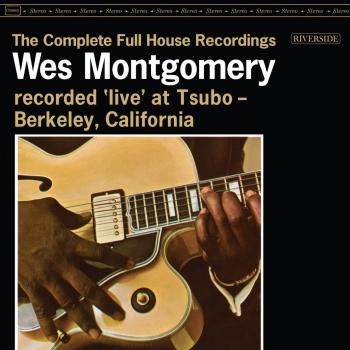

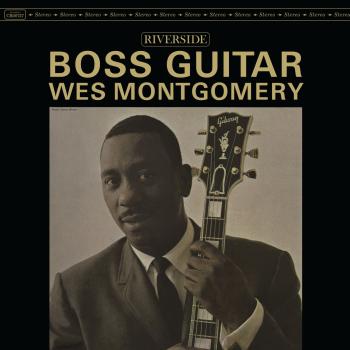
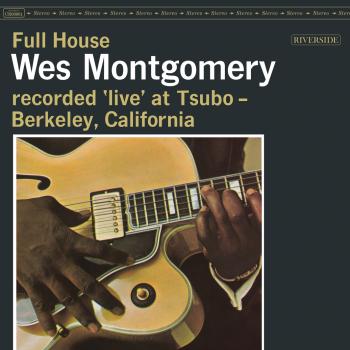
Wes Montgomery
wurde 1923 in Indianapolis, Indiana, geboren. Sein älterer Bruder Monk Montgomery schenkte ihm eine viersaitige Gitarre, die ihm seine ersten Berührungspunkte mit dem Gitarrenspiel bescherte. Später zog er nach Akron, Ohio, um dort die High School zu besuchen. Mitte der 1940er-Jahre begann er seine musikalische Karriere als Mitglied der Band von Lionel Hampton. Während dieser Zeit flog er regelmäßig zurück nach Indianapolis, um bei seiner Familie zu sein. Nebenbei arbeitete er tagsüber als Schweißer und spielte abends Konzerte. Schließlich unterschrieb Wes Montgomery einen Vertrag bei Riverside Records, wo er einige seiner wichtigsten Aufnahmen einspielte. Sein Gitarrenstil war einer der einzigartigsten seiner Zeit. Er zupfte die Saiten mit dem Daumen, was seinem Ton eine warme, gedämpfte Qualität verlieh, und nutzte Oktaven häufig, um eine tiefe Atmosphäre zu erzeugen. Zu den namhaften Musikern, mit denen Wes zusammenarbeitete, gehören: Wynton Kelly, Paul Chambers, Jimmy Cobb, Johnny Griffin, Tommy Flanagan, Percy Heath, Eddie Higgins und Charles Mingus.
Dieses Album enthält kein Booklet