


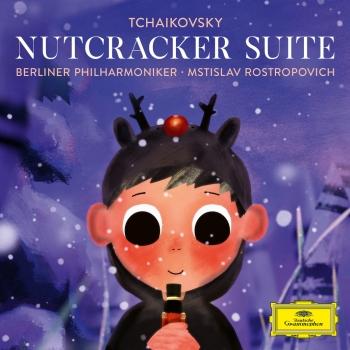
Tchaikovsky: The Nutcracker (Remastered 2026) Berliner Philharmoniker & Mstislav Rostropovich
Album Info
Album Veröffentlichung:
2026
HRA-Veröffentlichung:
09.10.2026
Label: Deutsche Grammophon (DG)
Genre: Classical
Subgenre: Orchestral
Interpret: Berliner Philharmoniker & Mstislav Rostropovich
Komponist: Peter Ilyich Tchaikovsky (1840-1893)
Das Album enthält Albumcover
Entschuldigen Sie bitte!
Sehr geehrter HIGHRESAUDIO Besucher,
leider kann das Album zurzeit aufgrund von Länder- und Lizenzbeschränkungen nicht gekauft werden oder uns liegt der offizielle Veröffentlichungstermin für Ihr Land noch nicht vor. Wir aktualisieren unsere Veröffentlichungstermine ein- bis zweimal die Woche. Bitte schauen Sie ab und zu mal wieder rein.
Wir empfehlen Ihnen das Album auf Ihre Merkliste zu setzen.
Wir bedanken uns für Ihr Verständnis und Ihre Geduld.
Ihr, HIGHRESAUDIO
- Pyotr Ilyich Tchaikovsky (1840 - 1893): The Nutcracker Suite, Op. 71a:
- 1 Tchaikovsky: The Nutcracker Suite, Op. 71a: I. Miniature Overture (Remastered 2026) 03:00
- 2 Tchaikovsky: The Nutcracker Suite, Op. 71a: IIa. March (Remastered 2026) 02:22
- 3 Tchaikovsky: The Nutcracker Suite, Op. 71a: IIb. Dance of the Sugar-Plum Fairy (Remastered 2026) 02:03
- 4 Tchaikovsky: The Nutcracker Suite, Op. 71a: IIc. Russian Dance (Trepak) (Remastered 2026) 01:05
- 5 Tchaikovsky: The Nutcracker Suite, Op. 71a: IId. Arabian Dance (Coffee) (Remastered 2026) 03:41
- 6 Tchaikovsky: The Nutcracker Suite, Op. 71a: IIe. Chinese Dance (Tea) (Remastered 2026) 01:10
- 7 Tchaikovsky: The Nutcracker Suite, Op. 71a: IIf. Dance of the Reed-Pipes (Remastered 2026) 02:28
- 8 Tchaikovsky: The Nutcracker Suite, Op. 71a: III. Waltz Of The Flowers (Remastered 2026) 06:45
Info zu Tchaikovsky: The Nutcracker (Remastered 2026)
Auf diesem Album präsentieren wir eine gefeierte, neu remasterte Aufnahme aus dem Jahr 1978 mit Mstislaw Rostropowitsch und den Berliner Philharmonikern, die Tschaikowskis vollständige Nussknacker-Suite interpretieren.
Mit leuchtenden Orchesterfarben und mitreißender theatralischer Energie fängt diese zeitlose Interpretation den Zauber von Tschaikowskis Musik auf besonders lebendige Weise ein. Das in den Emil Berliner Studios remasterte Album erscheint in klanglich überarbeiteter Form und mit einer neuen festlichen Gestaltung und eröffnet damit eine frische Perspektive auf diese beliebte Weihnachtsaufnahme.
Was wäre Weihnachten ohne Tchaikovskys Nussknacker? Undenkbar! Am 6. Dezember, ist es exakt 134 Jahre her, seitdem das Nussknacker-Ballett im Mariinski-Theater in Sankt Petersburg zum ersten Mal aufgeführt wurde. Es war der 6. Dezember 1892 und seither ist Weihnachten nicht mehr dasselbe.
Berliner Philharmoniker
Mstislav Rostropovich, Dirigent
Digitally remastered

Mstislav Rostropovich
Both Mstislav Rostropovich’s parents were musicians: his mother was an accomplished pianist, and his father, a distinguished cellist, had studied with Casals. In 1931 his family moved to Moscow. Here his mother began to teach him the piano, and his father introduced him to the cello soon afterwards. He continued to study under his father’s tuition at the Central Music School in Moscow and then when he was sixteen went on to the Moscow Conservatory, where in addition to his cello and piano studies he began to conduct. His composition teachers at the conservatory included Prokofiev and Shostakovich, and Rostropovich became a life-long champion of both composers. In 1945 he shot to prominence overnight as a cellist when he won the gold medal in the first-ever competition in the Soviet Union for young musicians. Thenceforth, despite his battles with the Communist authorities, he became one of the central figures of Soviet musical life, inspiring audiences, cellists and composers alike.
In 1950 Rostropovich won the Prague International Cellists’ Competition and in 1956 made a highly successful début at Carnegie Hall in New York City. He was appointed a teacher in 1953 at the Moscow Conservatory, becoming a professor there in 1956 and at the Leningrad Conservatory in 1961. After marrying the soprano Galina Vishnevskaya in 1955 Rostropovich often appeared accompanying her at the piano; and in 1961, he began his career as a conductor. He was awarded the Lenin Prize in 1963 and the gold medal of the Royal Philharmonic Society of London in 1970, the year in which he gave the British première of Shostakovich’s Cello Concerto No. 1. He recorded nearly the entire cello literature during this time and inspired a vast quantity of new repertoire for the instrument through his personal contact with composers such as Benjamin Britten, who wrote his Cello Symphony, Sonata for Cello and Piano and three Suites for Solo Cello especially for Rostropovich. Other composers who have written for Rostropovich include Prokofiev, Shostakovich, Khachaturian, Boulez, Berio, Messiaen, Schnittke, Bernstein, Dutilleux and Lutosławski.
Despite high-level recognition of his extraordinary abilities within the Soviet Union, Rostropovich came into conflict with the state authorities in 1969 when he allowed the dissident writer Alexander Solzhenitsyn to live in his dacha outside Moscow. This situation was further exacerbated in 1970 when Rostropovich wrote an open letter to the Soviet president Leonid Brezhnev protesting against Soviet restrictions on cultural freedom. As a result concerts and foreign tours by Rostropovich and Vishnevskaya were cancelled and they were both subject to a Soviet media black-out. Recording projects ceased and published recordings by both artists vanished from the Soviet and export catalogues. In 1974 they were finally granted exit visas, effectively allowing them to go into exile: their departure from the Soviet Union sparked international controversy and attention. Four years later they were stripped of their Soviet citizenship, a decree which held until 1990. Rostropovich immediately launched a new career in the West as a conductor, appearing with the London Philharmonic and Symphony Orchestras, the Berlin Philharmonic Orchestra and the Boston Symphony Orchestra. He was appointed chief conductor of the National Symphony Orchestra, Washington, in 1977, serving in this position until 1996. Following an emotional return to Russia in 1990 with this orchestra, he flew to Moscow without a visa during the attempted coup of August 1991, threw himself into the heart of the political situation and was subsequently hailed as a national hero, being awarded the State Prize of Russia. He and his wife worked tirelessly on behalf of human rights and humanitarian aid: the Vishnevskaya-Rostropovich Foundation has donated large sums of money to support children’s hospitals in Russia.
Rostropovich was as individual a conductor as he was a cellist: his recorded interpretations have a freedom and intensity which are both highly personal. His opera recordings are fine examples of his art, as is his complete cycle of the Tchaikovsky symphonies with the London Philharmonic Orchestra. For Teldec he recorded the complete symphonies of Shostakovich, whom he knew intimately and of whom he may be considered to have been an especially significant interpreter.
Dieses Album enthält kein Booklet