






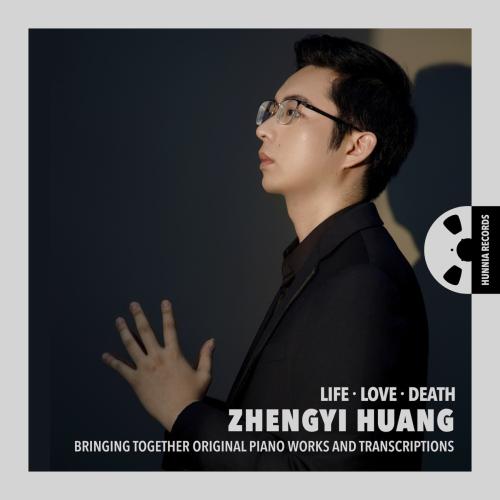
Life, Love, Death Zhengyi Huang
Album Info
Album Veröffentlichung:
2026
HRA-Veröffentlichung:
24.04.2026
Label: Hunnia Records
Genre: Classical
Subgenre: Instrumental
Interpret: Zhengyi Huang
Komponist: Igor Stravinsky (1882-1971), Franz Liszt (1811-1886), Fritz Kreisler (1875-1962), Johannes Brahms (1833-1897), Robert Schumann (1840-1856)
Das Album enthält Albumcover Booklet (PDF)
- Igor Stravinsky (1882 - 1971): Three Movements from Petrushka:
- 1 Stravinsky: Three Movements from Petrushka: I. Russian Dance 02:47
- 2 Stravinsky: Three Movements from Petrushka: II. In Petrushka's Room 04:38
- 3 Stravinsky: Three Movements from Petrushka: III. The Shrovetide Fair 08:44
- Franz Liszt (1811 - 1886): Liebestraum No. 3:
- 4 Liszt: Liebestraum No. 3 04:54
- Richard Wagner (1813 - 1883): Isolde’s Liebestod (Arr. Liszt):
- 5 Wagner: Isolde’s Liebestod (Arr. Liszt) 07:20
- Fritz Kreisler (1875 - 1962): Liebesleid (Arr. Rachmaninoff):
- 6 Kreisler: Liebesleid (Arr. Rachmaninoff) 04:57
- :Liebesfreud (Arr. Rachmaninoff):
- 7 Kreisler :Liebesfreud (Arr. Rachmaninoff) 06:55
- Johannes Brahms (1833 - 1897): Intermezzo in A major, Op. 118 No. 2:
- 8 Brahms: Intermezzo in A major, Op. 118 No. 2 05:55
- Robert Schumann (1810 - 1856): Widmung, Op. 25 No. 1 (Arr. Liszt, S. 566a):
- 9 Schumann: Widmung, Op. 25 No. 1 (Arr. Liszt, S. 566a) 03:51
- Franz Liszt: Totentanz, S.525:
- 10 Liszt: Totentanz, S.525 15:24
Info zu Life, Love, Death
„Metamorphosis“ ist als eine Reise der Verwandlung durch Leben, Liebe und Tod konzipiert. Anstatt zusammenhangslose Werke zusammenzustellen, wollte ich dieses Album als eine einzige innere Erzählung gestalten. Das Programm beginnt mit Strawinskys „Drei Sätzen aus Petruschka“, in denen einer Marionette plötzlich eine menschliche Seele verliehen wird. Für mich ist dies die erste Metamorphose: der Übergang von der Leblosigkeit hin zu Bewusstsein, Sehnsucht und Verletzlichkeit. In „Petruschkas Zimmer“ leidet er unter Isolation, Verwirrung und unerwiderter Liebe, während draußen auf dem Faschingsmarkt Tanz, Spektakel und kollektive Energie brodeln. Dieser Kontrast ist wesentlich, denn das Leben beinhaltet sowohl inneren Schmerz als auch äußeres Feiern.
Im Zentrum des Albums steht ein Liebeszyklus aus sechs Werken, den ich als das emotionale Herz der menschlichen Existenz verstehe.
Schließlich schließt das Album mit Liszts „Totentanz“, in dem der Tod nicht einfach als Ende erscheint, sondern als letzte Abrechnung, aus der Transzendenz und Erneuerung hervorgehen.
Zhengyi Huang, Steinway Modell D Konzertflügel

Zhengyi Huang
Chinese pianist Zhengyi Huang has built an international profile through competition successes, concerto appearances, solo recitals, and recording projects. In recent years, he has won seven consecutive first prizes in international piano competitions and has received more than thirty first prizes within the past 5 years. Among his recent awards are the Rubato International Competition, the William Byrd International Competition, and the Young Texas Artists Piano Competition. Huang studied at Rice University with Jon Kimura Parker, where he earned the Artist Diploma, and later at the University of Michigan with Logan Skelton, where he completed dual master’s degrees in Piano Performance and Chamber Music before continuing toward the Doctor of Musical Arts degree.
He has appeared as soloist with the Grand Junction Symphony Orchestra, the Richardson Symphony Orchestra, and the Flint Symphony Orchestra, and his recent recital activity has taken him to Japan, China, Barcelona, Paris, Vienna, Milan, and Turkey, as well as to venues across the United States.
In 2025, he was featured in a live broadcast on Seattle’s Classical KING-FM, reaching an audience of over 100,000 listeners.
Huang is currently engaged in recording projects with PARMA Recordings, Hunnia Records, and TvClassique Paris, and will embark on a nine-city China concert tour in the summer of 2026, including major cities such as Shenzhen, Suzhou, and Chengdu.
Booklet für Life, Love, Death