


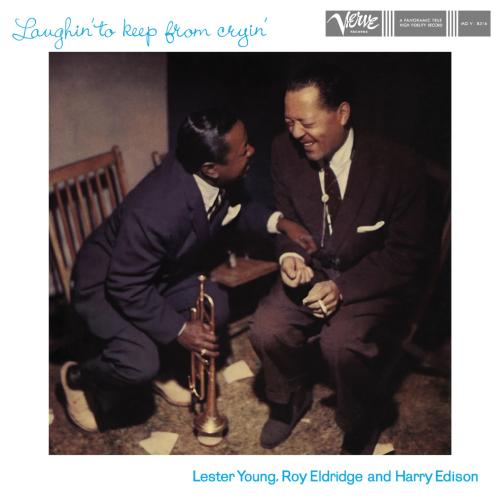
Laughin' To Keep From Cryin' (Remastered) Lester Young, Roy Eldridge, Harry Edison
Album Info
Album Veröffentlichung:
1958
HRA-Veröffentlichung:
31.07.2026
Label: Verve Reissues
Genre: Jazz
Subgenre: Cool
Interpret: Lester Young, Roy Eldridge, Harry Edison
Das Album enthält Albumcover
Entschuldigen Sie bitte!
Sehr geehrter HIGHRESAUDIO Besucher,
leider kann das Album zurzeit aufgrund von Länder- und Lizenzbeschränkungen nicht gekauft werden oder uns liegt der offizielle Veröffentlichungstermin für Ihr Land noch nicht vor. Wir aktualisieren unsere Veröffentlichungstermine ein- bis zweimal die Woche. Bitte schauen Sie ab und zu mal wieder rein.
Wir empfehlen Ihnen das Album auf Ihre Merkliste zu setzen.
Wir bedanken uns für Ihr Verständnis und Ihre Geduld.
Ihr, HIGHRESAUDIO
- 1 Salute To Benny (Remastered) 08:28
- 2 They Can't Take That Away From Me (Remastered) 05:57
- 3 Romping (Remastered) 11:39
- 4 Gypsy In My Soul (Remastered) 04:11
- 5 Please Don't Talk About Me When I'm Gone (Remastered) 05:58
Info zu Laughin' To Keep From Cryin' (Remastered)
Laughin' to Keep from Cryin' is a 1958 studio album by Lester Young featuring the trumpeters Harry "Sweets" Edison and Roy Eldridge.
Recorded and released in 1958, just over a year before his death, "Laughin' to Keep from Cryin'" captures saxophonist Lester Young in one of his final studio sessions. Though his tone had softened, Young's phrasing remains fluid and expressive, favoring subtlety over force. Produced by Norman Granz, the date brings together Roy Eldridge and Harry "Sweets" Edison on trumpet, whose contrasting styles—fiery drive and relaxed, bluesy restraint—create a compelling musical contrast. Backed by Hank Jones (piano), Herb Ellis (guitar), George Duvivier (bass), and Mickey Sheen (drums), the session blends small-group swing with a polished studio feel. Highlights include "They Can’t Take That Away from Me" and "Salute to Benny"—a tribute to Benny Goodman, who gave Young his first clarinet—with both tracks featuring rare late-career clarinet solos by Young. The album documents one of Young's final studio sessions, a closing chapter for "The Pres."
"One of tenor-saxophonist Lester Young's final studio sessions (he died a year later), this date apparently had a lot of difficulties but the recorded results are excellent. Prez was joined by two great swing trumpeters (Roy Eldridge and Harry "Sweets" Edison) and a fine rhythm section for two standards, two originals and the ballad "Gypsy in My Soul." Young takes rare clarinet solos on two of the selections with his emotional statement on "They Can't Take That Away from Me" being one of the highpoints of his career." (Scott Yanow, AMG)
Lester Young, clarinet, tenor saxophone
Harry "Sweets" Edison, trumpet
Roy Eldridge, trumpet
Herb Ellis, guitar
Hank Jones, piano
George Duvivier, double bass
Mickey Sheen, drums
Digitally remastered
Lester Young
also nicknamed ‘Pres’, was born in Woodville, Mississippi in 1909. He would gain early experience in music through his family, who had a travelling family band. The band would primarily tour around the Jim Crow south, which would turn into a point of contention with Lester Young’s father, ultimately resulting in his departure from the family band. In 1933 Lester Young came to Kansas City, and began his first stint as first tenor in the Count Basie Band. This would be a relatively short period, as he would move to New York soon after to replace Coleman Hawkins in Fletcher Henderson’s orchestra. Lester Young’s style varied greatly from Coleman Hawkins who was thought of as the top tenor player of the day. Young’s style was much more relaxed, sparse, light and airy. He was an extremely lyrical and melodic player, whose style would go on to inspire everyone from Stan Getz to Charlie Parker. Lester Young played with a countless number of incredible musicians, but a few of whom are Joe Jones, Count Basie, Walter Page, Buck Clayton, Billie Holiday, Teddy Wilson, and Nat King Cole.
Harry "Sweets" Edison
Known in the jazz world as "Sweets," for both his disposition and his playing ability, Harry Edison was a consummate big band section trumpeter and skilled soloist whose ability to enhance a piece without overpowering it was renowned.
A self-taught musician, his earliest gig came in high school with the Earl Hood band. From 1933-1935, he played in the Jeter-Pillars Orchestra, a prominent territory band of the time. He moved to New York in 1937, spending six months with Lucky Millinder's band before joining Count Basie. It was with Basie that he truly began to distinguish himself, not only as a strong member of the trumpet section, but also as a distinctive soloist. His warm sound, using repeated notes that he would bend and ripple, was a welcome contrast to the usual high-note, piercing solos of most trumpet players. Edison stayed with the Basie band until it disbanded in 1950.
Rarely a bandleader under his own name, he spent the bulk of his career working with singers and with big bands on the road and in the recording studio. Edison's work with Billie Holiday and the Nelson Riddle Orchestra backing Frank Sinatra during the 1950s -- accenting the vocals and setting up the mood of the songs -- is some of his finest. His echoing trumpet on Sinatra's Songs for Swingin' Lovers, for example, helped set the pace of the songs, playing off Sinatra's phrasing of the lyrics. Edison provided some of the bright moments in Holiday's output in the 1950s on albums such as Songs for Distingué Lovers. His tasteful playing created a great demand from singers for his services, and besides Sinatra and Holiday, Edison played behind Ella Fitzgerald, Josephine Baker, Sarah Vaughan, and Nat "King" Cole. Edison was also a welcome addition to the big bands he worked with, including Buddy Rich, Louie Bellson, and Quincy Jones.
Although he left the Basie band as a full-time member in 1950, he rejoined the band on many subsequent occasions for the rest of his career. He worked as musical director for such artists as Redd Foxx and Joe Williams, and collaborated with other soloists, such as Eddie "Lockjaw" Davis and Oscar Peterson. Valued for his superb sense of dynamics, he carved out a beautiful trumpet style noted for its simplicity and good taste. He also found a home in film and television soundtrack work. (Source: www.arts.gov)
Roy Eldridge
Also known as "Little Jazz," Roy Eldridge was a fiery, energetic trumpeter, the bridge between the towering trumpet stylists Louis Armstrong and Dizzy Gillespie. Some of the great rhythmic drive of Eldridge's later trumpet exploits could be traced to his beginnings on the drums, which he began playing at age six. Eldridge's older brother Joe, who played alto saxophone, was his first teacher.
In 1930, Eldridge moved to New York, heading straight to Harlem where he gained work with a number of dance bands before joining the Teddy Hill band. By 1935, Eldridge and saxophonist Chu Berry (who would later join the Count Basie Orchestra) were Hill's principal soloists, and after gigs they would go around town on cutting contests, challenging musicians to see who could play the best; with his lightning speed and awesome range, Eldridge rarely lost. After Hill's band, Eldridge became the lead trumpeter in the Fletcher Henderson Orchestra, where his upper register abilities were highlighted. It didn't take long for Eldridge to exert himself as a bandleader, forming his own octet in 1936 in Chicago, a band that included his brother Joe.
By the end of the 1930s, after freelancing with a wide array of bands, Eldridge gained notice as one of the swing bands' most potent soloists. In 1941, he joined drummer Gene Krupa's band. Not only did he provide trumpet fireworks for Krupa's outfit, he also sang, recording a memorable duet with the band's female singer, Anita O'Day, on the tune "Let Me Off Uptown" in 1941. Later, after Krupa's band disbanded in 1943 and a period of freelancing, he toured with the Artie Shaw band in 1944. Then Eldridge led his own bands, usually small swing groups.
In 1948, Norman Granz recruited Eldridge for his Jazz at the Philharmonic, an ideal situation since Eldridge was one of the ultimate jam session trumpeters. He toured briefly with Benny Goodman and took up residence in Paris in 1950, where he made some of his most successful recordings. He returned to New York in 1951 and continued freelancing with small bands, including work with Coleman Hawkins, Benny Carter, Ella Fitzgerald, and Johnny Hodges. He made notable albums for Verve Records alongside Hawkins and continued freelancing and leading a house band at Jimmy Ryan's club in New York. In 1971, he was inducted into the DownBeat Jazz Hall of Fame. A stroke in 1980 stopped him from playing the trumpet, but Eldridge continued to make music as a singer and pianist until his death in 1989. (Source: www.arts.gov)
Dieses Album enthält kein Booklet